Kitaw Tegene Atamenta, Haile Ribka Nigatu
School of Nursing, College of Health Science, Woldia University, Woldia, Ethiopia.
Front Reprod Health. 2023 Jul 14;5:1165204. doi: 10.3389/frph.2023.1165204. eCollection 2023.
Being a mother for the first time is the most significant event in a woman's life. "Age at first birth" refers to a mother's age in years when she gives birth to her first child. The age of first childbirth has physical, economic, and social implications. However, little is known about this issue in Ethiopia. Thus, this study sought to determine the time to first childbirth and its predictors at a national level.
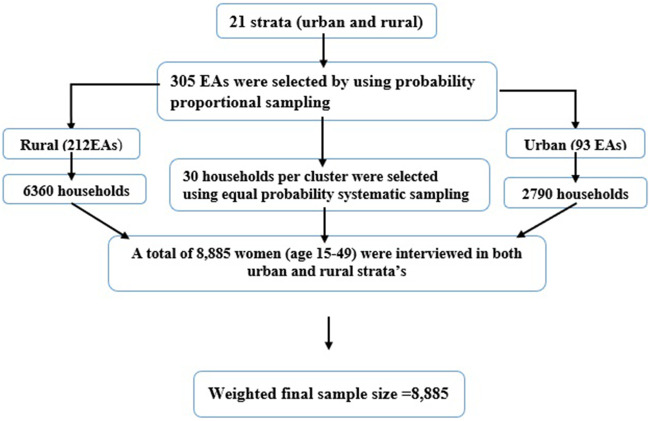
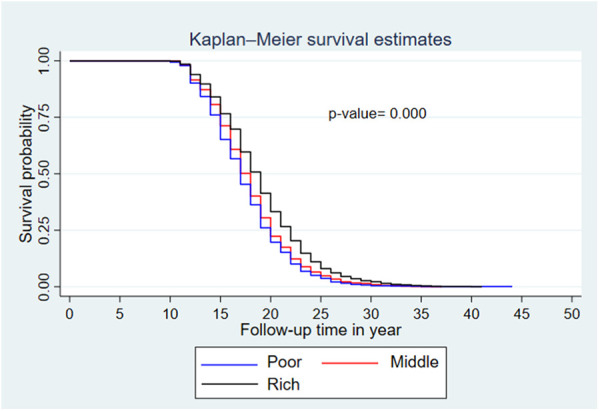
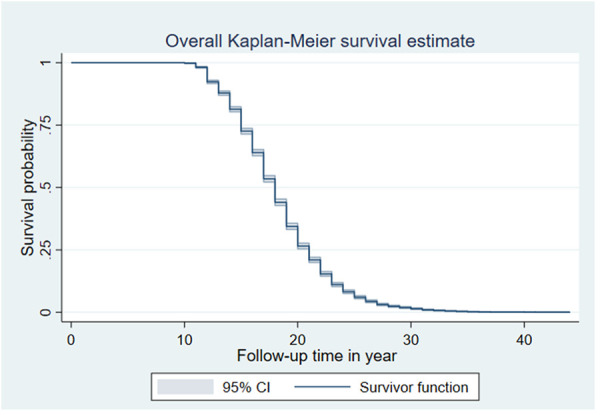
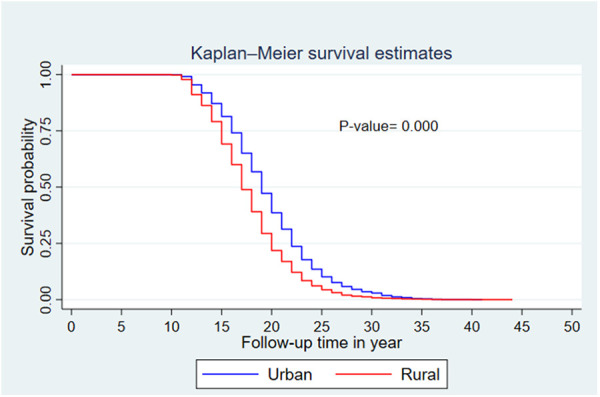
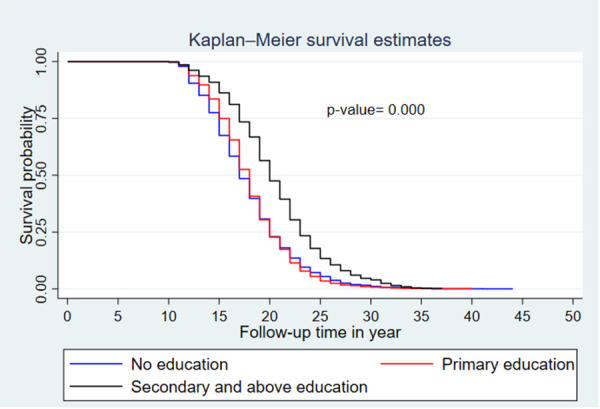
Data were extracted from the 2019 Ethiopia Demographic and Health Survey using STATA version 17 software. A total of 8,885 weighted reproductive-age women (15-49 years) were included in this study. A Kaplan-Meier survivor curve was generated to estimate the time of first childbirth. A log-rank test was used to compare the difference in survival curves. Akaike information criteria and Bayesian information criteria were calculated to select the appropriate survival model for the data. The Weibull accelerated failure time model with no frailty distribution was used to identify significant predictors.
The overall median survival time to first childbirth was 18 years. The significant predictors of time to first childbirth were the educational level of the mother [primary education (ϕ = 1.036, 95% CI: 1.011, 1.063), secondary and above education (ϕ = 1.154, 95% CI: 1.118, 1.191)], knowledge of any contraceptive method [know at least one (ϕ = 1.051, 95% CI: 1.006, 1.101)], and media exposure (ϕ = 1.048, 95% CI: 1.011, 1.086).
The median survival time to first childbirth was 18 years, which is lower than the optimal age for first childbirth (late 20 s and early 30 s). The timing of first childbirth in Ethiopia is mainly influenced by the educational level of women, knowledge of contraceptive methods, and exposure to media. Thus, exposing women to educational materials and other awareness-creation campaigns regarding the consequences of early first childbirth and strategies to improve women's knowledge of contraceptive methods is highly recommended.
初为人母是女性一生中最重要的事件。“首次生育年龄”指母亲生育第一个孩子时的年龄(以岁为单位)。首次生育年龄具有生理、经济和社会影响。然而,在埃塞俄比亚,人们对这个问题知之甚少。因此,本研究旨在在国家层面确定首次生育时间及其预测因素。
使用STATA 17软件从2019年埃塞俄比亚人口与健康调查中提取数据。本研究共纳入8885名加权的育龄妇女(15 - 49岁)。生成Kaplan-Meier生存曲线以估计首次生育时间。使用对数秩检验比较生存曲线的差异。计算赤池信息准则和贝叶斯信息准则以选择适合数据的生存模型。使用无脆弱性分布的威布尔加速失效时间模型来确定显著的预测因素。
首次生育的总体中位生存时间为18岁。首次生育时间的显著预测因素包括母亲的教育水平[小学教育(ϕ = 1.036,95%可信区间:1.011,1.063),中学及以上教育(ϕ = 1.154,95%可信区间:1.118,1.191)]、对任何避孕方法的了解[至少知道一种(ϕ = 1.051,95%可信区间:1.006,1.101)]以及媒体曝光(ϕ = 1.048,95%可信区间:1.011,1.086)。
首次生育的中位生存时间为18岁,低于首次生育的最佳年龄(20多岁末和30岁出头)。埃塞俄比亚首次生育的时间主要受女性教育水平、避孕方法知识和媒体曝光的影响。因此,强烈建议让女性接触有关早育后果的教育材料和其他提高认识的活动,以及提高女性避孕方法知识的策略。