Boerger Timothy F, Pahapill Peter, Butts Alissa M, Arocho-Quinones Elsa, Raghavan Manoj, Krucoff Max O
Department of Neurosurgery, Medical College of Wisconsin, Milwaukee, WI, United States.
Department of Neurology, Medical College of Wisconsin, Milwaukee, WI, United States.
Front Hum Neurosci. 2023 Jul 13;17:1170419. doi: 10.3389/fnhum.2023.1170419. eCollection 2023.
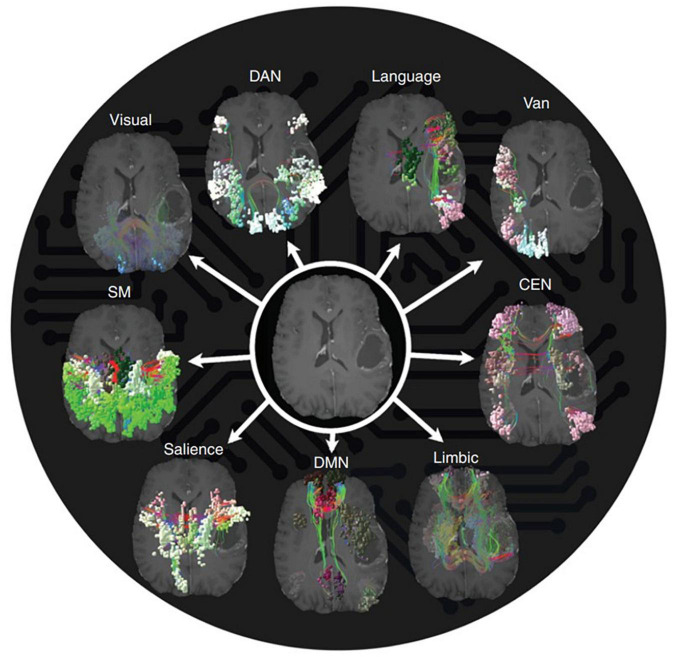
In recent years, a paradigm shift in neuroscience has been occurring from "localizationism," or the idea that the brain is organized into separately functioning modules, toward "connectomics," or the idea that interconnected nodes form networks as the underlying substrates of behavior and thought. Accordingly, our understanding of mechanisms of neurological function, dysfunction, and recovery has evolved to include connections, disconnections, and reconnections. Brain tumors provide a unique opportunity to probe large-scale neural networks with focal and sometimes reversible lesions, allowing neuroscientists the unique opportunity to directly test newly formed hypotheses about underlying brain structural-functional relationships and network properties. Moreover, if a more complete model of neurological dysfunction is to be defined as a "disconnectome," potential avenues for recovery might be mapped through a "reconnectome." Such insight may open the door to novel therapeutic approaches where previous attempts have failed. In this review, we briefly delve into the most clinically relevant neural networks and brain mapping techniques, and we examine how they are being applied to modern neurosurgical brain tumor practices. We then explore how brain tumors might teach us more about mechanisms of global brain dysfunction and recovery through pre- and postoperative longitudinal connectomic and behavioral analyses.
近年来,神经科学领域正发生着一种范式转变,从“定位主义”(即认为大脑由各自独立发挥功能的模块组成)转向“连接组学”(即认为相互连接的节点形成网络,作为行为和思维的潜在基础)。相应地,我们对神经功能、功能障碍及恢复机制的理解已发展到涵盖连接、断开连接和重新连接。脑肿瘤提供了一个独特的机会,可通过局灶性且有时可逆的损伤来探究大规模神经网络,使神经科学家有独特的机会直接检验关于潜在脑结构 - 功能关系和网络特性的新形成假说。此外,如果将更完整的神经功能障碍模型定义为“断连组”,那么恢复的潜在途径可能通过“重连组”来绘制。这种见解可能为以往尝试失败的新型治疗方法打开大门。在本综述中,我们简要探讨最具临床相关性的神经网络和脑图谱技术,并研究它们如何应用于现代神经外科脑肿瘤手术。然后,我们探讨脑肿瘤如何通过术前和术后的纵向连接组学及行为分析,让我们更多地了解全脑功能障碍和恢复的机制。