Public Health Dentistry, Manipal College of Dental Sciences, Mangalore, Manipal Academy of Higher Education (MAHE), Manipal, India.
F1000Res. 2023 Apr 13;12:390. doi: 10.12688/f1000research.132035.1. eCollection 2023.
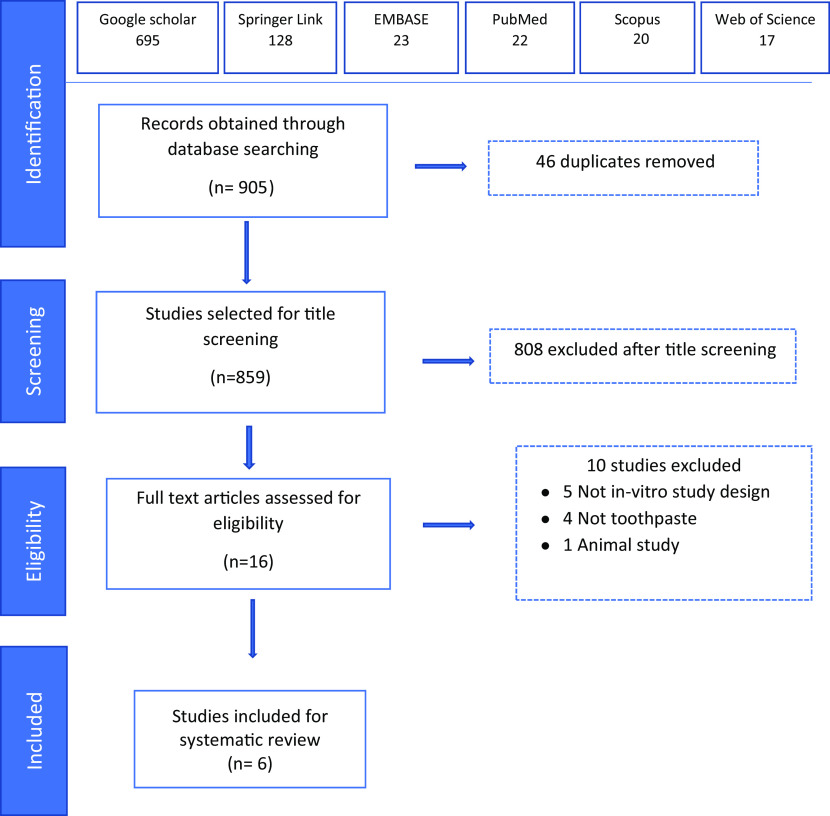
Microplastic particles are used as ingredients in personal care products such as face washes, shower gels and toothpastes and form one of the main sources of microplastic pollution, especially in the marine environment. In addition to being a potential pollutant to the environment, the transfer of microplastics to humans can become a severe threat to public health. This systematic review was conceptualized to identify evidence for the presence of and characteristics of microplastics in toothpaste formulations. The PICOS Criteria was used for including studies for the review. Electronic databases of Scopus, Embase, Springer Link, PubMed, Web of Science and Google Scholar were searched, as well as hand and reference searching of the articles was carried out. The articles were screened using the software application, Covidence® and data was extracted. This systematic review showed that toothpastes from China, Vietnam, Myanmar and the UAE, reported no evidence of microplastics and those from Malaysia, Turkey and India reported the presence of microplastics. The shape of the microplastics present in these toothpastes were found to be granular, irregular with opaque appearance and also in the form of fragments and fibers and the percentage weight in grams ranged from 0.2 to 7.24%. Malaysia releases 0.199 trillion microbeads annually from personal care products into the environment and toothpastes in Turkey release an average of 871 million grams of microplastics annually. Similarly, in India, it has been reported that 1.4 billion grams of microplastic particles are emitted annually from toothpaste. The findings of this systematic review provide evidence that toothpastes, at least in some parts of the world, do contain microplastics and that there is a great risk of increase in the addition of microplastics to the environment by the use of toothpaste.
微塑料颗粒被用作洗面奶、沐浴露和牙膏等个人护理产品的成分,是微塑料污染的主要来源之一,尤其是在海洋环境中。除了对环境构成潜在污染外,微塑料向人类的转移可能对公共健康构成严重威胁。本系统评价旨在确定牙膏配方中存在微塑料和微塑料特征的证据。本研究使用 PICOS 标准纳入研究。检索了 Scopus、Embase、Springer Link、PubMed、Web of Science 和 Google Scholar 等电子数据库,并对文章进行了手工和参考文献搜索。使用 Covidence®软件应用程序筛选文章,并提取数据。本系统评价表明,来自中国、越南、缅甸和阿联酋的牙膏没有微塑料的证据,而来自马来西亚、土耳其和印度的牙膏则报告了微塑料的存在。这些牙膏中存在的微塑料形状为颗粒状、不规则形状、不透明外观,也呈碎片和纤维状,重量百分比范围为 0.2 至 7.24%。马来西亚每年从个人护理产品向环境中释放 0.199 万亿颗微珠,土耳其的牙膏每年释放平均 8710 万克微塑料。同样,据报道,印度每年从牙膏中排放 14 亿克微塑料颗粒。本系统评价的结果提供了证据,表明牙膏至少在世界某些地区确实含有微塑料,而且由于使用牙膏,微塑料向环境中增加的风险很大。