Mahidol Oxford Tropical Medicine Research Unit, Faculty of Tropical Medicine, Mahidol University, Bangkok, Thailand.
Shoklo Malaria Research Unit, Faculty of Tropical Medicine, Mahidol University, Mae Sot, Tak, Thailand.
BMC Infect Dis. 2023 Jul 31;23(1):501. doi: 10.1186/s12879-023-08482-8.
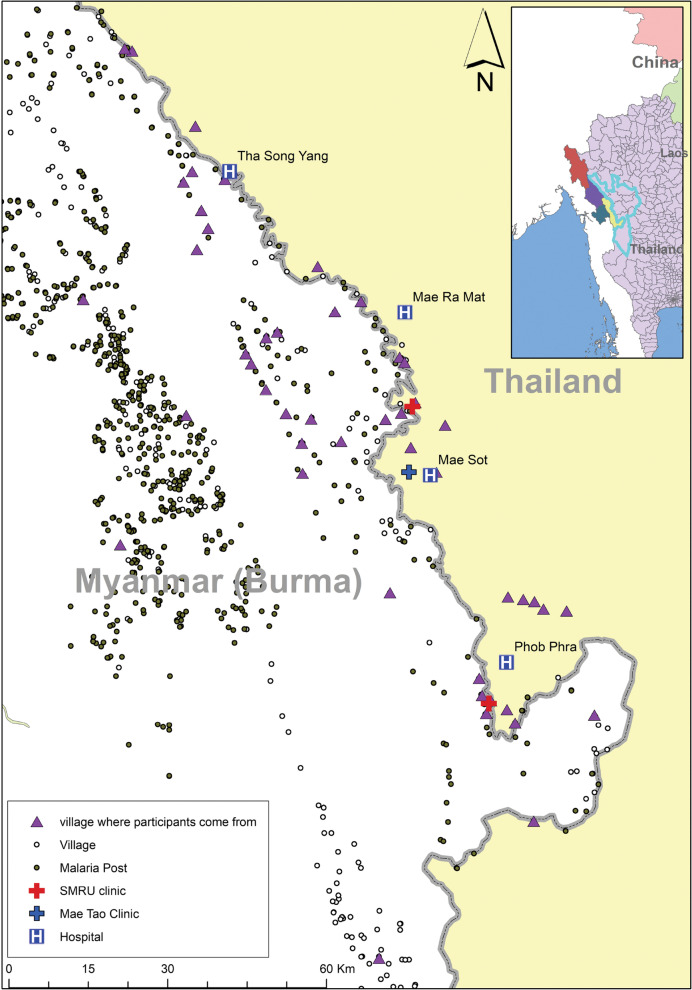
Fever is a common reason to seek healthcare in Southeast Asia, and the decline of malaria has complexified how is perceived, and what actions are taken towards it. We investigated the concept of fever and the determinants influencing health-seeking behaviours among migrants on the Thai-Myanmar border, where rapid economic development collides with precarious political and socio-economic conditions.
We implemented a mixed-methods study between August to December 2019. Phase I used a qualitative approach, with in-depth interviews and focus group discussions. Phase II used a quantitative approach with a close-ended questionnaire based on Phase I findings. A conditional inference tree (CIT) model first identified geographic and socio-demographic determinants, which were then tested using a logistic regression model.
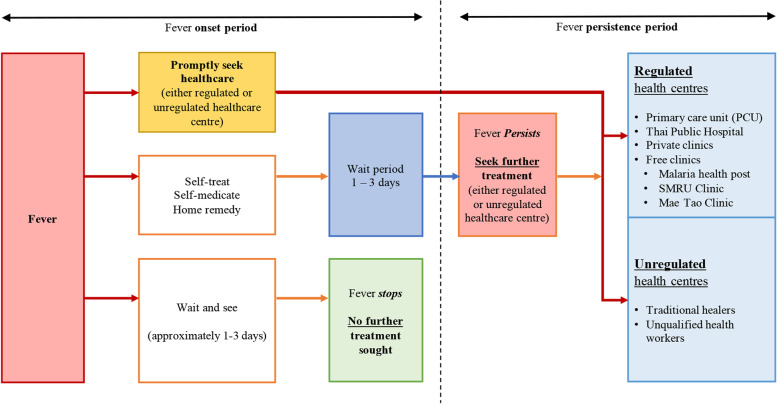
Fever corresponded to a high diversity of conceptions, symptoms and believed causes. Self-medication was the commonest behaviour at fever onset. If fever persisted, migrants primarily sought care in humanitarian cost-free clinics (45.5%, 92/202), followed by private clinics (43.1%, 87/202), health posts (36.1%, 73/202), public hospitals (33.7%, 68/202) and primary care units (30, 14.9%). The qualitative analysis identified distance and legal status as key barriers for accessing health care. The quantitative analysis further investigated determinants influencing health-seeking behaviour: living near a town where a cost-free clinic operated was inversely associated with seeking care at health posts (adjusted odds ratio [aOR], 0.40, 95% confidence interval [95% CI] [0.19-0.86]), and public hospital attendance (aOR 0.31, 95% CI [0.14-0.67]). Living further away from the nearest town was associated with health posts attendance (aOR 1.05, 95% CI [1.00-1.10] per 1 km). Having legal status was inversely associated with cost-free clinics attendance (aOR 0.27, 95% CI [0.10-0.71]), and positively associated with private clinic and public hospital attendance (aOR 2.56, 95% CI [1.00-6.54] and 5.15, 95% CI [1.80-14.71], respectively).
Fever conception and believed causes are context-specific and should be investigated prior to any intervention. Distance to care and legal status were key determinants influencing health-seeking behaviour. Current economic upheavals are accelerating the unregulated flow of undocumented migrants from Myanmar to Thailand, warranting further inclusiveness and investments in the public health system.
在东南亚,发烧是寻求医疗保健的常见原因,疟疾的减少使得人们对发烧的看法和采取的措施变得更加复杂。我们调查了泰国-缅甸边境移民对发烧的概念以及影响他们寻求医疗服务行为的决定因素,在那里,快速的经济发展与不稳定的政治和社会经济条件发生了冲突。
我们在 2019 年 8 月至 12 月期间实施了一项混合方法研究。第一阶段采用定性方法,进行深入访谈和焦点小组讨论。第二阶段采用定量方法,根据第一阶段的发现,采用封闭式问卷。条件推理树(CIT)模型首先确定了地理和社会人口学决定因素,然后使用逻辑回归模型对这些因素进行测试。
发烧对应的概念、症状和认为的原因多种多样。发烧初发时,自我药疗是最常见的行为。如果发烧持续,移民主要在人道主义免费诊所(45.5%,92/202)寻求医疗,其次是私人诊所(43.1%,87/202)、卫生所(36.1%,73/202)、公立医院(33.7%,68/202)和基层医疗单位(30%,14.9%)。定性分析确定距离和法律地位是获得医疗保健的关键障碍。定量分析进一步调查了影响卫生服务寻求行为的决定因素:居住在经营免费诊所的城镇附近与在卫生所寻求医疗服务呈负相关(调整后的优势比[OR],0.40,95%置信区间[95%CI] [0.19-0.86]),与公立医院就诊呈负相关(OR 0.31,95%CI [0.14-0.67])。离最近的城镇越远,与卫生所就诊呈正相关(每增加 1 公里,OR 1.05,95%CI [1.00-1.10])。合法身份与免费诊所就诊呈负相关(OR 0.27,95%CI [0.10-0.71]),与私人诊所和公立医院就诊呈正相关(OR 2.56,95%CI [1.00-6.54]和 5.15,95%CI [1.80-14.71])。
发烧的概念和认为的原因是具体的,在进行任何干预之前应该进行调查。距离和法律地位是影响卫生服务寻求行为的关键决定因素。当前的经济动荡加速了无证移民从缅甸向泰国的不受监管流动,这需要进一步包容和投资于公共卫生系统。