Department of Visceral, Thoracic and Vascular Surgery, University Hospital and Faculty of Medicine Carl Gustav Carus, Technische Universität Dresden.
National Center for Tumor Diseases (NCT/UCC), Dresden, Germany: German Cancer Research Center (DKFZ), Heidelberg, Germany; Faculty of Medicine and University Hospital Carl Gustav Carus, Technische Universität Dresden, Dresden, Germany; Helmholtz-Zentrum Dresden-Rossendorf (HZDR).
Int J Surg. 2023 Oct 1;109(10):2962-2974. doi: 10.1097/JS9.0000000000000595.
Lack of anatomy recognition represents a clinically relevant risk in abdominal surgery. Machine learning (ML) methods can help identify visible patterns and risk structures; however, their practical value remains largely unclear.
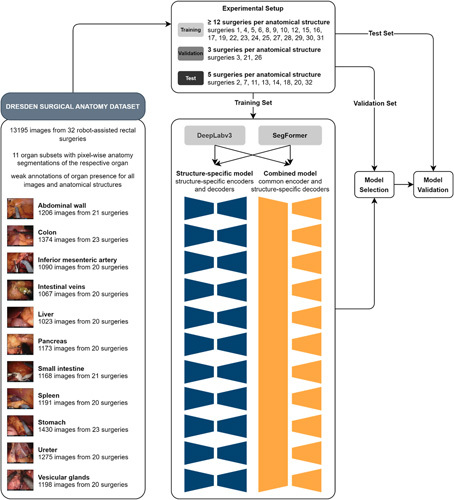
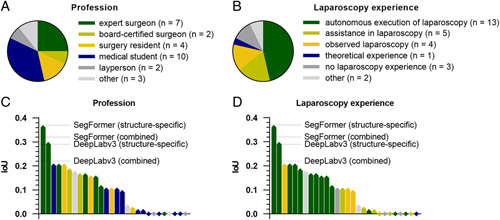
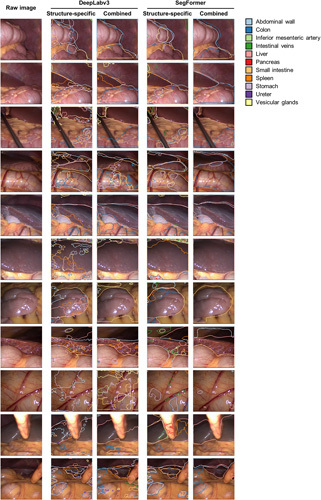
Based on a novel dataset of 13 195 laparoscopic images with pixel-wise segmentations of 11 anatomical structures, we developed specialized segmentation models for each structure and combined models for all anatomical structures using two state-of-the-art model architectures (DeepLabv3 and SegFormer) and compared segmentation performance of algorithms to a cohort of 28 physicians, medical students, and medical laypersons using the example of pancreas segmentation.
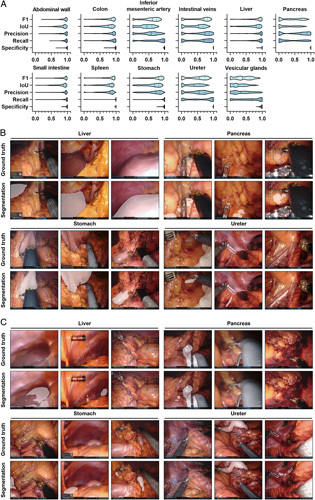
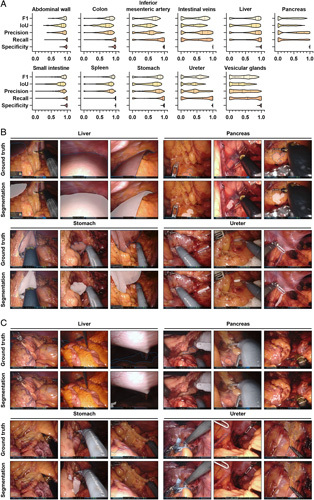
Mean Intersection-over-Union for semantic segmentation of intra-abdominal structures ranged from 0.28 to 0.83 and from 0.23 to 0.77 for the DeepLabv3-based structure-specific and combined models, and from 0.31 to 0.85 and from 0.26 to 0.67 for the SegFormer-based structure-specific and combined models, respectively. Both the structure-specific and the combined DeepLabv3-based models are capable of near-real-time operation, while the SegFormer-based models are not. All four models outperformed at least 26 out of 28 human participants in pancreas segmentation.
These results demonstrate that ML methods have the potential to provide relevant assistance in anatomy recognition in minimally invasive surgery in near-real-time. Future research should investigate the educational value and subsequent clinical impact of the respective assistance systems.
缺乏解剖学认知是腹部手术中一个具有临床相关性的风险。机器学习 (ML) 方法可以帮助识别可见模式和风险结构;然而,其实际价值在很大程度上仍不清楚。
基于一个包含 13195 个腹腔镜图像的新型数据集,这些图像对 11 个解剖结构进行了像素级分割,我们为每个结构开发了专门的分割模型,并使用两种最先进的模型架构(DeepLabv3 和 SegFormer)对所有解剖结构的模型进行了组合,并使用胰腺分割的例子,将算法的分割性能与 28 名医生、医学生和医学外行进行了比较。
用于腹部结构语义分割的平均交并比(Intersection-over-Union)范围为 0.28 至 0.83,DeepLabv3 为基础的结构特定模型和组合模型分别为 0.23 至 0.77,基于 SegFormer 的结构特定模型和组合模型分别为 0.31 至 0.85 和 0.26 至 0.67。基于 DeepLabv3 的结构特定模型和组合模型都能够进行接近实时的操作,而基于 SegFormer 的模型则不能。所有四种模型在胰腺分割方面的表现均优于 28 名参与者中的至少 26 名。
这些结果表明,机器学习方法有可能在微创外科中提供相关的解剖学认知辅助,实现接近实时的操作。未来的研究应调查各自辅助系统的教育价值和随后的临床影响。