Department of Biochemical Engineering University College London, London, United Kingdom.
Chinese Academy of Sciences (CAS) Key Laboratory of Quantitative Engineering Biology, Shenzhen Institute of Synthetic Biology, Shenzhen Institutes of Advanced Technology, Chinese Academy of Sciences, Shenzhen, China.
Front Immunol. 2023 Jul 17;14:1198996. doi: 10.3389/fimmu.2023.1198996. eCollection 2023.
Increasing evidence suggests the immune activation elicited by bacterial outer-membrane vesicles (OMVs) can initiate a potent anti-tumor immunity, facilitating the recognition and destruction of malignant cells. At present the pathways underlying this response remain poorly understood, though a role for innate-like cells such as γδ T cells has been suggested.
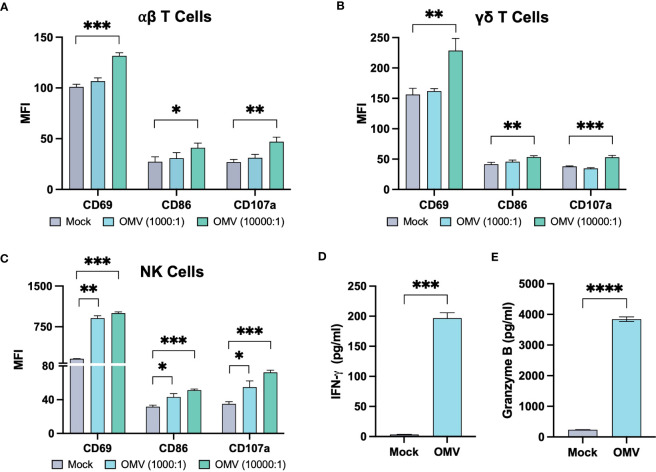
Peripheral blood mononuclear cells (PBMCs) from healthy donors were co-cultured with MG1655 Δ Δ OMVs and corresponding immune activation studied by cell marker expression and cytokine production. OMV-activated γδ T cells were co-cultured with cancer cell lines to determine cytotoxicity.
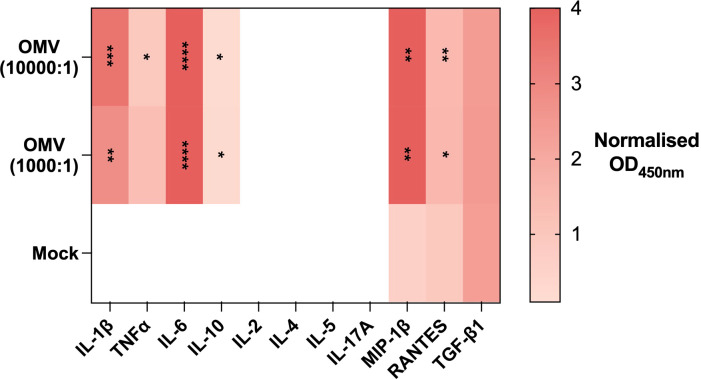
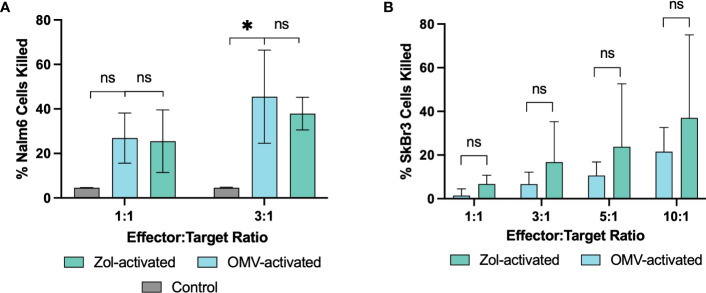
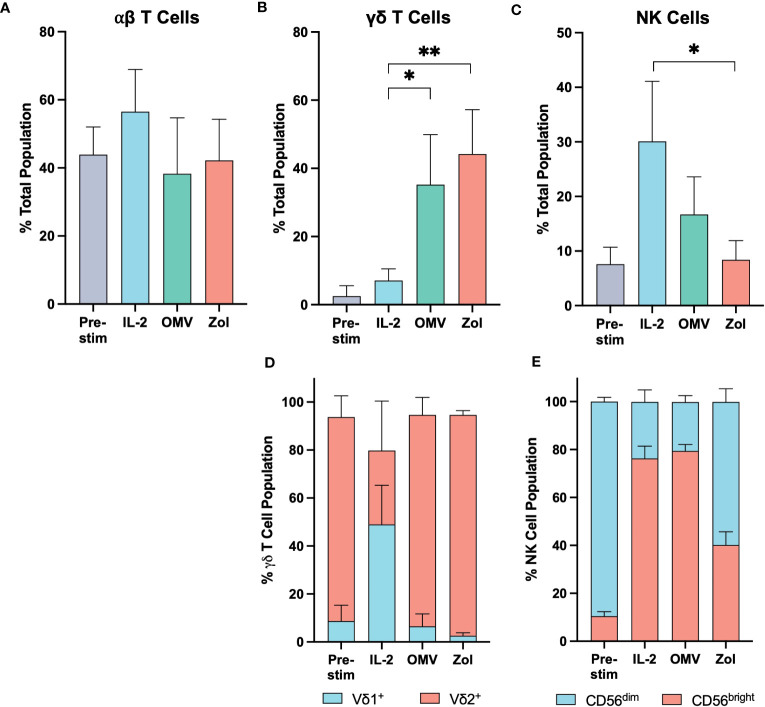
The vesicles induced a broad inflammatory response with γδ T cells observed as the predominant cell type to proliferate post-OMV challenge. Notably, the majority of γδ T cells were of the Vγ9Vδ2 type, known to respond to both bacterial metabolites and stress markers present on tumor cells. We observed robust cytolytic activity of Vγ9Vδ2 T cells against both breast and leukaemia cell lines (SkBr3 and Nalm6 respectively) after OMV-mediated expansion.
Our findings identify for the first time, that OMV-challenge stimulates the expansion of Vγ9Vδ2 T cells which subsequently present anti-tumor capabilities. We propose that OMV-mediated immune activation leverages the anti-microbial/anti-tumor capacity of Vγ9Vδ2 T cells, an axis amenable for improved future therapeutics.
越来越多的证据表明,细菌外膜囊泡(OMV)引起的免疫激活可以引发强烈的抗肿瘤免疫,促进对恶性细胞的识别和破坏。目前,这种反应的途径仍知之甚少,尽管已经提出了先天样细胞(如γδ T 细胞)的作用。
将健康供体的外周血单核细胞(PBMC)与 MG1655 Δ Δ OMV 共培养,并通过细胞标记物表达和细胞因子产生来研究相应的免疫激活。将 OMV 激活的 γδ T 细胞与癌细胞系共培养,以确定细胞毒性。
囊泡诱导了广泛的炎症反应,观察到 γδ T 细胞是 OMV 挑战后增殖的主要细胞类型。值得注意的是,大多数 γδ T 细胞为 Vγ9Vδ2 型,已知对细菌代谢物和肿瘤细胞上存在的应激标志物均有反应。我们观察到 Vγ9Vδ2 T 细胞在 OMV 介导的扩增后对乳腺癌和白血病细胞系(分别为 SkBr3 和 Nalm6)具有强大的细胞毒性活性。
我们的研究结果首次表明,OMV 刺激 Vγ9Vδ2 T 细胞的扩增,随后表现出抗肿瘤能力。我们提出,OMV 介导的免疫激活利用了 Vγ9Vδ2 T 细胞的抗微生物/抗肿瘤能力,这是一种可用于改进未来治疗的轴。