Khaleque M A, Hossain M I, Ali M R, Bacchu M S, Saad Aly M Aly, Khan M Z H
Dept. of Chemical Engineering, Jashore University of Science and Technology Jashore 7408 Bangladesh
Laboratory of Nano-bio and Advanced Materials Engineering (NAME), Jashore University of Science and technology Jashore 7408 Bangladesh.
RSC Adv. 2023 Jul 31;13(33):22973-22997. doi: 10.1039/d3ra03440b. eCollection 2023 Jul 26.
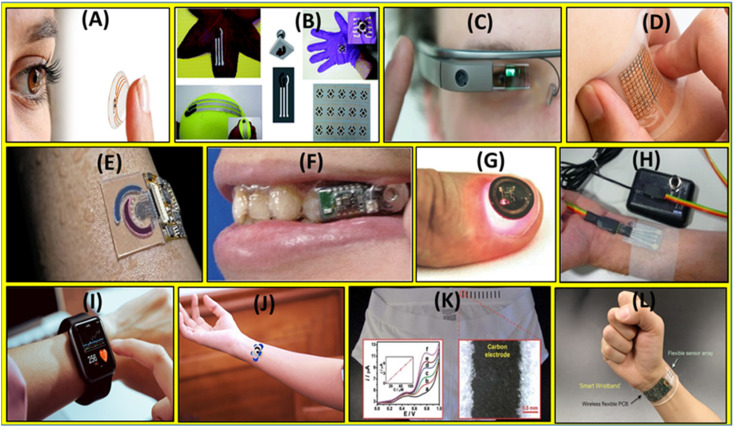
In recent years, there has been a rapid increase in demand for wearable sensors, particularly these tracking the surroundings, fitness, and health of people. Thus, selective detection in human body fluid is a demand for a smart lifestyle by quick monitoring of electrolytes, drugs, toxins, metabolites and biomolecules, proteins, and the immune system. In this review, these parameters along with the main features of the latest and mostly cited research work on nanostructured wearable electrochemical and biosensors are surveyed. This study aims to help researchers and engineers choose the most suitable selective and sensitive sensor. Wearable sensors have broad and effective sensing platforms, such as contact lenses, Google Glass, skin-patch, mouth gourds, smartwatches, underwear, wristbands, and others. For increasing sensor reliability, additional advancements in electrochemical and biosensor precision, stability in uncontrolled environments, and reproducible sample conveyance are necessary. In addition, the optimistic future of wearable electrochemical sensors in fields, such as remote and customized healthcare and well-being is discussed. Overall, wearable electrochemical and biosensing technologies hold great promise for improving personal healthcare and monitoring performance with the potential to have a significant impact on daily lives. These technologies enable real-time body sensing and the communication of comprehensive physiological information.
近年来,对可穿戴传感器的需求迅速增长,尤其是那些用于追踪人们周围环境、健康状况和身体状况的传感器。因此,通过快速监测电解质、药物、毒素、代谢物、生物分子、蛋白质和免疫系统,在人体体液中进行选择性检测是智能生活方式的一项需求。在这篇综述中,我们对这些参数以及关于纳米结构可穿戴电化学和生物传感器的最新且被广泛引用的研究工作的主要特点进行了调查。本研究旨在帮助研究人员和工程师选择最合适的选择性和灵敏性传感器。可穿戴传感器拥有广泛且有效的传感平台,如隐形眼镜、谷歌眼镜、皮肤贴片、口含式传感器、智能手表、内衣、腕带等等。为提高传感器的可靠性,电化学和生物传感器在精度、在非受控环境中的稳定性以及可重复的样品传输方面还需要进一步改进。此外,还讨论了可穿戴电化学传感器在远程和定制化医疗保健及健康等领域的乐观前景。总体而言,可穿戴电化学和生物传感技术在改善个人医疗保健和监测性能方面具有巨大潜力,有望对日常生活产生重大影响。这些技术能够实现实时身体传感并传递全面的生理信息。