School of Physics and Electronics, Hunan University, Changsha 410082, China.
College of Semiconductors (College of Integrated Circuits), Hunan University, Changsha 410082, China.
Biosensors (Basel). 2022 Oct 27;12(11):936. doi: 10.3390/bios12110936.
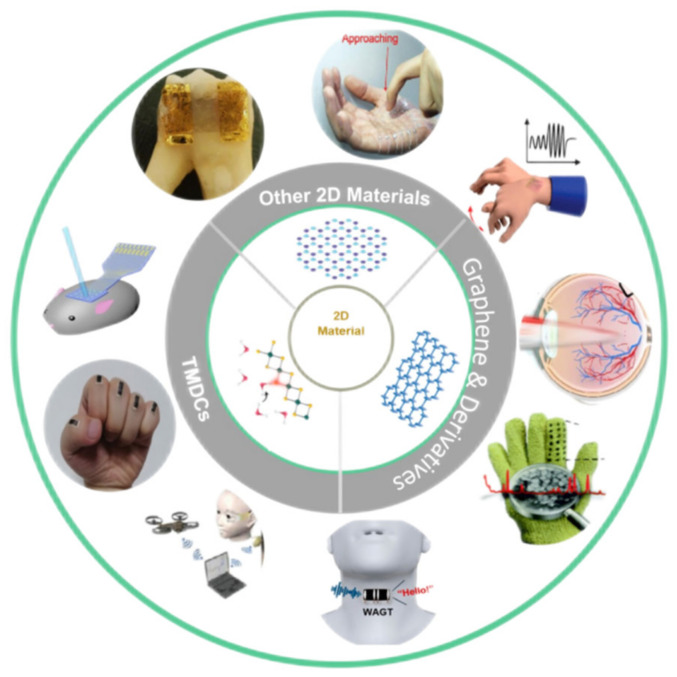
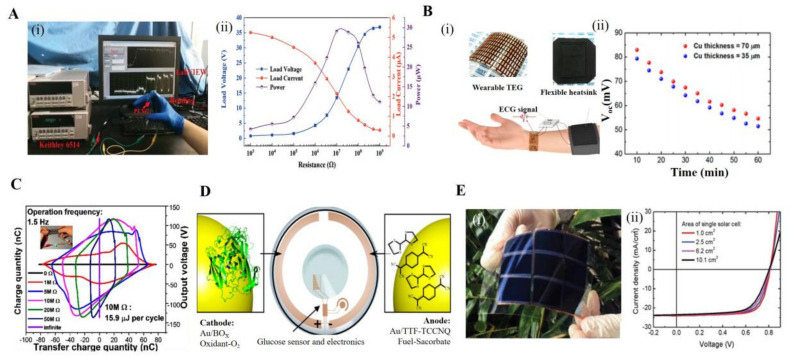
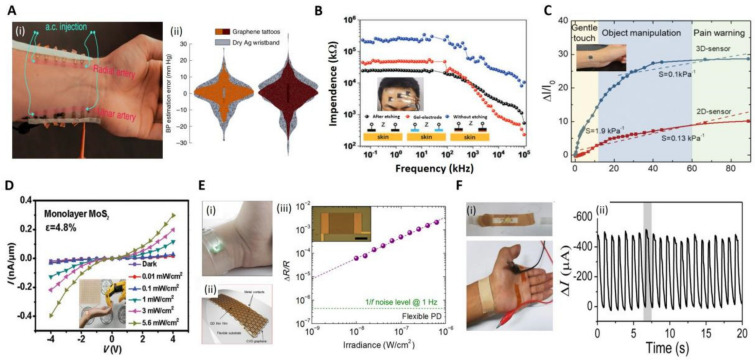
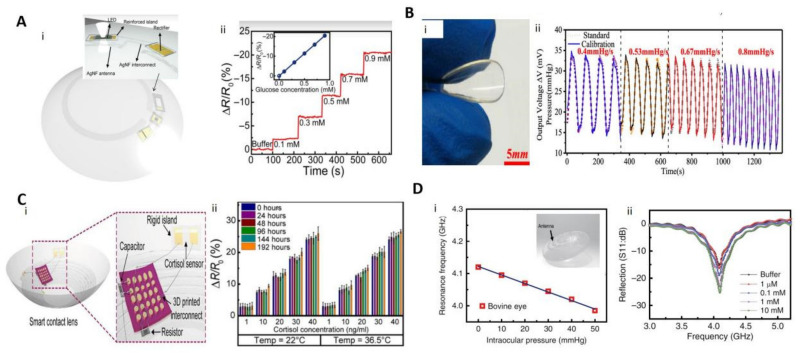
As an evolutionary success in life science, wearable biosensor systems, which can monitor human health information and quantify vital signs in real time, have been actively studied. Research in wearable biosensor systems is mainly focused on the design of sensors with various flexible materials. Among them, 2D materials with excellent mechanical, optical, and electrical properties provide the expected characteristics to address the challenges of developing microminiaturized wearable biosensor systems. This review summarizes the recent research progresses in 2D-materials-based wearable biosensors including e-skin, contact lens sensors, and others. Then, we highlight the challenges of flexible power supply technologies for smart systems. The latest advances in biosensor systems involving wearable wristbands, diabetic patches, and smart contact lenses are also discussed. This review will enable a better understanding of the design principle of 2D biosensors, offering insights into innovative technologies for future biosensor systems toward their practical applications.
作为生命科学中的一项进化成功,可实时监测人体健康信息并量化生命体征的可穿戴生物传感器系统一直受到积极研究。可穿戴生物传感器系统的研究主要集中在具有各种柔性材料的传感器设计上。其中,具有优异机械、光学和电学性能的二维材料为解决开发微型化可穿戴生物传感器系统的挑战提供了预期的特性。本综述总结了基于二维材料的可穿戴生物传感器的最新研究进展,包括电子皮肤、隐形眼镜传感器等。然后,我们强调了智能系统中灵活电源技术的挑战。还讨论了涉及可穿戴腕带、糖尿病贴片和智能隐形眼镜的生物传感器系统的最新进展。本综述将使人们更好地了解二维生物传感器的设计原理,为未来生物传感器系统的创新技术提供见解,以实现其实际应用。