Yang Chenguang, Li Baozhu, Li Yamei, He Yixuan, Zhang Yuan
College of Electronic and Information Engineering, Southwest University, Chongqing, China.
WESTA College, Southwest University, Chongqing, China.
Digit Health. 2023 Jul 27;9:20552076231188206. doi: 10.1177/20552076231188206. eCollection 2023 Jan-Dec.
Sleep is vital to human health, and sleep staging is an essential process in sleep assessment. However, manual classification is an inefficient task. Along with the increased demand for portable sleep quality detection devices, lightweight automatic sleep staging needs to be developed.
This study proposes a novel attention-based lightweight deep learning model called LWSleepNet. A depthwise separable multi-resolution convolutional neural network is introduced to analyze the input feature map and captures features at multiple frequencies using two different sized convolutional kernels. The temporal feature extraction module divides the input into patches and feeds them into a multi-head attention block to extract time-dependent information from sleep recordings. The model's convolution operations are replaced with depthwise separable convolutions to minimize its number of parameters and computational cost. The model's performance on two public datasets (Sleep-EDF-20 and Sleep-EDF-78) was evaluated and compared with those of previous studies. Then, an ablation study and sensitivity analysis were performed to evaluate further each module.
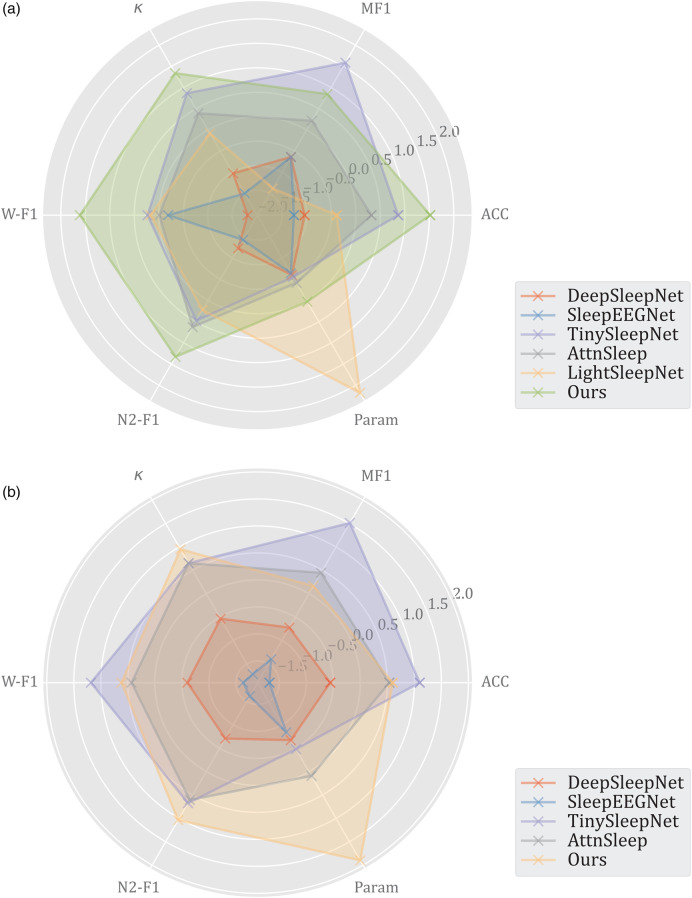
LWSleepNet achieves an accuracy of 86.6% and Macro-F1 score of 79.2% for the Sleep-EDF-20 dataset and an accuracy of 81.5% and Macro-F1 score of 74.3% for the Sleep-EDF-78 dataset with only 55.3 million floating-point operations per second and 180 K parameters.
On two public datasets, LWSleepNet maintains excellent prediction performance while substantially reducing the number of parameters, demonstrating that our proposed Light multiresolution convolutional neural network and temporal feature extraction modules can provide excellent portability and accuracy and can be easily integrated into portable sleep monitoring devices.
睡眠对人类健康至关重要,而睡眠分期是睡眠评估中的一个重要过程。然而,人工分类是一项低效的任务。随着对便携式睡眠质量检测设备需求的增加,需要开发轻量级自动睡眠分期技术。
本研究提出了一种名为LWSleepNet的基于注意力的新型轻量级深度学习模型。引入深度可分离多分辨率卷积神经网络来分析输入特征图,并使用两种不同大小的卷积核在多个频率上捕获特征。时间特征提取模块将输入划分为多个小块,并将它们输入到多头注意力块中,以从睡眠记录中提取与时间相关的信息。该模型的卷积操作被深度可分离卷积所取代,以最小化其参数数量和计算成本。评估了该模型在两个公共数据集(Sleep-EDF-20和Sleep-EDF-78)上的性能,并与先前研究的性能进行了比较。然后,进行了消融研究和敏感性分析,以进一步评估每个模块。
对于Sleep-EDF-20数据集,LWSleepNet的准确率达到86.6%,宏F1分数达到79.2%;对于Sleep-EDF-78数据集,准确率达到81.5%,宏F1分数达到74.3%,每秒仅需5530万次浮点运算,参数为18万个。
在两个公共数据集上,LWSleepNet在大幅减少参数数量的同时保持了出色的预测性能,表明我们提出的轻量级多分辨率卷积神经网络和时间特征提取模块可以提供出色的便携性和准确性,并且可以轻松集成到便携式睡眠监测设备中。