Department of Diagnostic and Interventional Radiology, Hokkaido University Hospital.
Department of Radiology, Juntendo University Graduate School of Medicine.
Magn Reson Med Sci. 2023 Oct 1;22(4):401-414. doi: 10.2463/mrms.rev.2023-0047. Epub 2023 Aug 1.
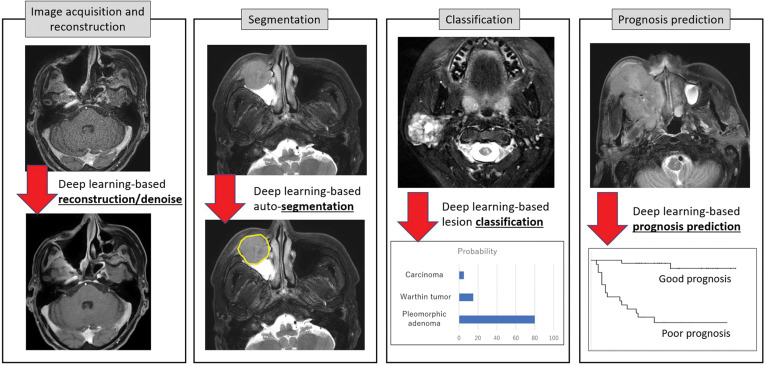
Due primarily to the excellent soft tissue contrast depictions provided by MRI, the widespread application of head and neck MRI in clinical practice serves to assess various diseases. Artificial intelligence (AI)-based methodologies, particularly deep learning analyses using convolutional neural networks, have recently gained global recognition and have been extensively investigated in clinical research for their applicability across a range of categories within medical imaging, including head and neck MRI. Analytical approaches using AI have shown potential for addressing the clinical limitations associated with head and neck MRI. In this review, we focus primarily on the technical advancements in deep-learning-based methodologies and their clinical utility within the field of head and neck MRI, encompassing aspects such as image acquisition and reconstruction, lesion segmentation, disease classification and diagnosis, and prognostic prediction for patients presenting with head and neck diseases. We then discuss the limitations of current deep-learning-based approaches and offer insights regarding future challenges in this field.
主要由于 MRI 提供了出色的软组织对比描绘,头部和颈部 MRI 在临床实践中的广泛应用可用于评估各种疾病。基于人工智能 (AI) 的方法,特别是使用卷积神经网络的深度学习分析,最近在全球范围内得到认可,并在医学影像学的多个领域(包括头部和颈部 MRI)的临床研究中进行了广泛研究,以评估其适用性。使用 AI 的分析方法已显示出解决与头部和颈部 MRI 相关的临床局限性的潜力。在这篇综述中,我们主要关注基于深度学习的方法的技术进步及其在头部和颈部 MRI 领域的临床应用,包括图像采集和重建、病变分割、疾病分类和诊断以及头颈部疾病患者的预后预测等方面。然后,我们讨论了当前基于深度学习的方法的局限性,并对该领域未来的挑战提出了见解。