Department of Neurobiology, Duke University School of Medicine, Durham, NC 27710, USA.
Edmond & Lily Safra Center for Brain Sciences, The Hebrew University of Jerusalem, Jerusalem, Israel.
Neuron. 2023 Aug 2;111(15):2448-2460.e6. doi: 10.1016/j.neuron.2023.07.002.
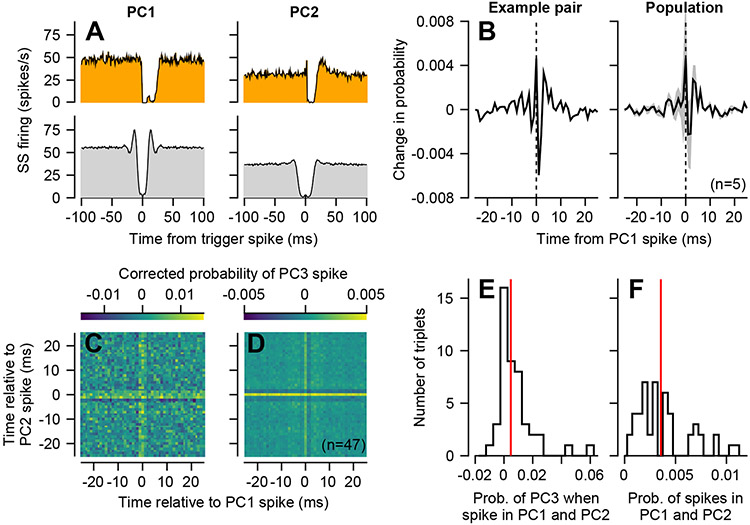
Information transmission between neural populations could occur through either coordinated changes in firing rates or the precise transmission of spike timing. We investigate the code for information transmission from a part of the cerebellar cortex that is crucial for the accurate execution of a quantifiable motor behavior. Simultaneous recordings from Purkinje cell pairs in the cerebellum of rhesus macaques reveal how these cells coordinate their activity to drive smooth pursuit eye movements. Purkinje cells show millisecond-scale coordination of spikes (synchrony), but the level of synchrony is small and insufficient to impact the firing of downstream vestibular nucleus neurons. Analysis of previous metrics that purported to reveal Purkinje cell synchrony demonstrates that these metrics conflate changes in firing rate and neuron-neuron covariance. We conclude that the output of the cerebellar cortex uses primarily a rate rather than a synchrony code to drive the activity of downstream neurons and thus control motor behavior.
信息在神经元群体之间的传递可以通过放电率的协调变化或精确的尖峰时间传递来实现。我们研究了小脑皮层的一部分的信息传递代码,这部分对于精确执行可量化的运动行为至关重要。同时记录恒河猴小脑的浦肯野细胞对,揭示了这些细胞如何协调活动来驱动平滑追踪眼球运动。浦肯野细胞表现出毫秒级别的尖峰(同步)协调,但同步水平很小,不足以影响下游前庭神经核神经元的放电。对之前声称揭示浦肯野细胞同步性的度量指标的分析表明,这些度量指标混淆了放电率和神经元-神经元协方差的变化。我们得出结论,小脑皮层的输出主要使用速率而不是同步代码来驱动下游神经元的活动,从而控制运动行为。