Department of Experimental Medical Science, Ningbo NO.2 Hospital, Ningbo, 315010, China.
Department of Pulmonary and Critical Care Medicine, Qinghai Provincial People's Hospital, Xining, 81000, China.
Sci Rep. 2023 Aug 3;13(1):12607. doi: 10.1038/s41598-023-39627-z.
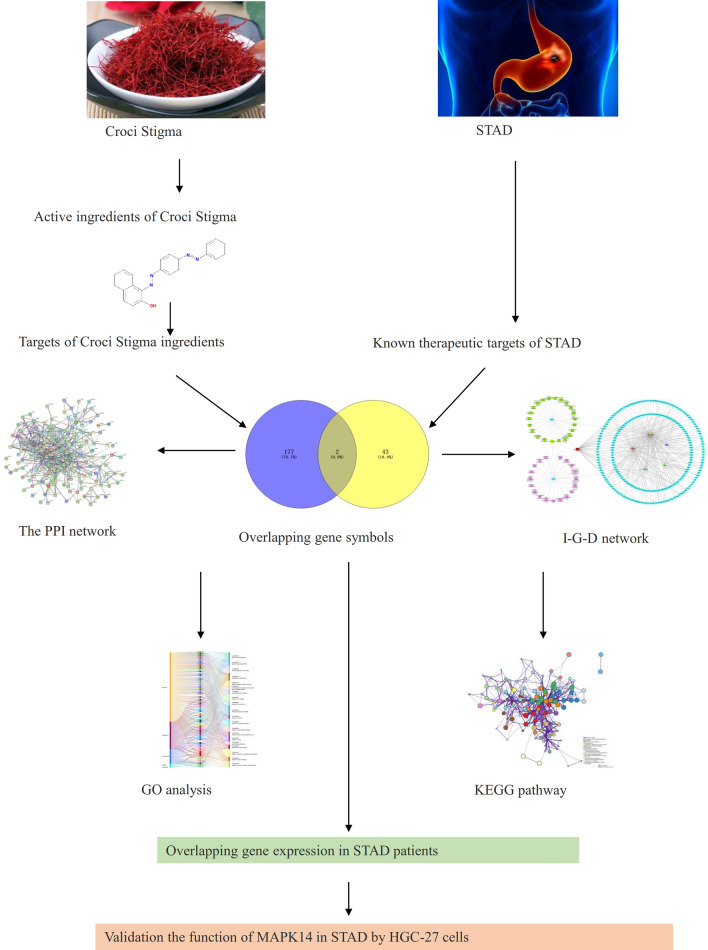
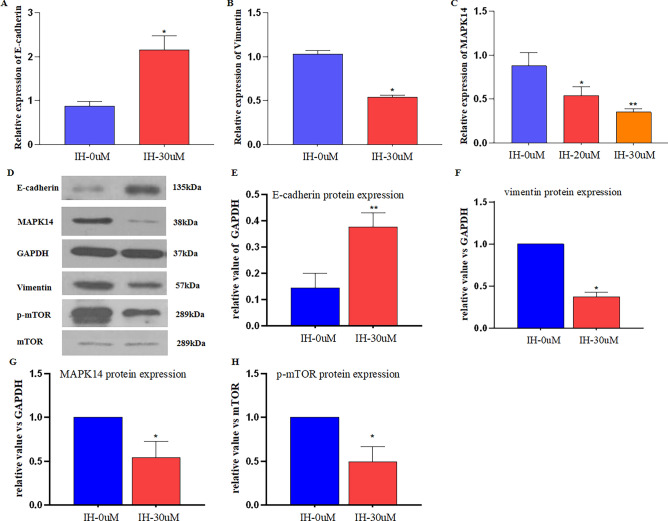
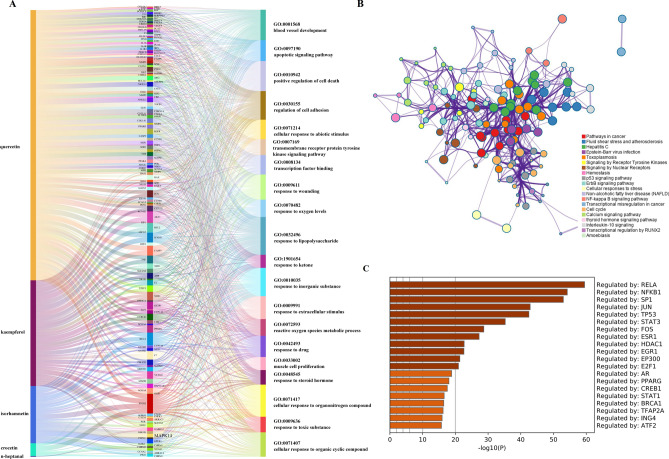
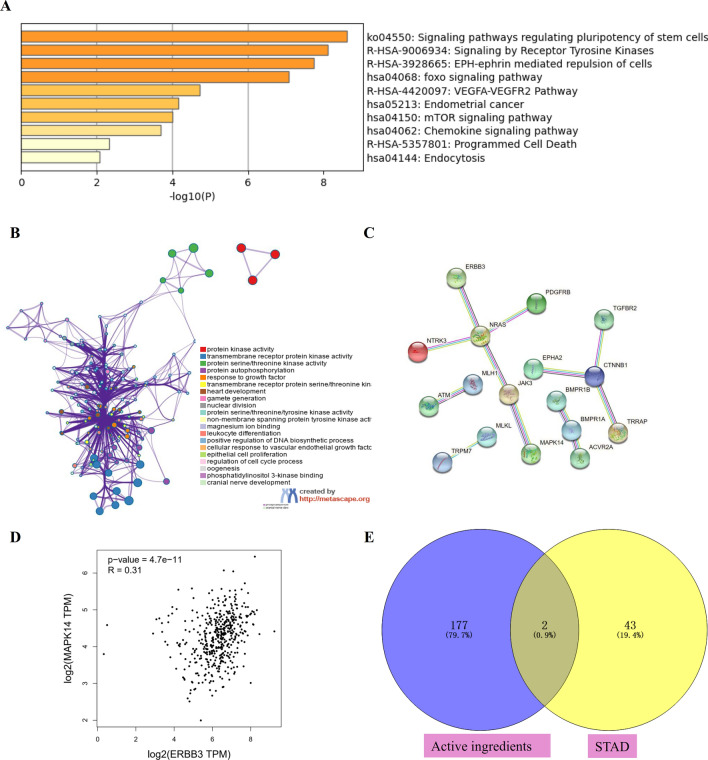
Gastric cancer (GC) remains the third leading cause of cancer-related mortality in the world, and ninety-five percent of GC are stomach adenocarcinomas (STAD). The active ingredients of Croci Stigma, such as Isorhamnetin, Crocin, Crocetin and Kaempferol, all have antitumor activity. However, their chemical and pharmacological profiles remain to be elusive. In this study, network pharmacology was used to characterize the action mechanism of Croci Stigma. All compounds were obtained from the traditional Chinese medicine systems pharmacology (TCMSP) database, and active ingredients were selected by their oral bioavailability and drug-likeness index. The targets of Croci Stigma active ingredients were obtained from the traditional Chinese medicine integrated database (TCMID), whereas the related genes of STAD were obtained from DisGeNET platform. Cytoscape was used to undertake visual analyses of the Drug Ingredients-Gene Symbols-Disease (I-G-D) network, and 2 core genes including MAPK14, ERBB3 were obtained, which are the predicted targets of isorhamnetin (IH) and quercetin, respectively. Data analysis from TCGA platform showed that MAPK14 and ERBB3 all upregulated in STAD patients, but only the effect of MAPK14 expression on STAD patients' survival was significant. Molecular docking showed that IH might affect the function of MAPK14 protein, and then the underlying action mechanisms of IH on STAD were experimentally validated using human gastric cancer cell line, HGC-27 cells. The results showed that IH can inhibit cell proliferation, migration, clonal formation, and arrest cell cycle, but promote the apoptosis of HGC-27 cells. qRT-PCR data demonstrated that IH downregulated the MAPK14 mRNA expression and EMT related genes. WB results showed that IH regulates MAPK/mTOR signaling pathway. These findings suggest that IH has the therapeutic potential for the treatment of STAD.
胃癌(GC)仍然是全球导致癌症相关死亡的第三大原因,其中 95%为胃腺癌(STAD)。西红花柱头的活性成分,如异鼠李素、藏红花酸、西红花酸和山奈酚,都具有抗肿瘤活性。然而,它们的化学和药理学特征仍然难以捉摸。在本研究中,网络药理学用于描述西红花柱头的作用机制。所有化合物均从中药系统药理学(TCMSP)数据库中获得,通过口服生物利用度和药物相似性指数选择活性成分。西红花柱头活性成分的靶点从中药综合数据库(TCMID)中获得,而 STAD 的相关基因从 DisGeNET 平台中获得。Cytoscape 用于对药物成分-基因符号-疾病(I-G-D)网络进行可视化分析,并获得了包括 MAPK14 和 ERBB3 在内的 2 个核心基因,这分别是异鼠李素(IH)和槲皮素的预测靶点。来自 TCGA 平台的数据分析表明,MAPK14 和 ERBB3 在 STAD 患者中均上调,但只有 MAPK14 表达对 STAD 患者生存的影响具有显著性。分子对接表明 IH 可能影响 MAPK14 蛋白的功能,然后使用人胃癌细胞系 HGC-27 细胞对 IH 对 STAD 的潜在作用机制进行了实验验证。结果表明,IH 可抑制 HGC-27 细胞的增殖、迁移、克隆形成和细胞周期阻滞,并促进细胞凋亡。qRT-PCR 数据表明 IH 下调了 MAPK14 mRNA 表达和 EMT 相关基因。WB 结果表明 IH 调节 MAPK/mTOR 信号通路。这些发现表明 IH 具有治疗 STAD 的潜力。