Plant and Microbial Biology Department and NC Plant Sciences Initiative, North Carolina State University, Raleigh, NC, 27695, USA.
Electrical and Computer Engineering Department, North Carolina State University, Raleigh, NC, 27695, USA.
Nat Commun. 2023 Aug 3;14(1):4654. doi: 10.1038/s41467-023-40365-z.
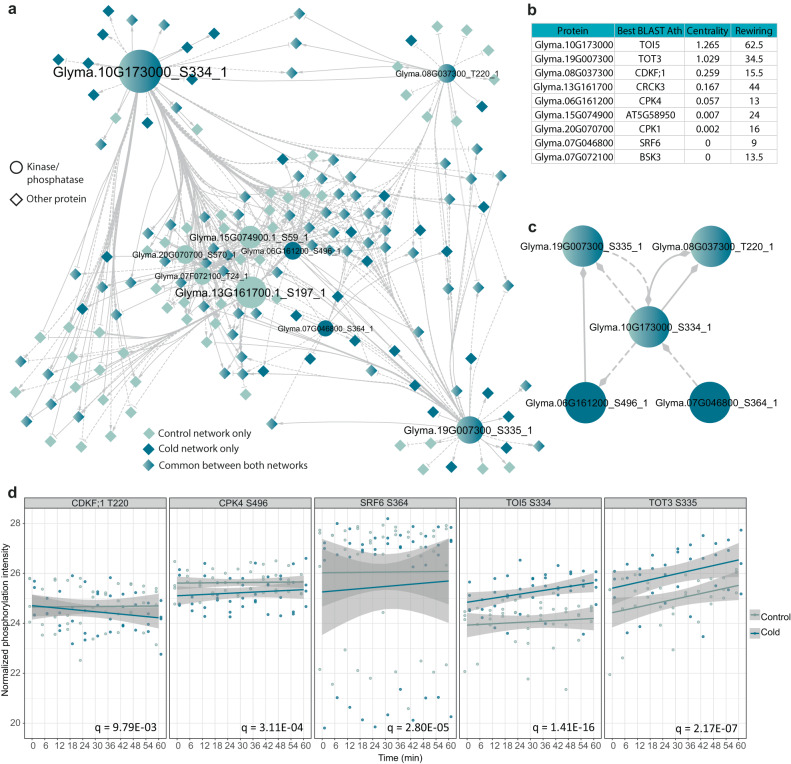
Molecular biology aims to understand cellular responses and regulatory dynamics in complex biological systems. However, these studies remain challenging in non-model species due to poor functional annotation of regulatory proteins. To overcome this limitation, we develop a multi-layer neural network that determines protein functionality directly from the protein sequence. We annotate kinases and phosphatases in Glycine max. We use the functional annotations from our neural network, Bayesian inference principles, and high resolution phosphoproteomics to infer phosphorylation signaling cascades in soybean exposed to cold, and identify Glyma.10G173000 (TOI5) and Glyma.19G007300 (TOT3) as key temperature regulators. Importantly, the signaling cascade inference does not rely upon known kinase motifs or interaction data, enabling de novo identification of kinase-substrate interactions. Conclusively, our neural network shows generalization and scalability, as such we extend our predictions to Oryza sativa, Zea mays, Sorghum bicolor, and Triticum aestivum. Taken together, we develop a signaling inference approach for non-model species leveraging our predicted kinases and phosphatases.
分子生物学旨在理解复杂生物系统中的细胞反应和调控动态。然而,由于调控蛋白的功能注释较差,这些研究在非模式物种中仍然具有挑战性。为了克服这一限制,我们开发了一种多层神经网络,可以直接从蛋白质序列中确定蛋白质的功能。我们对大豆 Glycine max 中的激酶和磷酸酶进行了注释。我们使用来自神经网络的功能注释、贝叶斯推理原理和高分辨率磷酸化蛋白质组学来推断大豆在受到冷胁迫时的磷酸化信号级联,并鉴定出 Glyma.10G173000(TOI5)和 Glyma.19G007300(TOT3)作为关键的温度调节剂。重要的是,该信号级联推断不依赖于已知的激酶基序或相互作用数据,从而能够从头鉴定激酶-底物相互作用。总之,我们的神经网络具有泛化和可扩展性,因此我们将预测结果扩展到了水稻、玉米、高粱和小麦。综上所述,我们开发了一种利用预测激酶和磷酸酶的非模式物种信号推断方法。