• 文献检索
  • 文档翻译
  • 深度研究
  • 学术资讯
  • Suppr Zotero 插件Zotero 插件
  • 邀请有礼
  • 套餐&价格
  • 历史记录
应用&插件
Suppr Zotero 插件Zotero 插件浏览器插件Mac 客户端Windows 客户端微信小程序
定价
高级版会员购买积分包购买API积分包
服务
文献检索文档翻译深度研究API 文档MCP 服务
关于我们
关于 Suppr公司介绍联系我们用户协议隐私条款
关注我们

Suppr 超能文献

核心技术专利:CN118964589B侵权必究
粤ICP备2023148730 号-1Suppr @ 2026

文献检索

告别复杂PubMed语法,用中文像聊天一样搜索,搜遍4000万医学文献。AI智能推荐,让科研检索更轻松。

立即免费搜索

文件翻译

保留排版,准确专业,支持PDF/Word/PPT等文件格式,支持 12+语言互译。

免费翻译文档

深度研究

AI帮你快速写综述,25分钟生成高质量综述,智能提取关键信息,辅助科研写作。

立即免费体验

沉浸式头戴虚拟现实在老年养老院居民中的耐受性。

Tolerance of immersive head-mounted virtual reality among older nursing home residents.

机构信息

Institut des Sciences du Sport-Santé de Paris (URP3625 - I3SP), Université Paris Cité, Paris, France.

Laboratoire Complexité, Innovations, Activités Motrices et Sportives (CIAMS, EA4532), Université Paris-Saclay, Orsay, France.

出版信息

Front Public Health. 2023 Jul 19;11:1163484. doi: 10.3389/fpubh.2023.1163484. eCollection 2023.

DOI:10.3389/fpubh.2023.1163484
PMID:37538272
原文链接:https://pmc.ncbi.nlm.nih.gov/articles/PMC10394641/
Abstract

INTRODUCTION

Virtual Reality (VR) is a tool that is increasingly used in the aging population. Head-Mounted Displays (HMDs) are stereoscopic vision devices used for immersive VR. Cybersickness is sometimes reported after head-mounted display (HMD) VR exposure. Cybersickness severity and anxiety state reflect VR low tolerance. We aimed to evaluate HMD VR tolerance among older nursing home residents through cybersickness and anxiety state.

METHODS

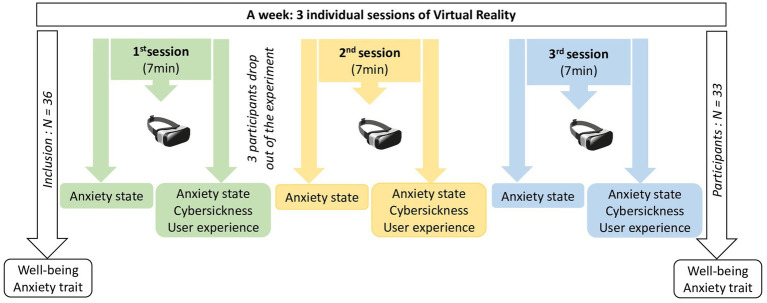
A total of 36 participants were included in this preliminary study, 33 of whom (mean age: 89.33 ± 5.48) underwent three individual HMD VR sessions with three different contents. Cybersickness occurrence and severity were scored by the Simulator Sickness Questionnaire (SSQ) after each session. Anxiety state was assessed by the State-Trait Anxiety Inventory form Y-A before and after each session. Anxiety trait (using State-Trait Anxiety Inventory form Y-B) was also evaluated before and after the experiment. In total, 92% (33/36) of patients completed all three sessions, of which 61% (20/33) did not report any cybersickness symptoms (SSQ = 0). Six participants reported significant cybersickness (defined by an SSQ score ⩾10) in at least one session.

DISCUSSION

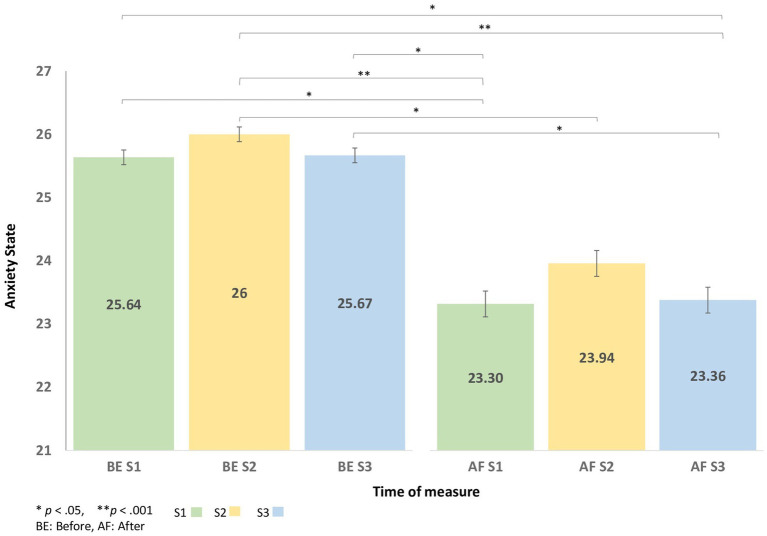
Only two participants stopped the study after the first exposure because of cybersickness. Age, cognitive function, anxiety trait, and well-being were not associated with cybersickness. The mean anxiety state decreased significantly from pre- to post-session. This immersive HMD VR experience was well tolerated among nursing home dwellers. Further larger studies in this population aiming to identify CS determinants are needed in order to use HMD VR on a standard basis.

摘要

简介

虚拟现实(VR)是一种在老年人群体中越来越常用的工具。头戴式显示器(HMD)是用于沉浸式 VR 的立体视觉设备。使用头戴式显示器(HMD)进行 VR 后有时会出现晕动症。晕动症的严重程度和焦虑状态反映了 VR 的低耐受性。我们旨在通过晕动症和焦虑状态来评估养老院居民对 HMD VR 的耐受性。

方法

共有 36 名参与者参与了这项初步研究,其中 33 名(平均年龄:89.33±5.48)接受了三个单独的 HMD VR 课程,每个课程都有不同的内容。每次课程后,通过模拟器晕动症问卷(SSQ)对晕动症的发生和严重程度进行评分。在每次课程前后,通过状态-特质焦虑量表(Y-A)评估焦虑状态。在实验前后,还评估了焦虑特质(使用状态-特质焦虑量表 Y-B)。共有 92%(33/36)的患者完成了所有三个课程,其中 61%(20/33)没有报告任何晕动症症状(SSQ=0)。在至少一个课程中,有 6 名参与者报告了明显的晕动症(定义为 SSQ 评分 ⩾10)。

讨论

只有两名参与者因晕动症在第一次暴露后停止了研究。年龄、认知功能、焦虑特质和幸福感与晕动症无关。从课前到课后,焦虑状态显著降低。这种沉浸式 HMD VR 体验在养老院居民中得到了很好的耐受。为了在标准基础上使用 HMD VR,需要在这一人群中进行进一步的更大规模的研究,以确定 CS 的决定因素。
https://cdn.ncbi.nlm.nih.gov/pmc/blobs/cabd/10394641/2be694fe2cc6/fpubh-11-1163484-g003.jpg
https://cdn.ncbi.nlm.nih.gov/pmc/blobs/cabd/10394641/2451f5385b48/fpubh-11-1163484-g001.jpg
https://cdn.ncbi.nlm.nih.gov/pmc/blobs/cabd/10394641/71a06c959439/fpubh-11-1163484-g002.jpg
https://cdn.ncbi.nlm.nih.gov/pmc/blobs/cabd/10394641/2be694fe2cc6/fpubh-11-1163484-g003.jpg
https://cdn.ncbi.nlm.nih.gov/pmc/blobs/cabd/10394641/2451f5385b48/fpubh-11-1163484-g001.jpg
https://cdn.ncbi.nlm.nih.gov/pmc/blobs/cabd/10394641/71a06c959439/fpubh-11-1163484-g002.jpg
https://cdn.ncbi.nlm.nih.gov/pmc/blobs/cabd/10394641/2be694fe2cc6/fpubh-11-1163484-g003.jpg

相似文献

1
Tolerance of immersive head-mounted virtual reality among older nursing home residents.沉浸式头戴虚拟现实在老年养老院居民中的耐受性。
Front Public Health. 2023 Jul 19;11:1163484. doi: 10.3389/fpubh.2023.1163484. eCollection 2023.
2
Feasibility of full immersive virtual reality video game on balance and cybersickness of healthy adolescents.健康青少年平衡和虚拟现实视频游戏晕动症的全沉浸式可行性。
Neurosci Lett. 2021 Aug 24;760:136063. doi: 10.1016/j.neulet.2021.136063. Epub 2021 Jun 24.
3
Motion sickness and cybersickness - Sensory mismatch.运动病和网络晕动症——感觉不匹配。
Physiol Behav. 2023 Jan 1;258:114015. doi: 10.1016/j.physbeh.2022.114015. Epub 2022 Oct 30.
4
Psychometric evaluation of Simulator Sickness Questionnaire and its variants as a measure of cybersickness in consumer virtual environments.消费者虚拟环境中网络晕动症测量的模拟器晕动症问卷及其变体的心理计量学评估。
Appl Ergon. 2020 Jan;82:102958. doi: 10.1016/j.apergo.2019.102958. Epub 2019 Sep 26.
5
Factors Associated With Virtual Reality Sickness in Head-Mounted Displays: A Systematic Review and Meta-Analysis.头戴式显示器中与虚拟现实疾病相关的因素:系统评价与荟萃分析。
Front Hum Neurosci. 2020 Mar 31;14:96. doi: 10.3389/fnhum.2020.00096. eCollection 2020.
6
Cybersickness and postural stability of first time VR users playing VR videogames.首次使用 VR 游戏的人玩 VR 视频游戏时的晕动症和姿势稳定性。
Appl Ergon. 2022 May;101:103698. doi: 10.1016/j.apergo.2022.103698. Epub 2022 Feb 10.
7
Immersive Virtual Reality during Robot-Assisted Gait Training: Validation of a New Device in Stroke Rehabilitation.沉浸式虚拟现实在机器人辅助步态训练中的应用:一种新型设备在脑卒中康复中的验证。
Medicina (Kaunas). 2022 Dec 7;58(12):1805. doi: 10.3390/medicina58121805.
8
Effects of a Modern Virtual Reality 3D Head-Mounted Display Exergame on Simulator Sickness and Immersion Under Specific Conditions in Young Women and Men: Experimental Study.现代虚拟现实3D头戴式显示器健身游戏对特定条件下年轻男女模拟器晕动症和沉浸感的影响:实验研究
JMIR Serious Games. 2022 Nov 29;10(4):e41234. doi: 10.2196/41234.
9
Estimating objective (EEG) and subjective (SSQ) cybersickness in people with susceptibility to motion sickness.评估晕动病易感人群的客观(脑电图)和主观(晕动病症状问卷)网络晕动症情况。
Appl Ergon. 2022 Jul;102:103731. doi: 10.1016/j.apergo.2022.103731. Epub 2022 Mar 3.
10
Cybersickness in People with Multiple Sclerosis Exposed to Immersive Virtual Reality.多发性硬化症患者在接触沉浸式虚拟现实时的网络病
Bioengineering (Basel). 2024 Jan 24;11(2):115. doi: 10.3390/bioengineering11020115.

引用本文的文献

1
Impact of sensorimotor mismatch on virtual reality sickness and user experience: age-related differences in a randomized trial.感觉运动不匹配对虚拟现实眩晕及用户体验的影响:一项随机试验中的年龄差异
J Neuroeng Rehabil. 2025 Jul 3;22(1):143. doi: 10.1186/s12984-025-01677-x.
2
The REAsmash serious game for the post-stroke diagnosis of distractor inhibition: contrast between immersive and non-immersive virtual reality test versions.用于中风后注意力分散抑制诊断的REAsmash严肃游戏:沉浸式与非沉浸式虚拟现实测试版本的对比
Eur J Phys Rehabil Med. 2025 Apr;61(2):197-208. doi: 10.23736/S1973-9087.25.08680-0. Epub 2025 Mar 6.
3

本文引用的文献

1
Acceptance of a Mobile Telepresence Robot, before Use, to Remotely Supervise Older Adults' Adapted Physical Activity.接受移动远程呈现机器人,在使用前,远程监督老年人的适应性身体活动。
Int J Environ Res Public Health. 2023 Feb 9;20(4):3012. doi: 10.3390/ijerph20043012.
2
Major Trends in Population Growth Around the World.世界各地人口增长的主要趋势。
China CDC Wkly. 2021 Jul 9;3(28):604-613. doi: 10.46234/ccdcw2021.160.
3
Chronic conditions and multimorbidity associated with institutionalization among Finnish community-dwelling older people: an 18-year population-based follow-up study.
Assessing the Feasibility and Acceptability of Virtual Reality for Remote Group-Mediated Physical Activity in Older Adults: Pilot Randomized Controlled Trial.
评估虚拟现实在老年人远程群体介导身体活动中的可行性和可接受性: 试点随机对照试验。
JMIR Form Res. 2024 Nov 8;8:e53156. doi: 10.2196/53156.
4
Development and Initial Testing of an Artificial Intelligence-Based Virtual Reality Companion for People Living with Dementia in Long-Term Care.一种基于人工智能的虚拟现实陪伴系统的开发及对长期护理中的痴呆症患者的初步测试
J Clin Med. 2024 Sep 20;13(18):5574. doi: 10.3390/jcm13185574.
慢性疾病和多病共存与芬兰社区居住的老年人机构化相关:一项 18 年的基于人群的随访研究。
Eur Geriatr Med. 2021 Dec;12(6):1275-1284. doi: 10.1007/s41999-021-00535-y. Epub 2021 Jul 14.
4
Acceptance of a Virtual Reality Headset Designed for Fall Prevention in Older Adults: Questionnaire Study.老年人防跌倒虚拟现实头戴设备接受度的研究:问卷调查。
J Med Internet Res. 2020 Dec 14;22(12):e20691. doi: 10.2196/20691.
5
Use of virtual reality-based training in different fields of rehabilitation: A systematic review and meta-analysis.虚拟现实在康复不同领域中的应用:系统综述和荟萃分析。
J Rehabil Med. 2020 Nov 19;52(11):jrm00121. doi: 10.2340/16501977-2755.
6
The Potential of Immersive Virtual Reality for Cognitive Training in Elderly.沉浸式虚拟现实在老年人认知训练中的潜力。
Gerontology. 2020;66(6):614-623. doi: 10.1159/000509830. Epub 2020 Sep 9.
7
Individual predictors of the susceptibility for motion-related sickness: A systematic review.运动相关疾病易感性的个体预测因素:系统评价。
J Vestib Res. 2020;30(3):165-193. doi: 10.3233/VES-200702.
8
The Role of Virtual Reality in Improving Health Outcomes for Community-Dwelling Older Adults: Systematic Review.虚拟现实在改善社区居住老年人健康结局中的作用:系统评价
J Med Internet Res. 2020 Jun 1;22(6):e17331. doi: 10.2196/17331.
9
Factors Associated With Virtual Reality Sickness in Head-Mounted Displays: A Systematic Review and Meta-Analysis.头戴式显示器中与虚拟现实疾病相关的因素:系统评价与荟萃分析。
Front Hum Neurosci. 2020 Mar 31;14:96. doi: 10.3389/fnhum.2020.00096. eCollection 2020.
10
Decreased Autonomy In Community-Dwelling Older Adults.社区居住的老年人自主性降低。
Clin Interv Aging. 2019 Nov 18;14:2041-2053. doi: 10.2147/CIA.S225479. eCollection 2019.