Department of Oral and Maxillofacial Diseases, University of Helsinki and Helsinki University Hospital, P.O. Box 63, 00014, Helsinki, Finland.
Department of Preventive Dentistry, Academic Centre for Dentistry Amsterdam (ACTA), Vrije Universiteit Amsterdam and University of Amsterdam, Amsterdam, the Netherlands.
Microbiome. 2023 Aug 5;11(1):171. doi: 10.1186/s40168-023-01613-y.
Treating oral squamous cell carcinoma (OSCC) introduces new ecological environments in the oral cavity. This is expected to cause changes in the oral microbiome. The purpose of this study was to gain new information on the salivary microbiome of OSCC patients in order to improve the aftercare of OSCC patients. The aims of this study were to investigate possible changes in the salivary microbiome profiles of OSCC patients before and after cancer treatment and to compare these changes with the profiles of healthy controls.
Paraffin-stimulated whole saliva samples were collected, and the salivary flow rate was measured from 99 OSCC patients prior to surgical resection of the tumor and other adjuvant therapy. After treatment, 28 OSCC patients were re-examined with a mean follow-up time of 48 months. In addition, 101 healthy controls were examined and sampled. After DNA extraction and purification, the V4 hypervariable region of the 16S rRNA gene was amplified and sequenced using Illumina MiSeq. The merged read pairs were denoised using UNOISE3, mapped to zero-radius operational taxonomic units (zOTUs), and the representative zOTU sequences were assigned a taxonomy using HOMD. Descriptive statistics were used to study the differences in the microbial profiles of OSCC patients before and after treatment and in comparison to healthy controls.
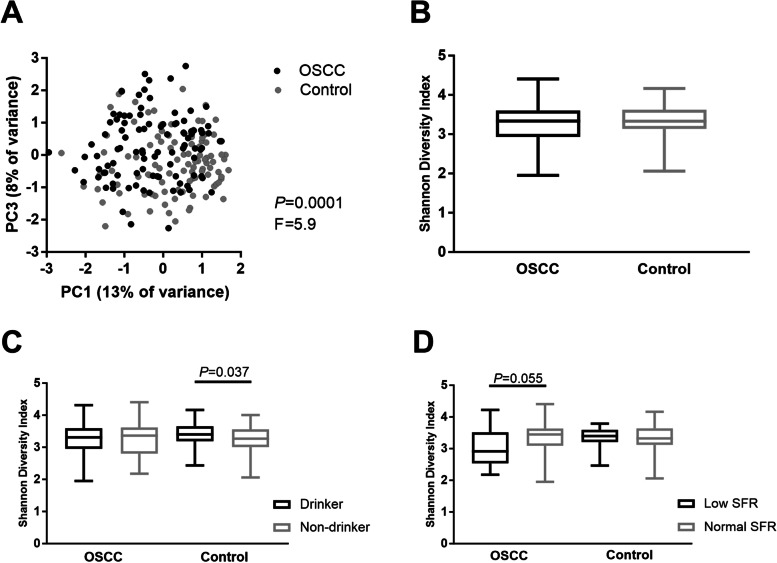
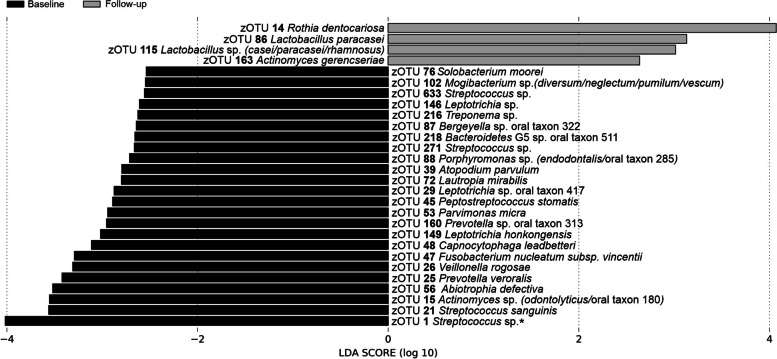
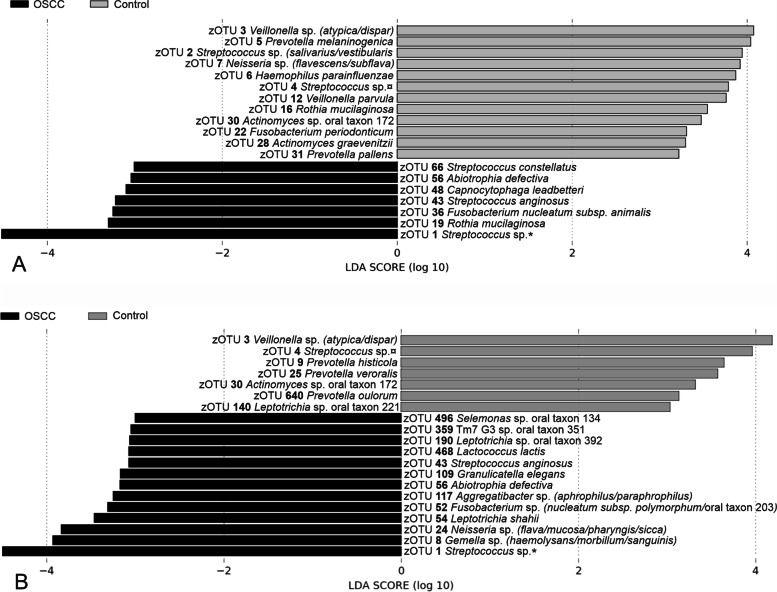
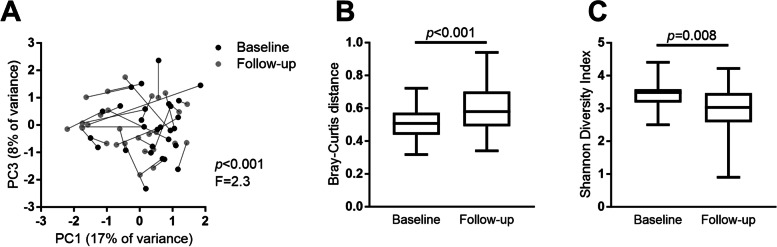
At baseline, the OSCC patients showed a higher relative abundance of zOTUs classified as Streptococcus anginosus, Abiotrophia defectiva, and Fusobacterium nucleatum. The microbial profiles differed significantly between OSCC patients and healthy controls (F = 5.9, p < 0.001). Alpha diversity of the salivary microbiome of OSCC patients was decreased at the follow-up, and the microbial profiles differed significantly from the pre-treatment (p < 0.001) and from that of healthy controls (p < 0.001).
OSCC patients' salivary microbiome profile had a higher abundance of potentially pathogenic bacteria compared to healthy controls. Treatment of the OSCC caused a significant decrease in alpha diversity and increase in variability of the salivary microbiome, which was still evident after several years of follow-up. OSCC patients may benefit from preventive measures, such as the use of pre- or probiotics, salivary substitutes, or dietary counseling. Video Abstract.
治疗口腔鳞状细胞癌 (OSCC) 会在口腔中引入新的生态环境。这预计会导致口腔微生物组发生变化。本研究的目的是获取有关 OSCC 患者唾液微生物组的新信息,以便改善 OSCC 患者的康复。本研究的目的是研究 OSCC 患者在癌症治疗前后唾液微生物组谱可能发生的变化,并将这些变化与健康对照组进行比较。
从 99 名接受肿瘤切除术和其他辅助治疗的 OSCC 患者中采集石蜡刺激全唾液样本,并测量唾液流量。治疗后,28 名 OSCC 患者在平均 48 个月的随访时再次接受检查。此外,还检查并采集了 101 名健康对照者的样本。在提取和纯化 DNA 后,使用 Illumina MiSeq 扩增和测序 16S rRNA 基因的 V4 高变区。使用 UNOISE3 对合并的读对进行去噪,映射到零半径操作分类单元 (zOTU),并使用 HOMD 将代表性 zOTU 序列分配给分类。使用描述性统计来研究 OSCC 患者治疗前后与健康对照组之间的微生物谱差异。
基线时,OSCC 患者的 zOTU 分类为咽峡炎链球菌、缺陷拟杆菌和核梭杆菌的相对丰度较高。OSCC 患者与健康对照组之间的微生物谱差异有统计学意义 (F = 5.9,p < 0.001)。OSCC 患者唾液微生物组的 alpha 多样性在随访时降低,且与治疗前 (p < 0.001) 和与健康对照组 (p < 0.001) 差异均有统计学意义。
与健康对照组相比,OSCC 患者的唾液微生物组谱中潜在致病性细菌的丰度更高。OSCC 的治疗导致 alpha 多样性显著降低,唾液微生物组的变异性增加,即使在数年的随访后仍然存在。OSCC 患者可能受益于预防措施,如使用前或益生菌、唾液替代品或饮食咨询。视频摘要。