Blumenfeld Andrew M, Lipton Richard B, Silberstein Stephen, Tepper Stewart J, Charleston Larry, Landy Stephen, Kuruvilla Deena E, Manack Adams Aubrey
The Los Angeles and San Diego Headache Centers, San Diego, CA, USA.
Albert Einstein College of Medicine, Bronx, NY, USA.
Neurol Ther. 2023 Oct;12(5):1533-1551. doi: 10.1007/s40120-023-00529-x. Epub 2023 Aug 5.
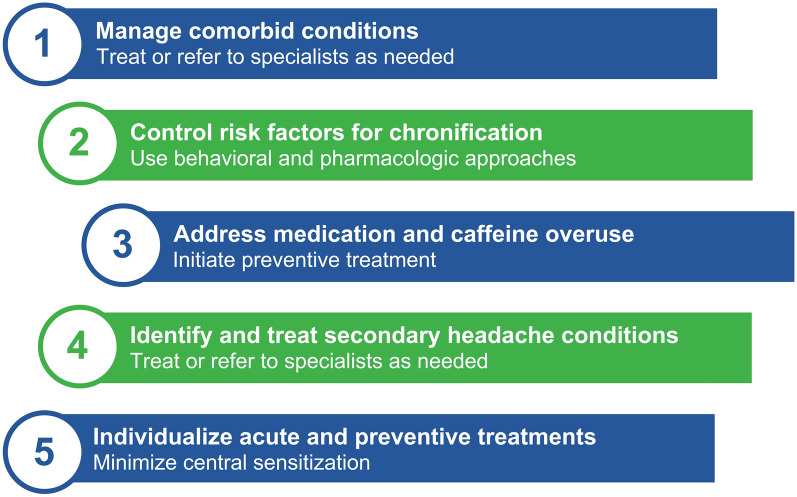
Migraine is a neurologic disease with a complex pathophysiology that can be controlled with current treatment options but not cured. Therefore, treatment expectations are highly variable. The concept of migraine freedom was recently introduced and can mean different things, with some, for example, expecting complete freedom from headache and associated symptoms and others accepting the occasional migraine attack if it does not impact functioning. Therefore, migraine management should be optimized so that patients can have the best opportunity to achieve their optimal treatment goals. With migraine freedom as a goal and, given the complex pathophysiology of migraine and the high incidence of comorbidities among individuals with migraine, treatment with a single modality may be insufficient, as it may not achieve migraine freedom in those with more frequent or disabling attacks. In this clinical perspective article, we have identified four key, partially overlapping principles of multimodal migraine treatment: (1) manage common comorbidities; (2) control modifiable risk factors for progression by addressing medication and caffeine overuse; (3) diagnose and treat secondary causes of headache, if present; and (4) individualize acute and preventive treatments to minimize pain, functional disability, and allodynia. There are many barriers to pursuing migraine freedom, and strategies to overcome them should be optimized. Migraine freedom should be an aspirational goal both at the individual attack level and for the disease overall. We believe that a comprehensive and multimodal approach that addresses all barriers people with migraine face could move patients closer to migraine freedom.
偏头痛是一种具有复杂病理生理学机制的神经系统疾病,目前的治疗方法可以控制病情,但无法治愈。因此,治疗期望差异很大。最近引入了偏头痛缓解的概念,其含义可能各不相同,例如,有些人期望完全摆脱头痛及相关症状,而另一些人则认为如果偏头痛发作不影响功能,偶尔发作也可接受。因此,应优化偏头痛管理,以便患者有最佳机会实现其最佳治疗目标。以偏头痛缓解为目标,鉴于偏头痛复杂的病理生理学机制以及偏头痛患者中合并症的高发生率,单一治疗方式可能并不充分,因为对于发作更频繁或致残的患者,单一治疗方式可能无法实现偏头痛缓解。在这篇临床观点文章中,我们确定了多模式偏头痛治疗的四个关键且部分重叠的原则:(1)管理常见合并症;(2)通过解决药物和咖啡因过度使用问题来控制可改变的病情进展风险因素;(3)诊断并治疗头痛的继发原因(如果存在);(4)个体化急性和预防性治疗,以尽量减少疼痛、功能障碍和痛觉过敏。实现偏头痛缓解存在许多障碍,应优化克服这些障碍的策略。偏头痛缓解应成为个体发作层面以及整个疾病的理想目标。我们认为,一种全面的多模式方法,能够解决偏头痛患者面临的所有障碍,可以使患者更接近偏头痛缓解的目标。