Department of Medicine and Medical Specialities, Faculty of Medicine and Health Sciences, University of Alcalá, Alcalá de Henares, Spain.
Ramón y Cajal Institute of Sanitary Research (IRYCIS), Madrid, Spain.
Front Immunol. 2023 Jul 20;14:1232629. doi: 10.3389/fimmu.2023.1232629. eCollection 2023.
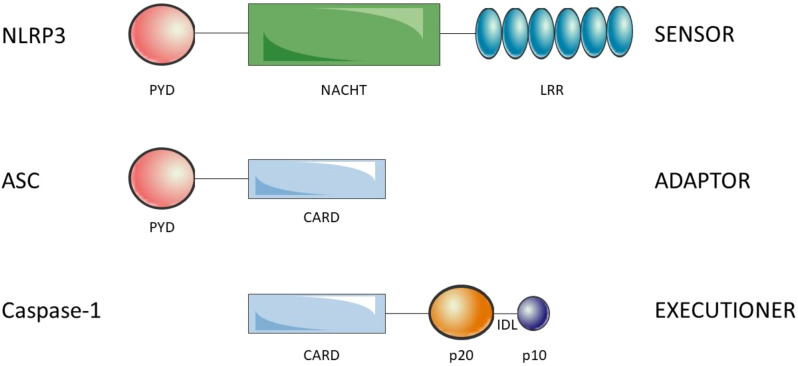
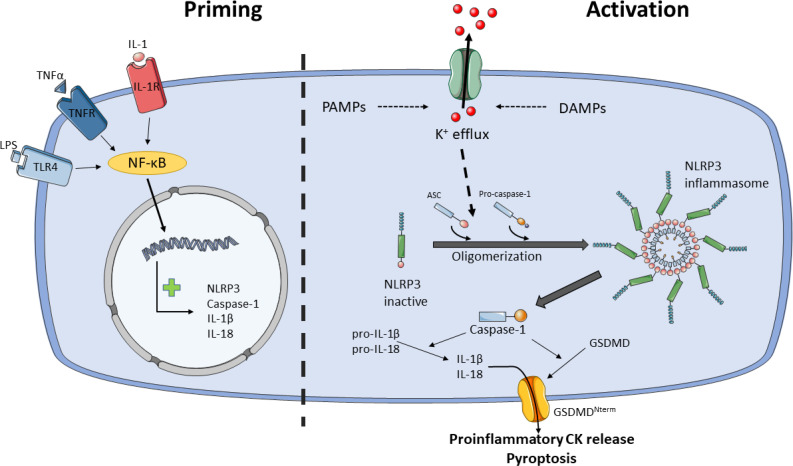
Inflammasomes are multiprotein signaling platforms in the cytosol that senses exogenous and endogenous danger signals and respond with the maturation and secretion of IL-1β and IL-18 and pyroptosis to induce inflammation and protect the host. The inflammasome best studied is the Nucleotide-binding oligomerization domain, leucine-rich repeat-containing family pyrin domain containing 3 (NLRP3) inflammasome. It is activated in a two-step process: the priming and the activation, leading to sensor NLRP3 oligomerization and recruitment of both adaptor ASC and executioner pro-caspase 1, which is activated by cleavage. Moreover, NLRP3 inflammasome activation is regulated by posttranslational modifications, including ubiquitination/deubiquitination, phosphorylation/dephosphorylation, acetylation/deacetylation, SUMOylation and nitrosylation, and interaction with NLPR3 protein binding partners. Moreover, the connection between it and metabolism is receiving increasing attention in this field. In this review, we present the structure, functions, activation, and regulation of NLRP3, with special emphasis on regulation by mitochondrial dysfunction-mtROS production and metabolic signals, i.e., metabolites as well as enzymes. By understanding the regulation of NLRP3 inflammasome activation, specific inhibitors can be rationally designed for the treatment and prevention of various immune- or metabolic-based diseases. Lastly, we review current NLRP3 inflammasome inhibitors and their mechanism of action.
炎症小体是细胞溶质中的多蛋白信号平台,可感知外源性和内源性危险信号,并通过成熟和分泌白细胞介素-1β(IL-1β)和白细胞介素-18(IL-18)以及细胞焦亡做出反应,从而引发炎症并保护宿主。研究最深入的炎症小体是核苷酸结合寡聚化结构域、富含亮氨酸重复序列的家族 pyrin 结构域包含 3(NLRP3)炎症小体。它通过两步激活:引发和激活,导致传感器 NLRP3 寡聚化,并招募衔接蛋白 ASC 和执行 pro-caspase 1,后者通过切割被激活。此外,NLRP3 炎症小体的激活受到翻译后修饰的调节,包括泛素化/去泛素化、磷酸化/去磷酸化、乙酰化/去乙酰化、SUMO 化和亚硝基化,以及与 NLRP3 蛋白结合伙伴的相互作用。此外,它与代谢之间的联系在该领域越来越受到关注。在这篇综述中,我们介绍了 NLRP3 的结构、功能、激活和调节,特别强调了线粒体功能障碍-mtROS 产生和代谢信号(即代谢物以及酶)的调节。通过了解 NLRP3 炎症小体激活的调节,可以合理设计针对各种免疫或代谢相关疾病的治疗和预防的特异性抑制剂。最后,我们综述了当前的 NLRP3 炎症小体抑制剂及其作用机制。