Almudhee Shaikah N, Al Saigul Abdullah M, Sulaiman Amel
Family Medicine, Family Medicine Academy, Qassim Health Cluster, Buraidah, SAU.
Family Medicine, Ministry of Health, Buraidah, SAU.
Cureus. 2023 Jul 5;15(7):e41388. doi: 10.7759/cureus.41388. eCollection 2023 Jul.
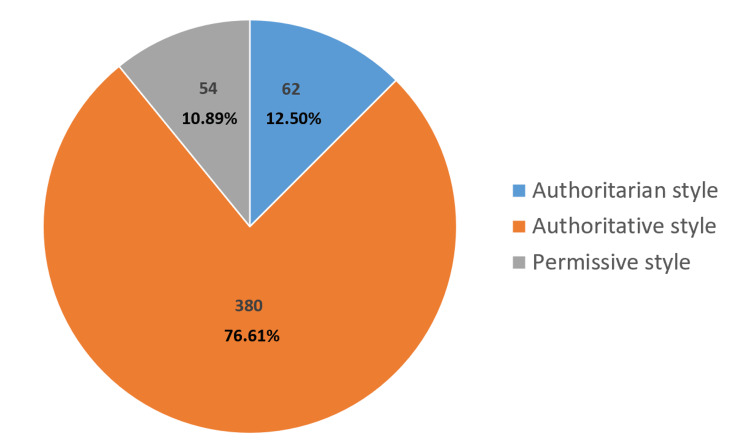
Background Three parenting styles still form the foundation for today's research into childhood development. The natural mode of parenting falls somewhere among Baumrind's parenting styles (authoritative, authoritarian, and permissive). Due to the lack of research that integrates the relationship between parenting styles and socioeconomic status in Saudi Arabia, we decided to study different types of parenting styles and their relationship with sociodemographic status. Objective This study aimed to estimate the frequency of parenting styles among adolescent children's parents in Buraidah City, Qassim, during the year 2021. Methods A descriptive cross-sectional community-based study was conducted among 496 parents. A structured questionnaire was used to collect data. The Parenting Style Dimension Questionnaire (PSDQ) was used to identify the parenting style of each participant. Data were analyzed using the Epi Info software version 7.2.5 (Centers for Disease Control and Prevention, Atlanta, GA, USA). Results Among the surveyed parents, there were 250 (50.4%) males, and the mean age was 36.7 (±10.6) years. The majority (390, 78.6%) live in a nuclear family with a family size ranging from four to six members (285, 57.5%). A total of 451 (90.9%) parents were educated in secondary school and above. In this study, the common parenting style was the authoritative style (380, 76.6%). The two sociodemographic factors found to be statistically correlated with authoritative style were big family size (P=0.014) and the husband's income (P=0.012). Conclusion The study revealed that the authoritative parenting style was the dominant type among younger parents. However, no factors affect the parents' style except family size and the husband's income. It is important to develop parenting education programs to provide parents with the necessary skills and abilities to deal with their children.
背景 三种育儿方式仍然是当今儿童发展研究的基础。自然育儿模式介于鲍姆林德的育儿方式(权威型、专制型和放任型)之间。由于沙特阿拉伯缺乏将育儿方式与社会经济地位之间的关系整合起来的研究,我们决定研究不同类型的育儿方式及其与社会人口统计学地位的关系。
目的 本研究旨在估计2021年卡西姆省布赖代市青少年儿童父母中育儿方式的频率。
方法 对496名父母进行了一项基于社区的描述性横断面研究。使用结构化问卷收集数据。育儿方式维度问卷(PSDQ)用于确定每位参与者的育儿方式。使用Epi Info软件7.2.5版(美国佐治亚州亚特兰大疾病控制与预防中心)对数据进行分析。
结果 在接受调查的父母中,男性有250人(50.4%),平均年龄为36.7(±10.6)岁。大多数(390人,78.6%)生活在核心家庭中,家庭规模为四至六人(285人,57.5%)。共有451名(90.9%)父母接受过中学及以上教育。在本研究中,常见的育儿方式是权威型(380人,76.6%)。发现与权威型育儿方式在统计学上相关的两个社会人口统计学因素是大家庭规模(P=0.014)和丈夫的收入(P=0.012)。
结论 研究表明,权威型育儿方式是年轻父母中占主导地位的类型。然而,除了家庭规模和丈夫的收入外,没有其他因素影响父母的育儿方式。开展育儿教育项目,为父母提供应对子女所需的技能和能力非常重要。