Werner Thomas, Käsbohrer Annemarie, Wasner Barbara, Köberl-Jelovcan Sandra, Vetter Sebastian G, Egger-Danner Christa, Fuchs Klemens, Obritzhauser Walter, Firth Clair L
Unit of Veterinary Public Health and Epidemiology, Institute of Food Safety, Food Technology and Veterinary Public Health, University of Veterinary Medicine, Vienna, Austria.
Department for Biological Safety, German Federal Institute for Risk Assessment, Berlin, Germany.
Front Vet Sci. 2023 Jul 21;10:1225826. doi: 10.3389/fvets.2023.1225826. eCollection 2023.
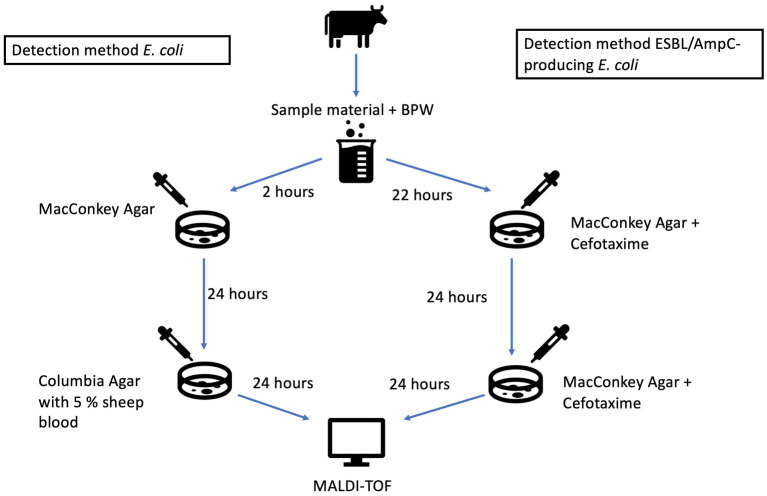
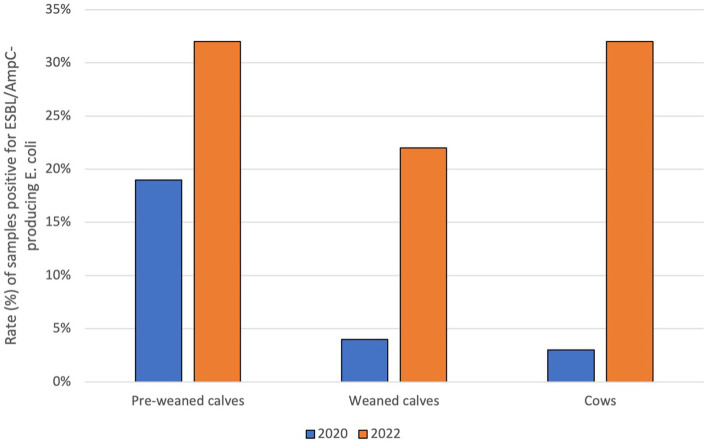
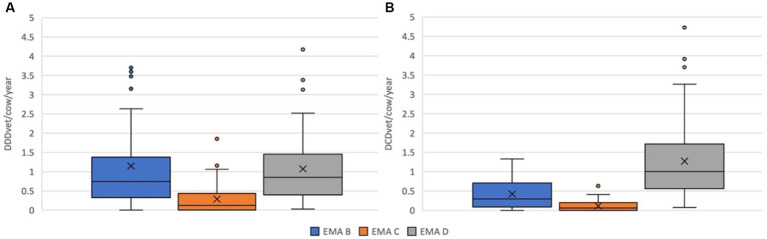
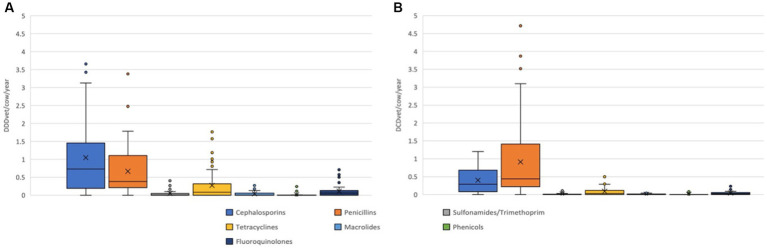
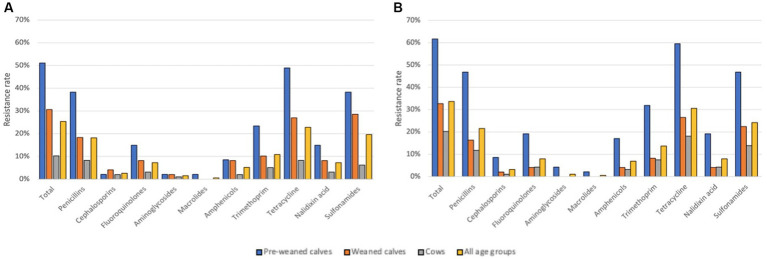
The aim of this study was to investigate the prevalence of ESBL/AmpC-producing and the resistance pattern of commensal , as well as the link between the use of antibiotics (AMU) and the occurrence of resistance in on Austrian dairy farms. AMU data from 51 farms were collected over a one-year period in 2020. Fecal samples were collected from cows, pre-weaned and weaned calves in 2020 and 2022. Samples were then analyzed using non-selective and selective agar plates, isolates were confirmed by MALDI-TOF analysis. Broth microdilution was used for antimicrobial susceptibility testing. The AMU of each farm was quantified as the number of Defined Daily Doses (nDDD) and Defined Course Doses (nDCD) per cow and year. Cephalosporins (mean 1.049; median 0.732 DDD/cow/year) and penicillins (mean 0.667; median 0.383 DDD/cow/year) were the most frequently used antibiotics on these farms, followed by tetracyclines (mean 0.275; median 0.084 DDD/cow/year). In 2020, 26.8% of the isolated were resistant to at least one antibiotic class and 17.7% of the isolates were classified as multidrug resistant (≥3 antibiotic classes). Out of 198 isolates, 7.6% were identified as extended-spectrum/AmpC beta-lactamase (ESBL/AmpC) producing . In 2022, 33.7% of isolates showed resistance to at least one antibiotic and 20.0% of isolates displayed multidrug resistance. Furthermore, 29.5% of the samples carried ESBL/AmpC-producing . In 2020 and 2022, the most frequently determined antibiotic resistances among commensal isolates were to tetracyclines, sulfonamides and penicillins. In addition, pre-weaned calves had the highest resistance rates in both years. Statistical analyses showed a significant association between low and high use AMU classifications for penicillins (in nDDD/cow/year) and their respective resistance among commensal isolates in 2020 ( = 0.044), as well as for sulfonamide/trimethoprim ( = 0.010) and tetracyclines ( = 0.042). A trend was also noted between the total amount of antibiotics used on farm in 2020 (by nDDD/cow/year) and multidrug resistances in commensal isolated on farm that year ( = 0.067). In conclusion, the relationship between AMU and antimicrobial resistance (AMR) on dairy farms continues to be complex and difficult to quantify.
本研究的目的是调查奥地利奶牛场中产超广谱β-内酰胺酶/头孢菌素酶(ESBL/AmpC)的共生菌的流行情况及其耐药模式,以及抗生素使用(AMU)与共生菌耐药性发生之间的联系。2020年,在一年时间内收集了51个农场的AMU数据。2020年和2022年从奶牛、断奶前和断奶后的犊牛采集粪便样本。然后使用非选择性和选择性琼脂平板进行分析,通过基质辅助激光解吸电离飞行时间(MALDI-TOF)分析确认分离株。采用肉汤微量稀释法进行药敏试验。每个农场的AMU被量化为每头奶牛每年的限定日剂量数(nDDD)和限定疗程剂量数(nDCD)。头孢菌素(平均1.049;中位数0.732 DDD/头/年)和青霉素(平均0.667;中位数0.383 DDD/头/年)是这些农场中最常用的抗生素,其次是四环素(平均0.275;中位数0.084 DDD/头/年)。2020年,26.8%的分离株对至少一类抗生素耐药,17.7%的分离株被分类为多重耐药(≥3类抗生素)。在198株分离株中,7.6%被鉴定为产超广谱/头孢菌素酶β-内酰胺酶(ESBL/AmpC)的菌株。2022年,33.7%的分离株对至少一种抗生素耐药,20.0%的分离株表现出多重耐药。此外,29.5%的样本携带产ESBL/AmpC的菌株。2020年和2022年,共生菌分离株中最常检测到的抗生素耐药性是对四环素、磺胺类和青霉素类。此外,断奶前犊牛在这两年中的耐药率最高。统计分析表明,2020年青霉素(以nDDD/头/年计)的低使用量和高使用量分类与其在共生菌分离株中的各自耐药性之间存在显著关联(P = 0.044),磺胺甲恶唑/甲氧苄啶(P = 0.010)和四环素(P = 0.042)也是如此。还注意到2020年农场使用的抗生素总量(以nDDD/头/年计)与当年农场分离的共生菌中的多重耐药性之间存在一种趋势(P = 0.067)。总之,奶牛场中AMU与抗菌药物耐药性(AMR)之间的关系仍然复杂且难以量化。