Bierens Margreet, Hartman Catharina A, Klip Helen, Deckers Stijn, Buitelaar Jan, Rommelse Nanda
Karakter Child and Adolescent Psychiatry, University Center, Nijmegen, Netherlands.
Department of Psychiatry, University of Groningen, Groningen, Netherlands.
Front Psychiatry. 2023 Jul 20;14:1101226. doi: 10.3389/fpsyt.2023.1101226. eCollection 2023.
Emotion dysregulation (ED) is increasingly under investigation as a cross-disorder trait, and is by some considered as the core feature in mental disorders. The aims of this study were to scrutinize the overlapping and distinct characteristics of ED for internalizing, externalizing and neurodevelopmental disorders and to identify the most pertinent ED characteristics to guide clinicians in treatment choice.
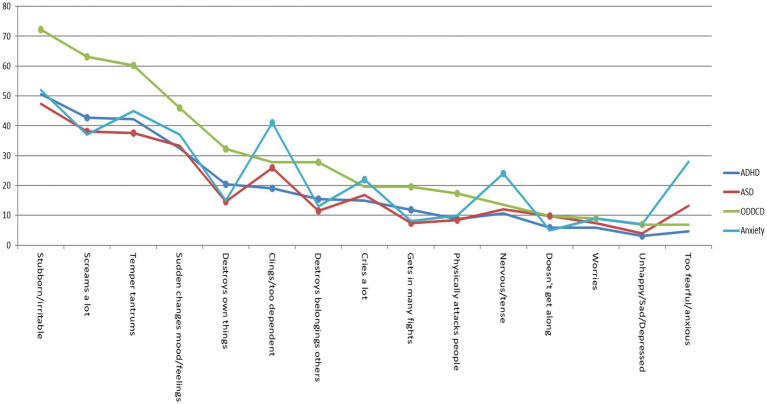
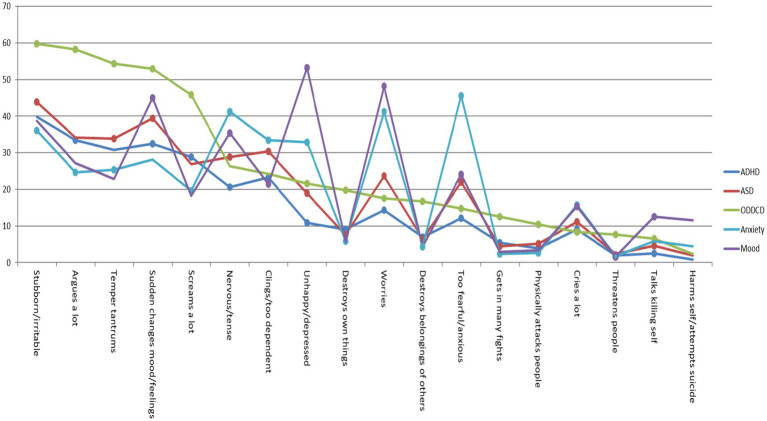
Information on clinical diagnosis (Attention Deficit/Hyperactivity Disorder ADHD, Autism Spectrum Disorder, Oppositional Defiant Disorder/Conduct Disorder, Anxiety and Mood Disorders), ED (measured by the CBCL-Emotion Dysregulation Index), Quality of Life (Qol, measured by the Kidscreen-27), and treatment duration (measured by Electronic Health Records) was retrieved from two large samples of toddlers (1.5-5 year old; = 1,544) and school aged children (6-18 year old; = 7,259). Frequency scores and logistic regression were used to study symptom profiles of ED, as measured with CBCL-EDI, across all disorders. Linear regression was used to determine the predictive value of ED (CBCL-EDI total score) regarding QoL and treatment duration in addition to-and in interaction with-clinical diagnosis.
Across disorders, equal levels of total ED were found, which predicted lower QoL and a longer treatment duration in addition to clinical diagnosis. The majority of items (11/15 and 16/18) were of equal relevance to the disorders; items that were not, largely reflected disorder specific DSM definitions (i.e., externalizing symptoms in ODD/CD and internalizing symptoms in Anxiety and Mood disorders).
ED is a clinically useful cross-disorder trait to predict severity of impairment as well as required treatment duration. In addition, ED is largely composed of shared features across disorders, with certain disorder specific colored elements.
情绪调节障碍(ED)作为一种跨障碍特征正受到越来越多的研究,一些人认为它是精神障碍的核心特征。本研究的目的是仔细研究ED在内化性、外化性和神经发育障碍中的重叠和不同特征,并确定最相关的ED特征,以指导临床医生进行治疗选择。
从两组大样本幼儿(1.5 - 5岁;n = 1544)和学龄儿童(6 - 18岁;n = 7259)中获取有关临床诊断(注意力缺陷/多动障碍、自闭症谱系障碍、对立违抗障碍/品行障碍、焦虑和情绪障碍)、ED(通过儿童行为检查表 - 情绪调节指数测量)、生活质量(通过儿童生活质量量表 - 27测量)和治疗持续时间(通过电子健康记录测量)的信息。使用频率得分和逻辑回归研究通过儿童行为检查表 - 情绪调节指数测量的ED在所有障碍中的症状特征。除了临床诊断之外,并与其相互作用,使用线性回归确定ED(儿童行为检查表 - 情绪调节指数总分)对生活质量和治疗持续时间的预测价值。
在所有障碍中,发现ED的总体水平相当,除了临床诊断外,它还预测较低的生活质量和较长的治疗持续时间。大多数项目(11/15和16/18)与这些障碍的相关性相同;不相同的项目在很大程度上反映了特定障碍的精神疾病诊断与统计手册定义(即对立违抗障碍/品行障碍中的外化症状以及焦虑和情绪障碍中的内化症状)。
ED是一种在临床上有用的跨障碍特征,可预测损害的严重程度以及所需的治疗持续时间。此外,ED在很大程度上由各障碍的共同特征组成,并带有某些特定障碍的独特元素。