Scarcella Ileana, Marino Flavia, Failla Chiara, Doria Germana, Chilà Paola, Minutoli Roberta, Vetrano Noemi, Vagni David, Pignolo Loris, Di Cara Marcella, Settimo Carmela, Quartarone Angelo, Cerasa Antonio, Pioggia Giovanni
Institute for Biomedical Research and Innovation (IRIB), National Research Council of Italy (CNR), Messina, Italy.
Faculty of Psychology, International Telematic University Uninettuno, Rome, Italy.
Front Psychiatry. 2023 Jul 20;14:1212522. doi: 10.3389/fpsyt.2023.1212522. eCollection 2023.
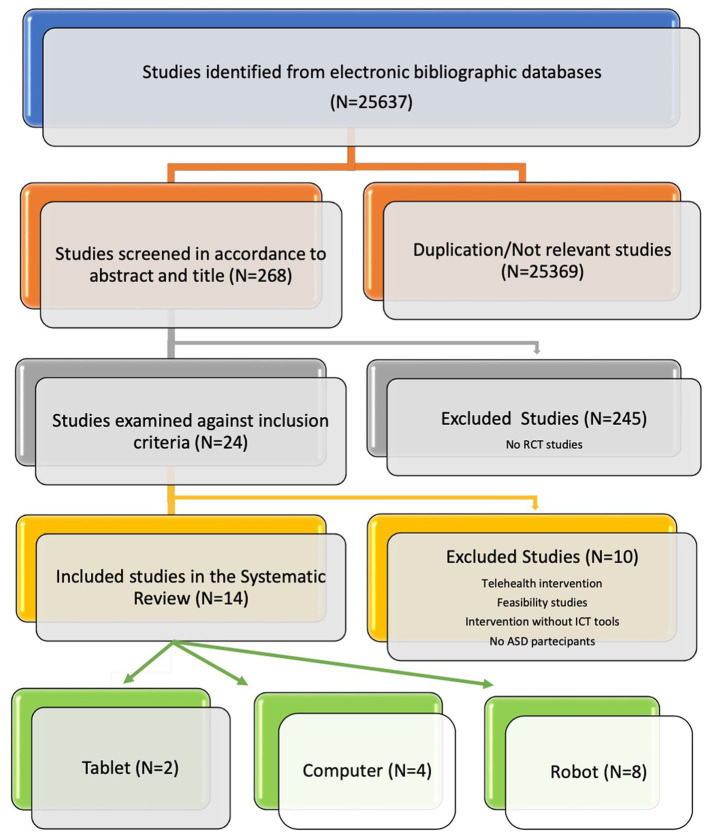
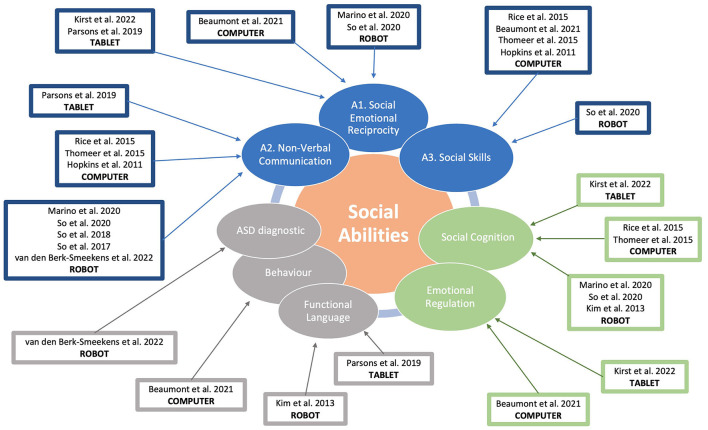
Information and communication technologies (ICTs) have become more widely used in the past years to help people with autism spectrum conditions (ASC). Serious games embedded into computers or tablets, as well as social robots, are the most employed ICT-related tools that are appealing to and appropriate for autistic children. The goal of ICT applications is to enhance behavioral abnormalities associated with ASC while also creating an interactive link between one person and one computer. Comparatively, to human-based therapy, ICT tools aid to inspire autistic children by providing predictability and regularity of tasks. Regaining social skills is the primary behavioral goal for which ICT tools have been designed and implemented. In the past several years, many studies have been created to show how effective it is at improving targeted behaviors. However, only a small number of researchers have used an RCT approach to evaluate its effectiveness. In this systematic review, we only included RCT studies where ICT technologies were used to help children with ASC in improving their social skills. Only 14 RCT studies satisfied the criteria and 12 described significant improvements, showing how the use of technology in educational contexts produced better improvement in developing several social skill facets with respect to the traditional face-to-face approach. Some studies used interventions and outcome measures focused on the core ASC symptoms, but many others addressed neurocognitive functions directly, like social cognition or emotional regulation, while other more general functions such as language or adaptive behaviors. We propose a classification based on processes and outcome measures to foster future research in this specific area of research. The behavioral intervention mediated by technological tools such as computer-based, tablet, and social robotics, undoubtedly provides a comfortable environment that promotes constant learning for people with ASC. Evidence provided in this review highlights the translational potential of this field of study in primary care practice and educational settings.
在过去几年中,信息通信技术(ICT)已被更广泛地用于帮助患有自闭症谱系障碍(ASC)的人群。嵌入计算机或平板电脑中的严肃游戏以及社交机器人,是最常用的与ICT相关的工具,对自闭症儿童具有吸引力且适用。ICT应用的目标是改善与ASC相关的行为异常,同时在人与计算机之间建立互动链接。相比之下,与基于人的治疗方法相比,ICT工具通过提供任务的可预测性和规律性来帮助激发自闭症儿童的兴趣。恢复社交技能是设计和实施ICT工具的主要行为目标。在过去几年中,已经开展了许多研究来表明其在改善目标行为方面的有效性。然而,只有少数研究人员采用随机对照试验(RCT)方法来评估其有效性。在本系统评价中,我们仅纳入了使用ICT技术帮助ASC儿童提高社交技能的RCT研究。只有14项RCT研究符合标准,其中12项描述了显著改善,表明在教育环境中使用技术相对于传统面对面方法在发展多个社交技能方面产生了更好的改善。一些研究使用了针对ASC核心症状的干预措施和结果测量方法,但许多其他研究直接涉及神经认知功能,如社会认知或情绪调节,而其他更一般的功能,如语言或适应性行为。我们提出了一种基于过程和结果测量的分类方法,以促进该特定研究领域的未来研究。由基于计算机、平板电脑和社交机器人等技术工具介导的行为干预,无疑为ASC患者提供了一个促进持续学习的舒适环境。本评价中提供的证据突出了该研究领域在初级保健实践和教育环境中的转化潜力。