Wang Youlin, Liu Jing, Wang Yongchen
Department of Dermatology, The Second Affiliated Hospital of Harbin Medical University, Harbin, Heilongjiang, China.
General Practice Department, The Second Affiliated Hospital of Harbin Medical University, Harbin, Heilongjiang, China.
Front Cell Dev Biol. 2023 Jul 24;11:1166308. doi: 10.3389/fcell.2023.1166308. eCollection 2023.
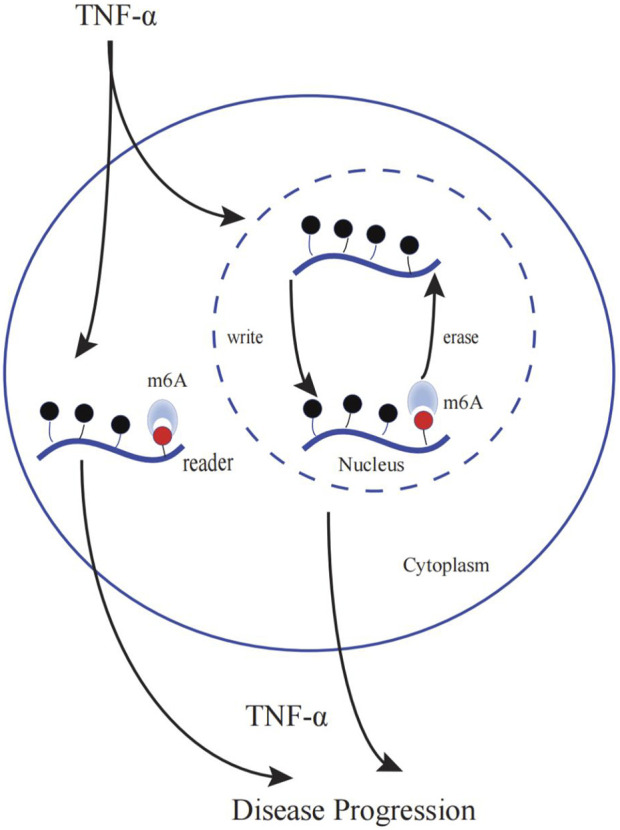
Tumor Necrosis Factor-alpha (TNF-α) is ubiquitous in the human body and plays a significant role in various physiological and pathological processes. However, TNF-α-induced diseases remain poorly understood with limited efficacy due to the intricate nature of their mechanisms. N6-methyladenosine (m6A) methylation, a prevalent type of epigenetic modification of mRNA, primarily occurs at the post-transcriptional level and is involved in intranuclear and extranuclear mRNA metabolism. Evidence suggests that m6A methylation participates in TNF-α-induced diseases and signaling pathways associated with TNF-α. This review summarizes the involvement of TNF-α and m6A methylation regulators in various diseases, investigates the impact of m6A methylation on TNF-α-induced diseases, and puts forth potential therapeutic targets for treating TNF-α-induced diseases.
肿瘤坏死因子-α(TNF-α)在人体中广泛存在,在各种生理和病理过程中发挥着重要作用。然而,由于其机制复杂,TNF-α诱导的疾病仍了解甚少,疗效有限。N6-甲基腺苷(m6A)甲基化是mRNA一种普遍的表观遗传修饰类型,主要发生在转录后水平,并参与核内和核外mRNA代谢。有证据表明,m6A甲基化参与了TNF-α诱导的疾病以及与TNF-α相关的信号通路。本综述总结了TNF-α和m6A甲基化调节因子在各种疾病中的作用,研究了m6A甲基化对TNF-α诱导疾病的影响,并提出了治疗TNF-α诱导疾病的潜在治疗靶点。