Jenkins Edward, Whitehead Toby, Fellermeyer Martin, Davis Simon J, Sharma Sumana
Kennedy Institute of Rheumatology, University of Oxford, Oxford OX3 7FY, UK.
Medical Research Council Human Immunology Unit, John Radcliffe Hospital, University of Oxford, Oxford OX3 9DS, UK.
Oxf Open Immunol. 2023 Jul 8;4(1):iqad006. doi: 10.1093/oxfimm/iqad006. eCollection 2023.
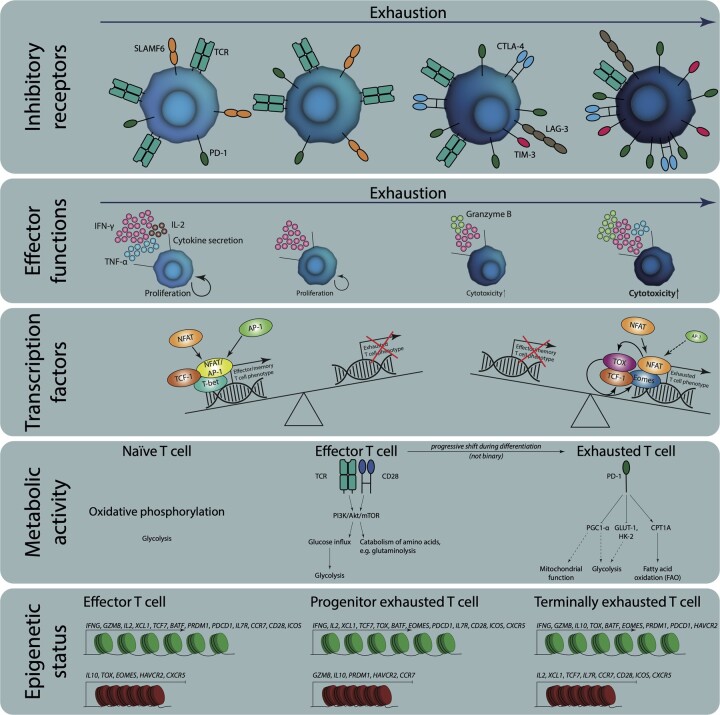
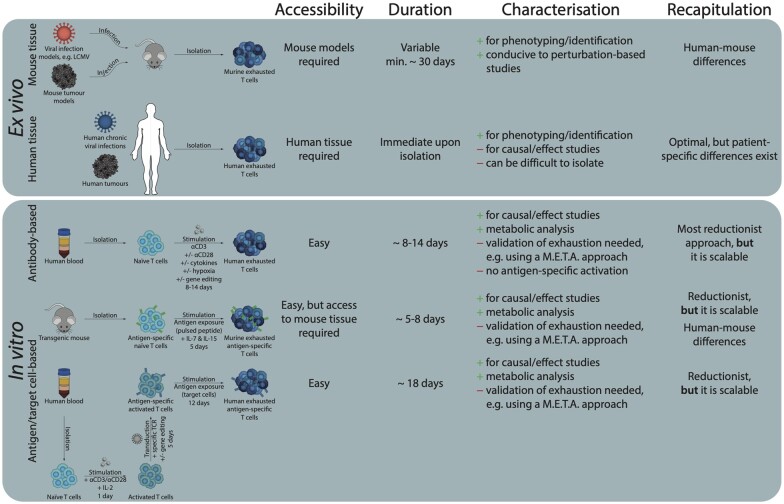
'Exhaustion' is a term used to describe a state of native and redirected T-cell hypo-responsiveness resulting from persistent antigen exposure during chronic viral infections or cancer. Although a well-established phenotype across mice and humans, exhaustion at the molecular level remains poorly defined and inconsistent across the literature. This is, in part, due to an overreliance on surface receptors to define these cells and explain exhaustive behaviours, an incomplete understanding of how exhaustion arises, and a lack of clarity over whether exhaustion is the same across contexts, e.g. chronic viral infections versus cancer. With the development of systems-based genetic approaches such as single-cell RNA-seq and CRISPR screens applied to data, we are moving closer to a consensus view of exhaustion, although understanding how it arises remains challenging given the difficulty in manipulating the setting. Accordingly, producing and studying exhausted T-cells are burgeoning, allowing experiments to be conducted at scale up and with high throughput. Here, we first review what is currently known about T-cell exhaustion and how it's being studied. We then discuss how improvements in their method of isolation/production and examining the impact of different microenvironmental signals and cell interactions have now become an active area of research. Finally, we discuss what the future holds for the analysis of this physiological condition and, given the diversity of ways in which exhausted cells are now being generated, propose the adoption of a unified approach to clearly defining exhaustion using a set of metabolic-, epigenetic-, transcriptional-, and activation-based phenotypic markers, that we call 'M.E.T.A'.
“耗竭”是一个用于描述在慢性病毒感染或癌症期间由于持续暴露于抗原而导致的天然和重定向T细胞低反应性状态的术语。尽管在小鼠和人类中这是一种已被充分证实的表型,但在分子水平上的耗竭在文献中仍定义不明确且不一致。部分原因在于过度依赖表面受体来定义这些细胞并解释耗竭行为,对耗竭如何产生的理解不完整,以及对于在不同背景下(例如慢性病毒感染与癌症)耗竭是否相同缺乏清晰认识。随着基于系统的遗传方法(如单细胞RNA测序和应用于数据的CRISPR筛选)的发展,我们正朝着对耗竭的共识观点迈进,尽管鉴于操纵相关环境的困难,理解其产生机制仍然具有挑战性。相应地,产生和研究耗竭T细胞的工作正在蓬勃发展,使得能够大规模且高通量地进行实验。在此,我们首先回顾目前关于T细胞耗竭的已知信息以及它是如何被研究的。然后我们讨论其分离/产生方法的改进以及研究不同微环境信号和细胞相互作用的影响如何成为一个活跃的研究领域。最后,我们讨论对这种生理状态进行分析的未来发展方向,并且鉴于目前产生耗竭细胞的方式多种多样,我们建议采用一种统一的方法,使用一组基于代谢、表观遗传、转录和激活的表型标记来明确定义耗竭,我们将其称为“M.E.T.A”。