Department of Breast and Thyroid Surgery, Second Affiliated Hospital of Chongqing Medical University, Chongqing, China.
Front Endocrinol (Lausanne). 2023 Jul 24;14:1154984. doi: 10.3389/fendo.2023.1154984. eCollection 2023.
To screen out the predictors and establish a prediction model of positive fine needle aspiration biopsy (FNAB) in the Chinese Guidelines for Malignant Risk Stratification of Thyroid Nodule Ultrasound (C-TIRADS) 4 thyroid nodules, and this nomogram can help clinicians evaluate the risk of positive FNAB and determine if FNAB is necessary.
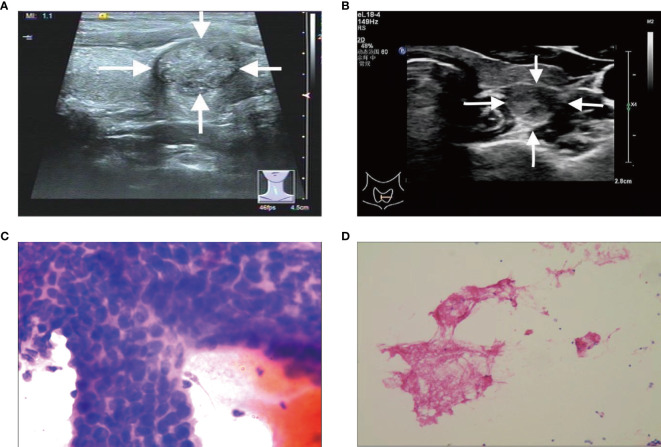
We retrospectively analyzed data from 547 patients who had C-TIRADS 4 thyroid nodules and underwent fine-needle aspiration biopsy (FNAB) at the Second Affiliated Hospital of Chongqing Medical University between November 30, 2021 and September 5, 2022. Patients who met our inclusion criteria were divided into two groups based on positive or negative FNAB results. We compared their ultrasound (US) features, BRAF V600E status, thyroid function, and other general characteristics using univariate and multivariate logistic regression analyses to identify independent predictors. These predictors were then used to construct a nomogram. The calibration plot, area under the curve (AUC), and decision curve analysis were employed to evaluate the calibration, discrimination, and clinical utility of the prediction model.
Out of 547 patients, 39.3% (215/547) had a positive result on fine-needle aspiration biopsy (FNAB), while 60.7% (332/547) had a negative result. Univariate logistic regression analysis revealed no significant differences in TPOAb, TgAb, TSH, Tg, nodule location, sex, or solid status between the two groups (P>0.05). However, age, nodule size, internal or surrounding blood flow signal, microcalcifications, aspect ratio, morphology, and low echo showed significant differences (P<0.05). Multivariate logistic regression analysis was conducted to explore the correlation between potential independent predictors. The results showed that only age (OR=0.444, 95% Cl=0.2960.666, P<0.001), low echo (OR=3.549, 95% Cl=2.3195.432, P<0.001), microcalcifications (OR=2.531, 95% Cl=1.6613.856, P<0.001), aspect ratio (OR=3.032, 95% Cl=1.8195.052, P<0.001), and morphology (OR=2.437, 95% Cl=1.586~3.745, P<0.001) were independent predictors for a positive FNAB. These variables were used to construct a prediction nomogram. An ROC curve analysis was performed to assess the accuracy of the nomogram, and AUC=0.793, which indicated good discrimination and decision curve analysis demonstrated clinical significance within a threshold range of 14% to 91%.
In conclusion, 5 independent predictors of positive FNAB, including age (≤45 years old), low echo (yes), microcalcifications (yes), aspect ratio (>1) and morphology (irregular), were identified. A nomogram was established based on the above 5 predictors, and the nomogram can be used as a complementary basis to help clinicians make decisions on FNAB of C-TI-RADS 4 thyroid nodules.
筛选出中国甲状腺结节超声恶性危险分层(C-TIRADS)4 级甲状腺结节行细针抽吸活检(FNAB)阳性的预测指标,并建立预测模型,该诺模图有助于临床医生评估 FNAB 阳性的风险,确定是否需要进行 FNAB。
回顾性分析 2021 年 11 月 30 日至 2022 年 9 月 5 日在重庆医科大学第二附属医院行 C-TIRADS 4 级甲状腺结节 FNAB 的 547 例患者的资料。根据 FNAB 阳性或阴性结果,将符合纳入标准的患者分为两组。采用单因素和多因素 logistic 回归分析比较两组的超声(US)特征、BRAF V600E 状态、甲状腺功能及其他一般特征,以确定独立的预测因素。然后,使用这些预测因素构建一个诺模图。使用校准图、曲线下面积(AUC)和决策曲线分析来评估预测模型的校准、判别和临床实用性。
547 例患者中,39.3%(215/547)FNAB 阳性,60.7%(332/547)FNAB 阴性。单因素 logistic 回归分析显示,两组间 TPOAb、TgAb、TSH、Tg、结节位置、性别或实性状态差异无统计学意义(P>0.05)。然而,年龄、结节大小、内部或周围血流信号、微钙化、纵横比、形态和低回声差异有统计学意义(P<0.05)。多因素 logistic 回归分析探讨了潜在的独立预测因素之间的相关性。结果显示,只有年龄(OR=0.444,95%Cl=0.2960.666,P<0.001)、低回声(OR=3.549,95%Cl=2.3195.432,P<0.001)、微钙化(OR=2.531,95%Cl=1.6613.856,P<0.001)、纵横比(OR=3.032,95%Cl=1.8195.052,P<0.001)和形态(OR=2.437,95%Cl=1.586~3.745,P<0.001)是 FNAB 阳性的独立预测因素。这些变量被用于构建预测诺模图。ROC 曲线分析评估了该诺模图的准确性,AUC=0.793,表明其具有良好的判别能力,决策曲线分析显示在 14%至 91%的阈值范围内具有临床意义。
总之,本研究确定了 5 个与 C-TI-RADS 4 级甲状腺结节 FNAB 阳性相关的独立预测因素,包括年龄(≤45 岁)、低回声(是)、微钙化(是)、纵横比(>1)和形态(不规则)。基于上述 5 个预测因素建立了一个诺模图,该诺模图可作为补充依据,帮助临床医生对 C-TIRADS 4 级甲状腺结节行 FNAB 做出决策。