Mashamaite Lefentse, Lebre Pedro H, Varliero Gilda, Maphosa Silindile, Ortiz Max, Hogg Ian D, Cowan Don A
Department of Biochemistry, Genetics and Microbiology, Centre for Microbial Ecology and Genomics, University of Pretoria, Pretoria, South Africa.
Rhizosphere Processes Group, Swiss Federal Research Institute WSL, Birmensdorf, Switzerland.
Front Microbiol. 2023 Jul 24;14:1203216. doi: 10.3389/fmicb.2023.1203216. eCollection 2023.
The Antarctic McMurdo Dry Valleys are geologically diverse, encompassing a wide variety of soil habitats. These environments are largely dominated by microorganisms, which drive the ecosystem services of the region. While altitude is a well-established driver of eukaryotic biodiversity in these Antarctic ice-free areas (and many non-Antarctic environments), little is known of the relationship between altitude and microbial community structure and functionality in continental Antarctica.
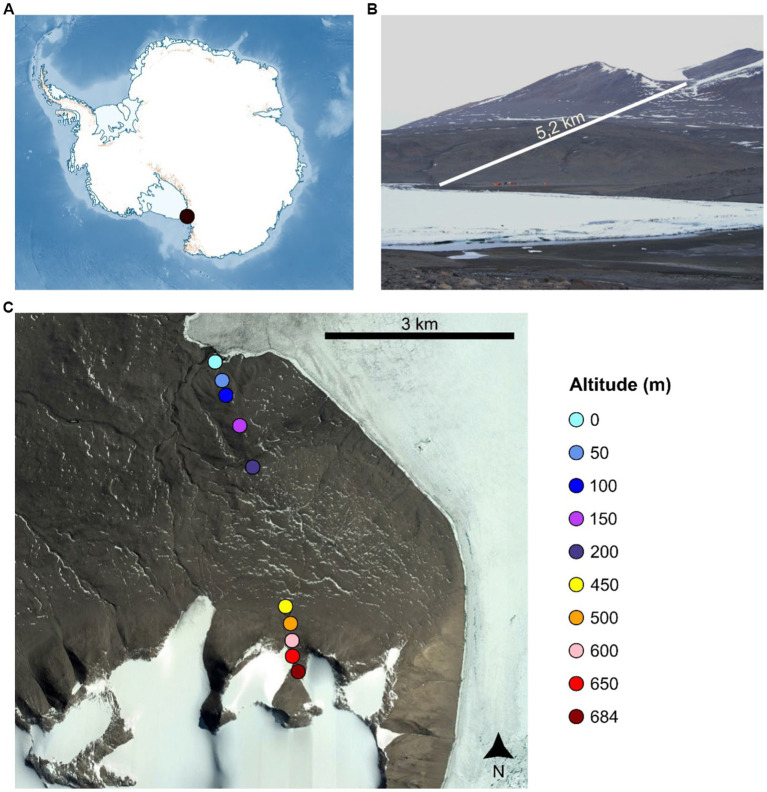
We analysed prokaryotic and lower eukaryotic diversity from soil samples across a 684 m altitudinal transect in the lower Taylor Valley, Antarctica and performed a phylogenic characterization of soil microbial communities using short-read sequencing of the 16S rRNA and ITS marker gene amplicons.
Phylogenetic analysis showed clear altitudinal trends in soil microbial composition and structure. Cyanobacteria were more prevalent in higher altitude samples, while the highly stress resistant Chloroflexota and Deinococcota were more prevalent in lower altitude samples. We also detected a shift from Basidiomycota to Chytridiomycota with increasing altitude. Several genera associated with trace gas chemotrophy, including and , were widely distributed across the entire transect, suggesting that trace-gas chemotrophy may be an important trophic strategy for microbial survival in oligotrophic environments. The ratio of trace-gas chemotrophs to photoautotrophs was significantly higher in lower altitude samples. Co-occurrence network analysis of prokaryotic communities showed some significant differences in connectivity within the communities from different altitudinal zones, with cyanobacterial and trace-gas chemotrophy-associated taxa being identified as potential keystone taxa for soil communities at higher altitudes. By contrast, the prokaryotic network at low altitudes was dominated by heterotrophic keystone taxa, thus suggesting a clear trophic distinction between soil prokaryotic communities at different altitudes. Based on these results, we conclude that altitude is an important driver of microbial ecology in Antarctic ice-free soil habitats.
南极麦克默多干谷地质多样,包含多种土壤栖息地。这些环境主要由微生物主导,微生物驱动着该地区的生态系统服务。虽然海拔是这些南极无冰地区(以及许多非南极环境)真核生物多样性的一个公认驱动因素,但对于南极大陆海拔与微生物群落结构及功能之间的关系却知之甚少。
我们分析了南极泰勒谷下游一个684米海拔梯度样带土壤样本中的原核生物和低等真核生物多样性,并使用16S rRNA和ITS标记基因扩增子的短读测序对土壤微生物群落进行了系统发育特征分析。
系统发育分析表明,土壤微生物组成和结构存在明显的海拔梯度趋势。蓝细菌在高海拔样本中更为普遍,而高度抗逆的绿弯菌门和异常球菌-栖热菌门在低海拔样本中更为普遍。我们还检测到随着海拔升高,担子菌门向壶菌门转变。几个与微量气体化学营养相关的属,包括[具体属名缺失]和[具体属名缺失],在整个样带中广泛分布,这表明微量气体化学营养可能是贫营养环境中微生物生存的一种重要营养策略。低海拔样本中微量气体化学营养菌与光合自养菌的比例显著更高。原核生物群落的共现网络分析表明,不同海拔区域群落内部的连通性存在一些显著差异,蓝细菌和与微量气体化学营养相关的分类群被确定为高海拔土壤群落的潜在关键类群。相比之下,低海拔的原核生物网络由异养关键类群主导,因此表明不同海拔的土壤原核生物群落之间存在明显的营养差异。基于这些结果,我们得出结论,海拔是南极无冰土壤栖息地微生物生态学的一个重要驱动因素。