Bradford Institute for Health Research, Bradford Teaching Hospitals NHS Foundation Trust, Bradford Royal Infirmary, Bradford, West Yorkshire, United Kingdom.
Faculty of Health Studies, University of Bradford, Bradford, West Yorkshire, United Kingdom.
PLoS One. 2023 Aug 9;18(8):e0289831. doi: 10.1371/journal.pone.0289831. eCollection 2023.
Increased time at home during the COVID-19 pandemic significantly decreased children's physical activity. This systematic review aimed to evaluate the effectiveness of children's home-based physical activity interventions, and identify 'active ingredients' underpinning these.
Databases searched-AMED, PsychINFO, CINAHL, Cochrane, EMBASE, PubMed/Medline, Scopus, SPORTDiscus and Web of Science, from inception until June 2022. Eligibility criteria-children aged 2-16 years, targeting home-based physical activity, a control group, and physical activity measured pre- and post- intervention. Studies were excluded if it was not possible to identify change in physical activity at home. The review was written following the Preferred Reporting Items for Systematic Reviews and Meta-Analyses (PRISMA) guidance. Study quality was evaluated using the quality assessment tool for quantitative studies. Study design, intervention characteristics, outcome data, behavior change theory, Behavior Change Techniques (BCTs) and process evaluation data were extracted and discussed using narrative syntheses.
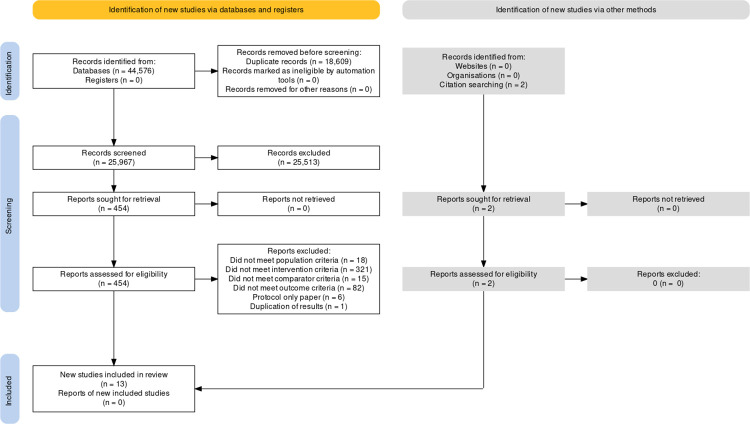
13 studies (including 1,182 participants) from 25,967 were included. Interventions primarily involved active video games, with the addition of coaching or telehealth support (n = 5). Three of the 13 studies significantly increased children's physical activity (1 = Moderate to vigorous physical activity, 2 = total volume, P<0.05). The largest effect size (d = 3.45) was for moderate to vigorous physical activity. 29% of BCTs were identified across included interventions; the most common being adding objects to the environment. The most effective intervention scored strong for design quality, incorporated telehealth coaching, and included the most commonly coded BCTs. Variation among studies and insufficient reporting of data made a meta-analysis unfeasible.
COVID-19 emphasized the importance of the home for physical activity. Whilst effectiveness of interventions was limited, building social support and self-efficacy are mechanisms that should be explored further. The review provides recommendations to improve the design and evaluation of future interventions.
Prospero registration number: CRD42020193110.
在 COVID-19 大流行期间,儿童居家时间大幅增加,导致其身体活动量减少。本系统评价旨在评估儿童居家身体活动干预的效果,并确定这些干预措施的“有效成分”。
检索数据库-AMED、PsychINFO、CINAHL、Cochrane、EMBASE、PubMed/Medline、Scopus、SPORTDiscus 和 Web of Science,时间从建库起至 2022 年 6 月。纳入标准-年龄为 2-16 岁的儿童,以居家身体活动为目标,设置对照组,且干预前后测量身体活动量。如果无法确定居家身体活动量的变化,则排除该研究。本研究遵循系统评价和荟萃分析的首选报告项目(PRISMA)指南进行。使用定量研究质量评估工具评估研究质量。提取并讨论研究设计、干预特征、结局数据、行为改变理论、行为改变技术(BCTs)和过程评估数据,采用叙述性综合方法进行讨论。
纳入了 25967 篇文献中的 13 项研究(共 1182 名参与者)。干预措施主要涉及体感游戏,外加教练指导或远程医疗支持(n=5)。13 项研究中有 3 项显著增加了儿童的身体活动量(1=中高强度身体活动,2=总活动量,P<0.05)。最大的效应量(d=3.45)是中高强度身体活动。纳入的干预措施中共确定了 29%的 BCTs,最常见的是增加环境中的物体。最有效的干预措施在设计质量方面得分较高,采用了远程医疗指导,并包含了最常编码的 BCTs。研究间存在差异,且数据报告不充分,使得无法进行荟萃分析。
COVID-19 强调了家庭在身体活动中的重要性。尽管干预措施的效果有限,但建立社会支持和自我效能感是需要进一步探索的机制。本综述为未来干预措施的设计和评估提供了建议。
Prospero 注册号:CRD42020193110。