Department of Psychology, Manchester Metropolitan University, Manchester M15 6BH, United Kingdom.
Brain and Cognitive Sciences Department, Massachusetts Institute of Technology, Cambridge, MA 02139, United States.
Cereb Cortex. 2023 Sep 26;33(19):10380-10400. doi: 10.1093/cercor/bhad289.
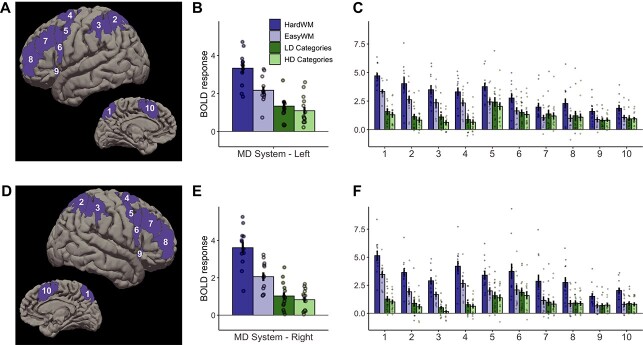
The relationship between language and thought is the subject of long-standing debate. One claim states that language facilitates categorization of objects based on a certain feature (e.g. color) through the use of category labels that reduce interference from other, irrelevant features. Therefore, language impairment is expected to affect categorization of items grouped by a single feature (low-dimensional categories, e.g. "Yellow Things") more than categorization of items that share many features (high-dimensional categories, e.g. "Animals"). To test this account, we conducted two behavioral studies with individuals with aphasia and an fMRI experiment with healthy adults. The aphasia studies showed that selective low-dimensional categorization impairment was present in some, but not all, individuals with severe anomia and was not characteristic of aphasia in general. fMRI results revealed little activity in language-responsive brain regions during both low- and high-dimensional categorization; instead, categorization recruited the domain-general multiple-demand network (involved in wide-ranging cognitive tasks). Combined, results demonstrate that the language system is not implicated in object categorization. Instead, selective low-dimensional categorization impairment might be caused by damage to brain regions responsible for cognitive control. Our work adds to the growing evidence of the dissociation between the language system and many cognitive tasks in adults.
语言和思维之间的关系是一个长期存在的争论话题。有一种观点认为,语言通过使用类别标签来促进基于某个特征(例如颜色)对物体进行分类,从而减少其他不相关特征的干扰。因此,语言障碍预计会影响基于单个特征(低维类别,例如“黄色物体”)进行的物品分类,而不是影响基于多个特征(高维类别,例如“动物”)进行的物品分类。为了验证这一说法,我们进行了两项针对失语症患者的行为研究和一项针对健康成年人的 fMRI 实验。失语症研究表明,选择性的低维分类障碍存在于一些严重命名障碍患者中,但并非所有患者都存在,且并非一般失语症的特征。fMRI 结果显示,在进行低维和高维分类时,语言反应区域的活动都很少;相反,分类任务会激活一般性的多重需求网络(涉及广泛的认知任务)。综合结果表明,语言系统与物体分类无关。相反,选择性的低维分类障碍可能是由于负责认知控制的大脑区域受损所致。我们的工作增加了越来越多的证据,证明在成年人中,语言系统与许多认知任务之间存在分离。