Stony Brook University, 101 Nicolls Road, Stony Brook, NY, 11794-8343, USA.
Francis I. Proctor Foundation, University of California, San Francisco, 490 Illinois Street, 2nd Floor, San Francisco, CA, 94110, USA.
BMC Public Health. 2023 Aug 9;23(1):1511. doi: 10.1186/s12889-023-16425-w.
Quality surveillance data used to build tuberculosis (TB) transmission models are frequently unavailable and may overlook community intrinsic dynamics that impact TB transmission. Social network analysis (SNA) generates data on hyperlocal social-demographic structures that contribute to disease transmission.
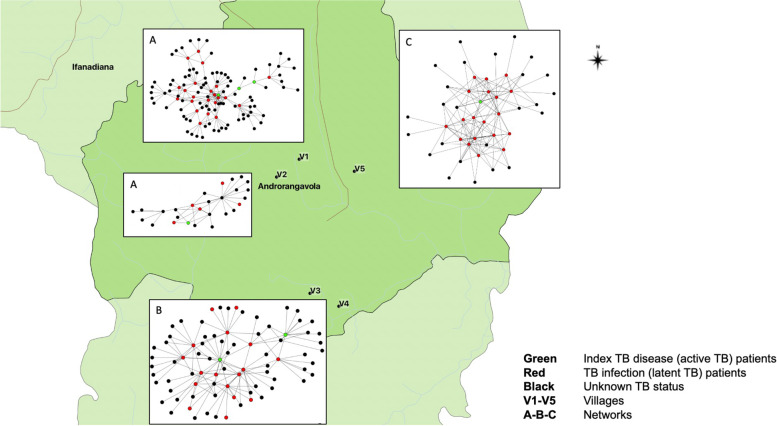
We collected social contact data in five villages and built SNA-informed village-specific stochastic TB transmission models in remote Madagascar. A name-generator approach was used to elicit individual contact networks. Recruitment included confirmed TB patients, followed by snowball sampling of named contacts. Egocentric network data were aggregated into village-level networks. Network- and individual-level characteristics determining contact formation and structure were identified by fitting an exponential random graph model (ERGM), which formed the basis of the contact structure and model dynamics. Models were calibrated and used to evaluate WHO-recommended interventions and community resiliency to foreign TB introduction.
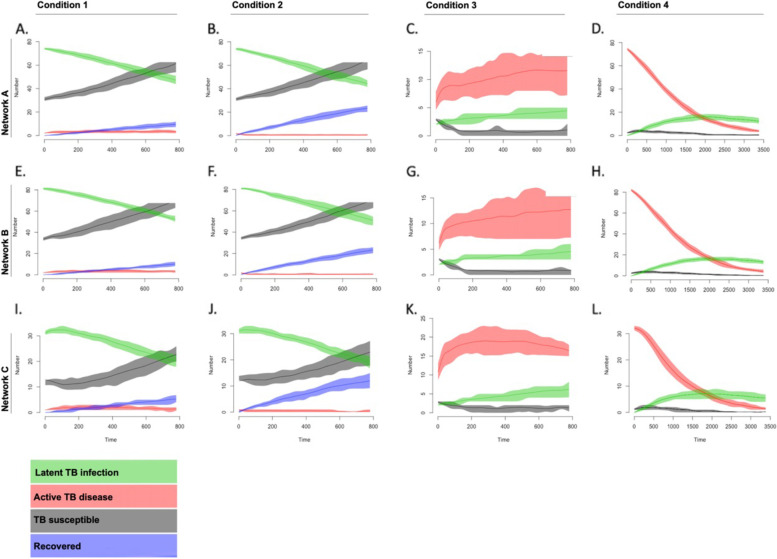
Inter- and intra-village SNA showed variable degrees of interconnectivity, with transitivity (individual clustering) values of 0.16, 0.29, and 0.43. Active case finding and treatment yielded 67%-79% reduction in active TB disease prevalence and a 75% reduction in TB mortality in all village networks. Following hypothetical TB elimination and without specific interventions, networks A and B showed resilience to both active and latent TB reintroduction, while Network C, the village network with the highest transitivity, lacked resiliency to reintroduction and generated a TB prevalence of 2% and a TB mortality rate of 7.3% after introduction of one new contagious infection post hypothetical elimination.
In remote Madagascar, SNA-informed models suggest that WHO-recommended interventions reduce TB disease (active TB) prevalence and mortality while TB infection (latent TB) burden remains high. Communities' resiliency to TB introduction decreases as their interconnectivity increases. "Top down" population level TB models would most likely miss this difference between small communities. SNA bridges large-scale population-based and hyper focused community-level TB modeling.
用于构建结核病(TB)传播模型的质量监测数据通常不可用,并且可能忽略了影响 TB 传播的社区内在动态。社会网络分析(SNA)生成有关超局部社会人口结构的数据,这些结构有助于疾病传播。
我们在五个村庄收集了社会接触数据,并在马达加斯加偏远地区建立了基于 SNA 的特定村庄随机 TB 传播模型。使用名称生成器方法来获取个人接触网络。招募包括确诊的 TB 患者,然后对命名的接触者进行雪球抽样。将个体网络数据汇总为村庄级网络。通过拟合指数随机图模型(ERGM)确定确定接触形成和结构的网络和个体特征,该模型是接触结构和模型动态的基础。对模型进行校准,并用于评估世界卫生组织推荐的干预措施和社区对外国 TB 传入的恢复力。
村际和村内 SNA 显示出不同程度的互联性,个体聚类的传递性(transitivity)值分别为 0.16、0.29 和 0.43。主动病例发现和治疗使所有村庄网络中的活动性 TB 疾病患病率降低了 67%-79%,TB 死亡率降低了 75%。在假设消除 TB 之后,如果没有具体的干预措施,网络 A 和 B 对活动性和潜伏性 TB 的重新引入都具有恢复力,而网络 C 是具有最高传递性的村庄网络,缺乏重新引入的恢复力,在假设消除后引入一个新的传染性感染后,网络 C 的 TB 患病率为 2%,TB 死亡率为 7.3%。
在马达加斯加偏远地区,基于 SNA 的模型表明,世界卫生组织推荐的干预措施可降低 TB 疾病(活动性 TB)的患病率和死亡率,而 TB 感染(潜伏性 TB)负担仍然很高。随着社区互联性的增加,社区对 TB 传入的恢复力下降。“自上而下”的人群 TB 模型很可能会忽略小社区之间的这种差异。SNA 弥合了大规模人群为基础和超聚焦社区级 TB 建模之间的差距。