Lydia Becker Institute of Immunology and Inflammation, Faculty of Biology Medicine and Health, The University of Manchester, Manchester, UK.
J Exp Med. 2022 Sep 5;219(9). doi: 10.1084/jem.20221183. Epub 2022 Aug 16.
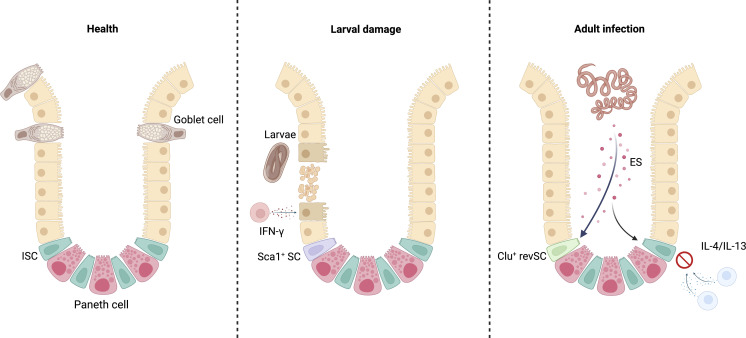
Helminth parasites are well known to have co-evolved a diverse arsenal of immunomodulatory factors to aid their persistence following infection. In this issue, Karo-Atar et al. (2022. J. Exp. Med.https://doi.org/10.1084/jem.20212311) demonstrate that products released by the gut-dwelling helminth Heligmosomoides polygyrus barkeri modify intestinal stem cells into a "revival" state, which is associated with a loss of helminth-expelling secretory cell types from the epithelium.
寄生虫与宿主共同进化出了多样化的免疫调节因子,以帮助它们在感染后持续存在。在本期《实验医学杂志》中,Karo-Atar 等人(2022. J. Exp. Med.https://doi.org/10.1084/jem.20212311)表明,肠道寄生虫 Heligmosomoides polygyrus barkeri 释放的产物将肠道干细胞转变为“复苏”状态,这与上皮层中驱逐寄生虫的分泌细胞类型的丧失有关。