Tsoukos Athanasios, Bogdanis Gregory C
School of Physical Education and Sport Science, National & Kapodistrian University of Athens, Athens, Greece.
J Hum Kinet. 2023 Jul 15;87:119-129. doi: 10.5114/jhk/168792. eCollection 2023 Jul.
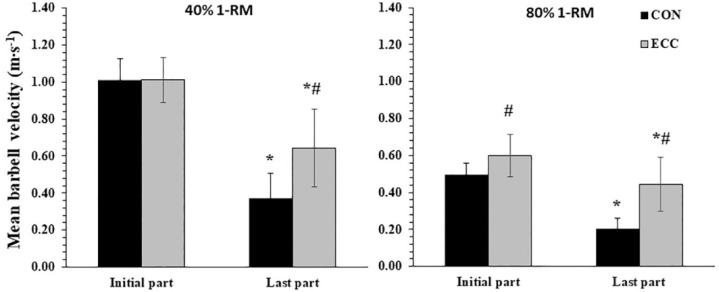
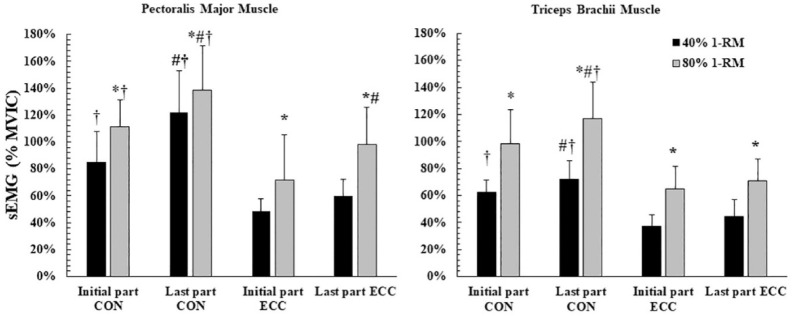
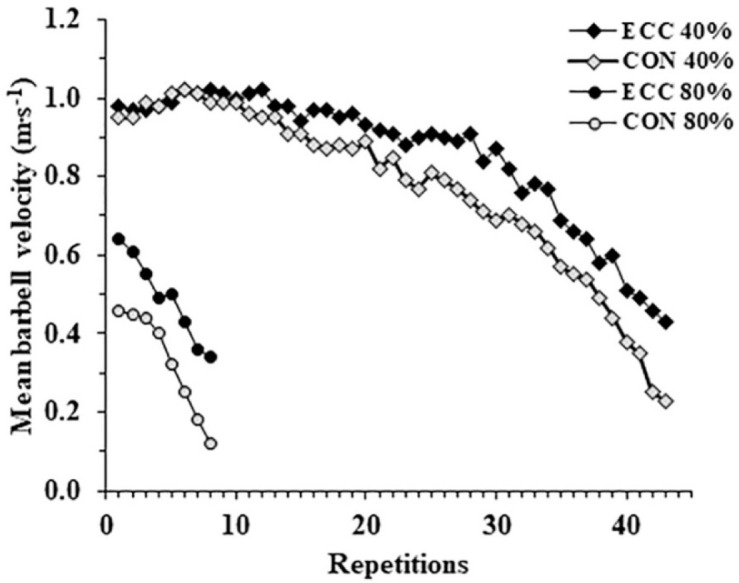
We examined changes in barbell velocity and surface electromyographic activity (sEMG) during the concentric (CON) and eccentric (ECC) phases of a bench press set. Ten men executed a set to instant exhaustion as fast as possible, against a low (40% 1-RM) and a heavy load (80% 1-RM), one week apart. The reduction in mean barbell velocity was lower in the ECC compared with the CON phase for both loads (40%1-RM: ECC: -36 ± 21% vs. CON: -63 ± 14%, p < 0.001; 80%1-RM: ECC: -26 ± 15% vs. CON: -59 ± 9%, p < 0.001). Under both loading conditions, sEMG activity of the pectoralis major increased in the last compared to the first repetitions only in the CON phase (by 48.6% and 24.8%, p < 0.01, in the 40% and 80%1-RM, respectively). Similarly, triceps brachii sEMG increased by 15.7% (p = 0.02) and by 21.0% (p < 0.001) during the CON phase in the 40% and 80%1-RM conditions, respectively. However, during the ECC phase, sEMG remained unchanged in the last part of the set for both muscles and loads except for 80%1-RM in the pectoralis major muscle. It was concluded that fatigue measured by velocity loss was lower during the ECC than the CON phase of the bench press movement, when the exercise was performed with maximum velocity to failure, irrespective of the load. sEMG was lower in the ECC than the CON phase for all loads, and increased at the end of the set only during the CON phase, while it remained relatively unchanged in the ECC phase, with the exception of the pectoralis muscle when the load was heavier.
我们研究了卧推组向心(CON)和离心(ECC)阶段杠铃速度和表面肌电图活动(sEMG)的变化。10名男性分别在一周内,以低负荷(40%1-RM)和重负荷(80%1-RM)尽可能快地进行一组动作直至即刻疲劳。两种负荷下,离心阶段杠铃平均速度的降低幅度均低于向心阶段(40%1-RM:离心阶段:-36±21%,向心阶段:-63±14%,p<0.001;80%1-RM:离心阶段:-26±15%,向心阶段:-59±9%,p<0.001)。在两种负荷条件下,仅在向心阶段,胸大肌的sEMG活动在最后一次重复时相较于第一次重复有所增加(40%1-RM时增加48.6%,80%1-RM时增加24.8%,p<0.01)。同样,在40%和80%1-RM条件下,肱三头肌的sEMG在向心阶段分别增加了15.7 %(p = 0.02)和21.0%(p<0.001)。然而,在离心阶段,除了胸大肌在80%1-RM负荷时,两种肌肉和负荷在该组动作的最后部分sEMG均保持不变。研究得出结论,当以最大速度进行卧推动作直至疲劳时,无论负荷如何,通过速度损失衡量的疲劳在离心阶段低于向心阶段。所有负荷下离心阶段的sEMG均低于向心阶段,且仅在向心阶段该组动作结束时增加,而在离心阶段保持相对不变,重负荷时胸大肌除外。