Tsoukos Athanasios, Brown Lee E, Veligekas Panagiotis, Terzis Gerasimos, Bogdanis Gregory C
School of Physical Education and Sports Science, National & Kapodistrian University of Athens, Athens Greece.
Human Performance Laboratory, California State University, Fullerton, Fullerton, CA, USA.
J Hum Kinet. 2019 Aug 21;68:81-98. doi: 10.2478/hukin-2019-0058. eCollection 2019 Aug.
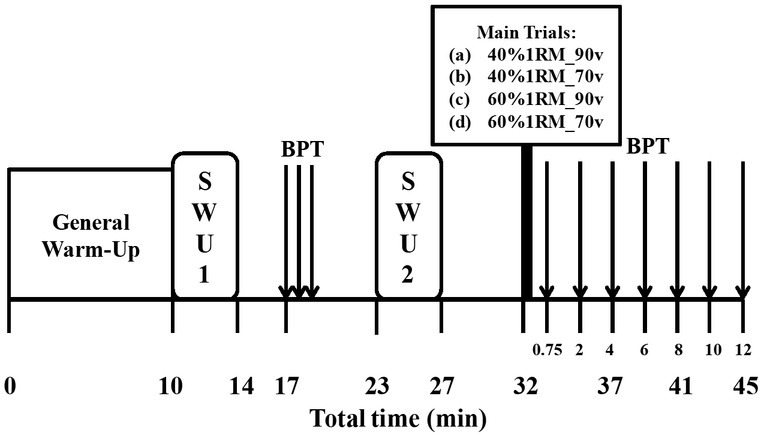
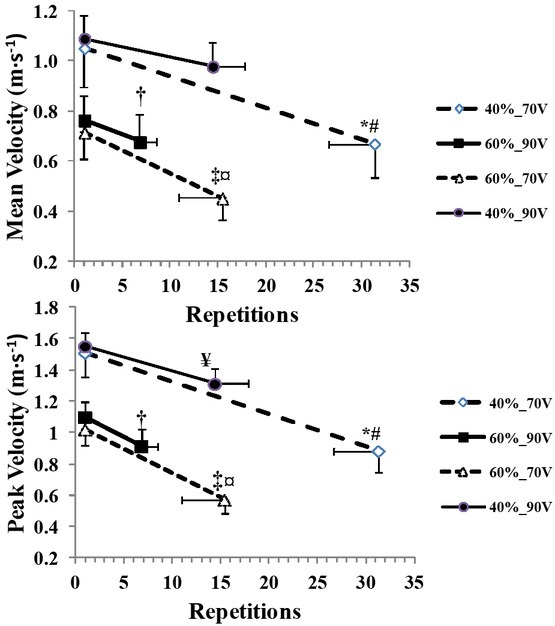
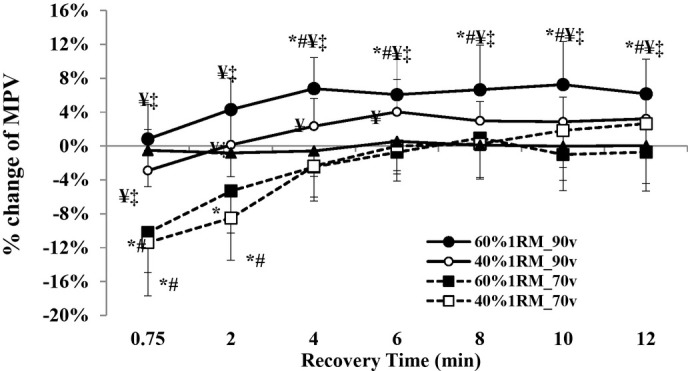
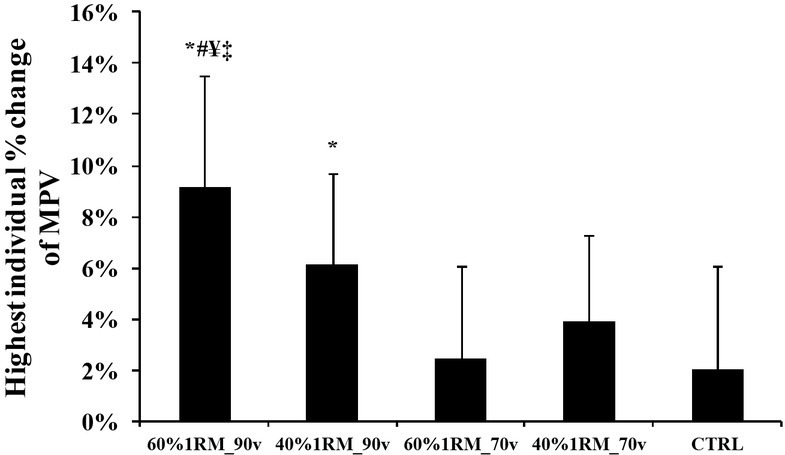
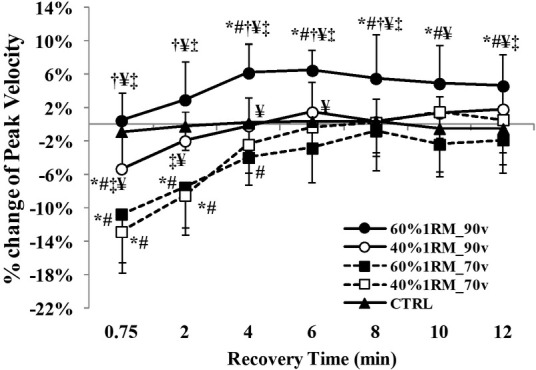
This study examined the acute effects of the bench press exercise with low and moderate loads as well as with two predetermined movement velocity loss percentages on bench press throw performance and surface electromyographic (sEMG) activity. Ten trained men completed 5 main trials in randomized and counterbalanced order one week apart. Mean propulsive velocity (MPV), peak velocity (PV) and sEMG activity of prime movers were evaluated before and periodically for 12 minutes of recovery under five conditions: using loads of 40 or 60% of 1 RM, until mean velocity dropped to 90 or 70%, as well as a control condition (CTRL). MPV and PV were increased 4-12 min into recovery by 4.5-6.8% only after the 60%1RM condition during which velocity dropped to 90% and total exercise volume was the lowest of all conditions (p < 0.01, Hedges' g = 0.8-1.7). When peak individual responses were calculated irrespective of time, MPV was increased by 9.2 ± 4.4 (p < 0.001, Hedges' g = 1.0) and 6.1 ± 3.6% (p < 0.001, Hedges' g = 0.7) under the two conditions with the lowest total exercise volume irrespective of the load, i.e. under the conditions of 40 and 60% 1RM where velocity was allowed to drop to 90%. sEMG activity of the triceps was significantly greater when peak individual responses were taken into account only under the 60%1RM condition when velocity dropped to 90% (p < 0.05, Hedges' g = 0.4). This study showed that potentiation may be maximized by taking into account individual fatigue profiles using velocity-based training.
本研究考察了低负荷和中等负荷卧推练习以及两种预定运动速度损失百分比对卧推投掷性能和表面肌电图(sEMG)活动的急性影响。10名受过训练的男性以随机和平衡的顺序,每隔一周完成5次主要试验。在五种条件下,分别在运动前以及恢复的12分钟内定期评估平均推进速度(MPV)、峰值速度(PV)和原动肌的sEMG活动:使用1RM的40%或60%的负荷,直到平均速度降至90%或70%,以及一个对照条件(CTRL)。仅在60%1RM条件下,即速度降至90%且总运动量在所有条件中最低的情况下,恢复4 - 12分钟时MPV和PV增加了4.5 - 6.8%(p < 0.01,Hedges' g = 0.8 - 1.7)。当不考虑时间计算个体峰值反应时,在总运动量最低的两种条件下,无论负荷如何,即1RM的40%和60%且速度允许降至90%的条件下,MPV分别增加了9.2 ± 4.4(p < 0.001,Hedges' g = 1.0)和6.1 ± 3.6%(p < 0.001,Hedges' g = 0.7)。仅在60%1RM条件下,即速度降至90%时,考虑个体峰值反应时肱三头肌的sEMG活动显著更大(p < 0.05,Hedges' g = 0.4)。本研究表明,通过基于速度的训练考虑个体疲劳情况,可能使增强效果最大化。