Dartmouth College, Thayer School of Engineering, Hanover, New Hampshire, United States.
University of Wisconsin-Madison, Department of Medical Physics, Madison, Wisconsin, United States.
J Biomed Opt. 2023 Aug;28(8):080901. doi: 10.1117/1.JBO.28.8.080901. Epub 2023 Aug 8.
Radiation damage studies are used to optimize radiotherapy treatment techniques. Although biological indicators of damage are the best assays of effect, they are highly variable due to biological heterogeneity. The free radical radiochemistry can be assayed with optical reporters, allowing for high precision titration of techniques.
We examine the optical reporters of radiochemistry to highlight those with the best potential for translational use , as surrogates for biological damage assays, to inform on mechanisms.
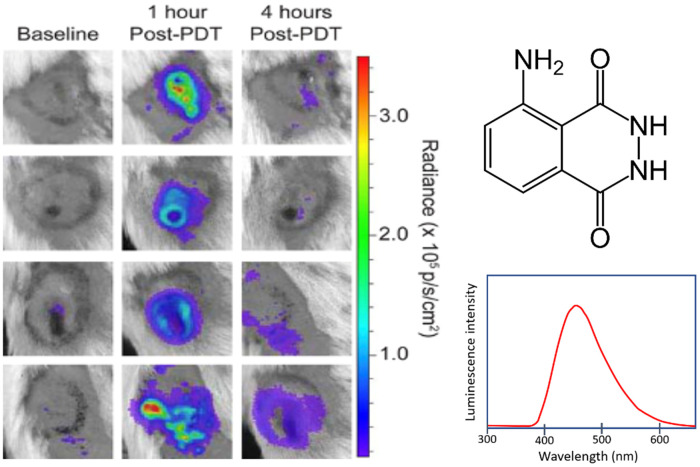
A survey of the radical chemistry effects from reactive oxygen species (ROS) and oxygen itself was completed to link to DNA or biological damage. Optical reporters of ROS include fluorescent, phosphorescent, and bioluminescent molecules that have a variety of activation pathways, and each was reviewed for its translation potential.
There are molecular reporters of ROS having potential to report within living systems, including derivatives of luminol, 2'7'-dichlorofluorescein diacetate, Amplex Red, and fluorescein. None have unique specificity to singular ROS species. Macromolecular engineered reporters unique to specific ROS are emerging. The ability to directly measure oxygen via reporters, such as Oxyphor and protoporphyrin IX, is an opportunity to quantify the consumption of oxygen during ROS generation, and this translates from to use. Emerging techniques, such as ion particle beams, spatial fractionation, and ultra-high dose rate FLASH radiotherapy, provide the motivation for these studies.
optical reporters of radiochemistry are quantitatively useful for comparing radiotherapy techniques, although their use comes at the cost of the unknown connection to the mechanisms of radiobiological damage. Still their lower measurement uncertainty, compared with biological response assay, makes them an invaluable tool. Linkage to DNA damage and biological damage is needed, and measures such as oxygen consumption serve as useful surrogate measures that translate to use.
辐射损伤研究用于优化放射治疗技术。虽然损伤的生物学指标是评估效应的最佳检测方法,但由于生物学异质性,这些指标变化很大。自由基放射化学可以用光学报告物来检测,从而可以高精度滴定技术。
我们检查放射化学的光学报告物,以突出那些最有潜力用于转化的报告物,作为生物学损伤检测的替代物,以了解机制。
对来自活性氧(ROS)和氧气本身的自由基化学效应进行了调查,以将其与 DNA 或生物损伤联系起来。ROS 的光学报告物包括具有各种激活途径的荧光、磷光和生物发光分子,每种分子的转化潜力都进行了综述。
有一些 ROS 的分子报告物具有在活体内报告的潜力,包括发光氨、2'7'-二氯荧光素二乙酸酯、Amplex Red 和荧光素的衍生物。没有一种报告物对单一 ROS 具有独特的特异性。针对特定 ROS 的大分子工程报告物正在出现。通过报告物直接测量氧气的能力,例如 Oxyphor 和原卟啉 IX,为量化 ROS 生成过程中氧气的消耗提供了机会,这从转化研究到临床应用。新兴技术,如离子粒子束、空间分割和超高剂量率 FLASH 放射治疗,为这些研究提供了动力。
放射化学的光学报告物对于比较放射治疗技术是定量有用的,尽管它们的使用是以未知与放射生物学损伤机制的联系为代价的。然而,与生物学反应测定相比,它们的测量不确定性较低,这使它们成为非常有价值的工具。需要与 DNA 损伤和生物损伤建立联系,而诸如氧气消耗等措施则可以作为有用的替代指标,适用于临床应用。