Iida Atsuyoshi, Saito Shinya, Hamada Jun, Nakamura Shunsuke, Nojima Tsuyoshi, Naito Hiromichi, Mikane Takeshi
Department of Emergency, Critical Care, and Disaster Medicine, Okayama University Graduate School of Medicine Dentistry and Pharmaceutical Sciences, Okayama, Japan.
Graduate School of Health Sciences, Okayama University Graduate School of Medicine Dentistry and Pharmaceutical Sciences, Okayama, Japan.
JMA J. 2023 Jul 14;6(3):284-291. doi: 10.31662/jmaj.2022-0172. Epub 2023 May 22.
It is essential to establish appropriate medical quality metrics and make improvements to safely and efficiently deliver optimum emergency medical services. The Ministry of Health, Labor and Welfare (MHLW) recommends prefectures to establish numerical quality metrics in their regional healthcare plans (RHCP). The 7th RHCP was issued by the MHLW in 2017 along with a notice of planning in covering the six-year period from 2018 to 2023. In this descriptive study, the emergency medicine policies in the 7th RHCP of each prefecture were analyzed from a quality improvement perspective.
The authors examined the chapters on emergency medicine in the RHCPs of 47 prefectural governments for the overall structure, cost-benefits, and connection to community-based integrated care systems. The type and number of clinical measures listed as numerical metrics and their classification methods were emphasized.
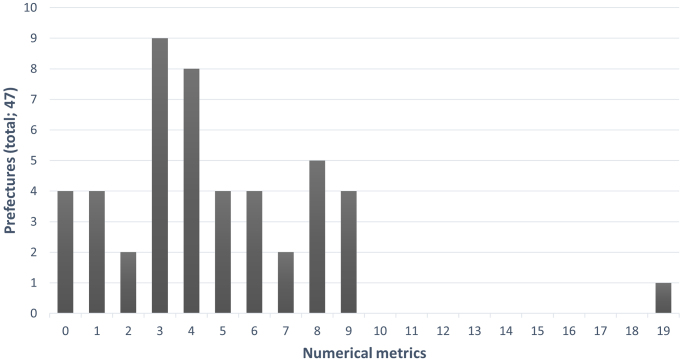
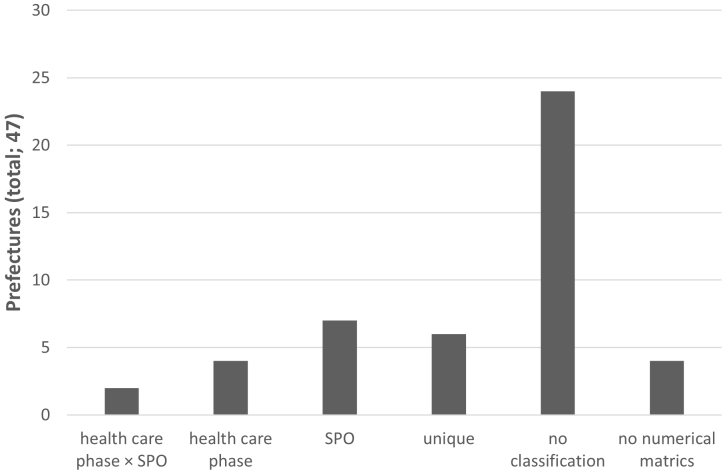
Regarding the overall plan structure, 40 prefectural governments began their description with an analysis of current surroundings. In total, 24 prefectural governments mentioned community-based integrated care systems but none mentioned cost-benefit analysis. Altogether, only 43 of 47 prefectural governments (91%) indicated numerical metrics. The maximum number of numerical targets for quality measures by prefecture was 19, the minimum was 0, and the median was 4 (IQR: 3-6.5); there were 220 metrics in total, with 82 structural, 96 process, and 42 outcome measures. Additionally, 13 prefectures (28%) classified quality measures according to the MHLW's guidance, 6 (13%) used their own classification manner, while the others did not classify their measures.
There were significant differences in emergency medicine policies and quality metrics among the prefectural governments. Further research is needed to develop and establish more comprehensive and appropriate metrics based on a common methodology to improve the quality of emergency medicine.
建立适当的医疗质量指标并加以改进,对于安全、高效地提供最佳紧急医疗服务至关重要。厚生劳动省建议各都道府县在其区域医疗计划(RHCP)中设定数字化质量指标。厚生劳动省于2017年发布了第7版区域医疗计划,并附有一份涵盖2018年至2023年六年期间的规划通知。在这项描述性研究中,从质量改进的角度分析了各都道府县第7版区域医疗计划中的急诊医学政策。
作者研究了47个都道府县政府区域医疗计划中有关急诊医学的章节,以了解其总体结构、成本效益以及与社区综合护理系统的联系。重点关注列为数字化指标的临床措施的类型和数量及其分类方法。
关于总体计划结构,40个都道府县政府在描述时首先分析了当前环境。总共有24个都道府县政府提到了社区综合护理系统,但没有一个提到成本效益分析。在47个都道府县政府中,只有43个(91%)指出了数字化指标。各都道府县质量措施的数字化指标最大数量为19,最小为0,中位数为4(四分位间距:3 - 6.5);总共有220项指标,其中82项为结构指标,96项为过程指标,42项为结果指标。此外,13个都道府县(28%)根据厚生劳动省的指导对质量措施进行了分类,6个(13%)采用了自己的分类方式,而其他都道府县没有对其措施进行分类。
各都道府县政府在急诊医学政策和质量指标方面存在显著差异。需要进一步开展研究,以基于通用方法制定和建立更全面、适当的指标,从而提高急诊医学质量。