Samelska Katarzyna, Szaflik Jacek Paweł, Guszkowska Maria, Kurowska Anna Katarzyna, Zaleska-Żmijewska Anna
Department of Ophthalmology, Medical University of Warsaw, 02-091 Warsaw, Poland.
SPKSO Ophthalmic University Hospital, 00-576 Warsaw, Poland.
Diagnostics (Basel). 2023 Jul 25;13(15):2472. doi: 10.3390/diagnostics13152472.
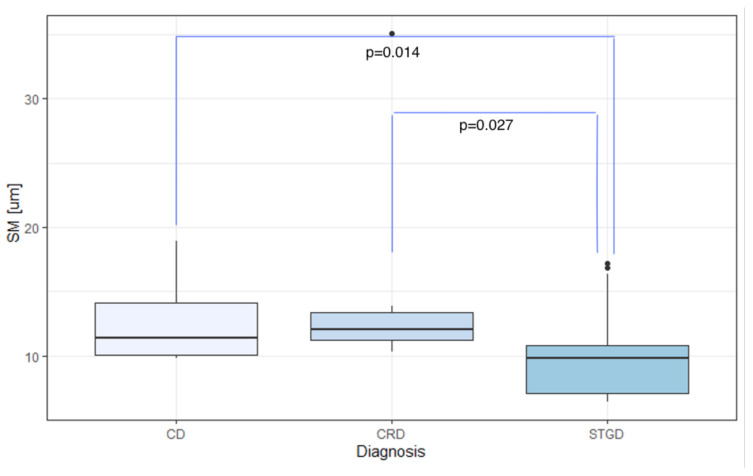
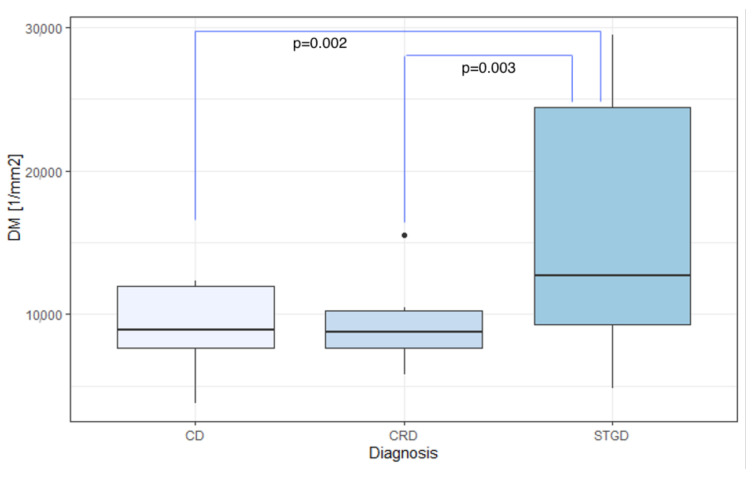
Inherited retinal dystrophies (IRDs) are genetic disorders that lead to the bilateral degeneration of the retina, causing irreversible vision loss. These conditions often manifest during the first and second decades of life, and their primary symptoms can be non-specific. Diagnostic processes encompass assessments of best-corrected visual acuity, fundoscopy, optical coherence tomography, fundus autofluorescence, fluorescein angiography, electrophysiological tests, and genetic testing. This study focuses on the application of adaptive optics (AO), a non-invasive retinal examination, for the assessment of patients with IRDs. AO facilitates the high-quality, detailed observation of retinal photoreceptor structures (cones and rods) and enables the quantitative analysis of parameters such as cone density (DM), cone spacing (SM), cone regularity (REG), and Voronoi analysis (N%6). AO examinations were conducted on eyes diagnosed with Stargardt disease (STGD, N=36), cone dystrophy (CD, N=9), and cone-rod dystrophy (CRD, N=8), and on healthy eyes (N=14). There were significant differences in the DM, SM, REG, and N%6 parameters between the healthy and IRD-affected eyes (p<0.001 for DM, SM, and REG; p=0.008 for N%6). The mean DM in the CD, CRD, and STGD groups was 8900.39/mm2, 9296.32/mm2, and 16,209.66/mm2, respectively, with a significant inter-group difference (p=0.006). The mean SM in the CD, CRD, and STGD groups was 12.37 μm, 14.82 μm, and 9.65 μm, respectively, with a significant difference observed between groups (p=0.002). However, no significant difference was found in REG and N%6 among the CD, CRD, and STGD groups. Significant differences were found in SM and DM between CD and STGD (p=0.014 for SM; p=0.003 for DM) and between CRD and STGD (p=0.027 for SM; p=0.003 for DM). Our findings suggest that AO holds significant potential as an impactful diagnostic tool for IRDs.
遗传性视网膜营养不良(IRDs)是一种遗传性疾病,可导致视网膜双侧变性,造成不可逆的视力丧失。这些病症通常在生命的第一个和第二个十年中出现,其主要症状可能不具有特异性。诊断过程包括最佳矫正视力评估、眼底镜检查、光学相干断层扫描、眼底自发荧光、荧光素血管造影、电生理测试和基因检测。本研究重点关注自适应光学(AO)这一非侵入性视网膜检查方法在IRD患者评估中的应用。AO有助于高质量、详细地观察视网膜光感受器结构(视锥细胞和视杆细胞),并能够对诸如视锥细胞密度(DM)、视锥细胞间距(SM)、视锥细胞规则性(REG)和Voronoi分析(N%6)等参数进行定量分析。对诊断为Stargardt病(STGD,N = 36)、视锥细胞营养不良(CD,N = 9)和视锥 - 视杆细胞营养不良(CRD,N = 8)的眼睛以及健康眼睛(N = 14)进行了AO检查。健康眼睛与受IRD影响的眼睛在DM、SM、REG和N%6参数上存在显著差异(DM、SM和REG的p<0.001;N%6的p = 0.008)。CD、CRD和STGD组的平均DM分别为8900.39/mm²、9296.32/mm²和16209.66/mm²,组间差异显著(p = 0.006)。CD、CRD和STGD组的平均SM分别为12.37μm、14.82μm和9.65μm,组间观察到显著差异(p = 0.002)。然而,CD、CRD和STGD组在REG和N%6方面未发现显著差异。CD与STGD之间以及CRD与STGD之间在SM和DM方面存在显著差异(SM的p = 0.014;DM的p = 0.003)。我们的研究结果表明,AO作为一种对IRD有重要影响的诊断工具具有巨大潜力。