Garcia-Vargas Igor, Louisnard Olivier, Barthe Laurie
Centre RAPSODEE, IMT Mines-Albi, UMR CNRS 5302, Université de Toulouse, 81013 Albi CT, France; Laboratoire de Genie Chimique, Université de Toulouse, CNRS, INPT, UPS, Toulouse, France; SinapTec, 7, Avenue Pierre et Marie Curie, 59260, Lezennes, France.
Centre RAPSODEE, IMT Mines-Albi, UMR CNRS 5302, Université de Toulouse, 81013 Albi CT, France.
Ultrason Sonochem. 2023 Oct;99:106542. doi: 10.1016/j.ultsonch.2023.106542. Epub 2023 Aug 2.
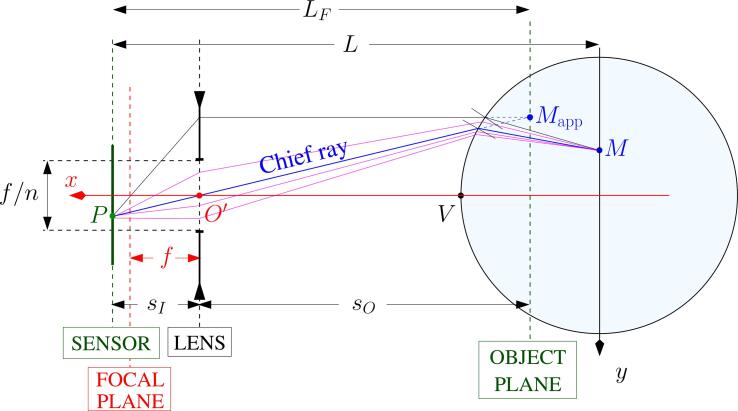
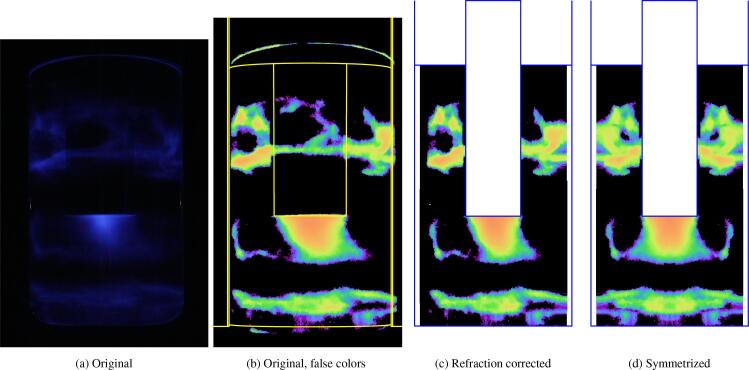
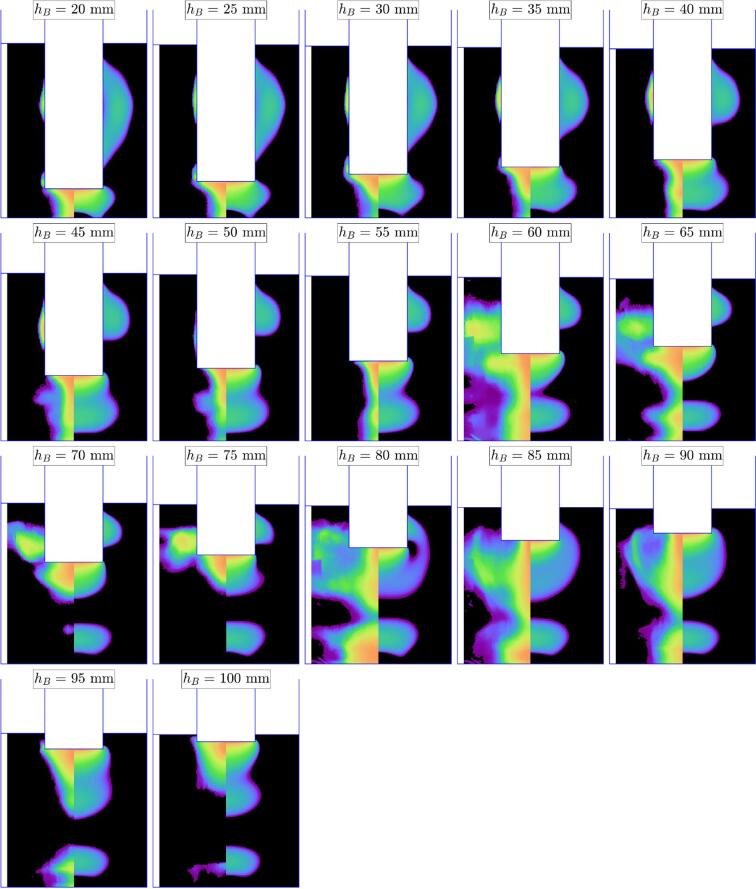
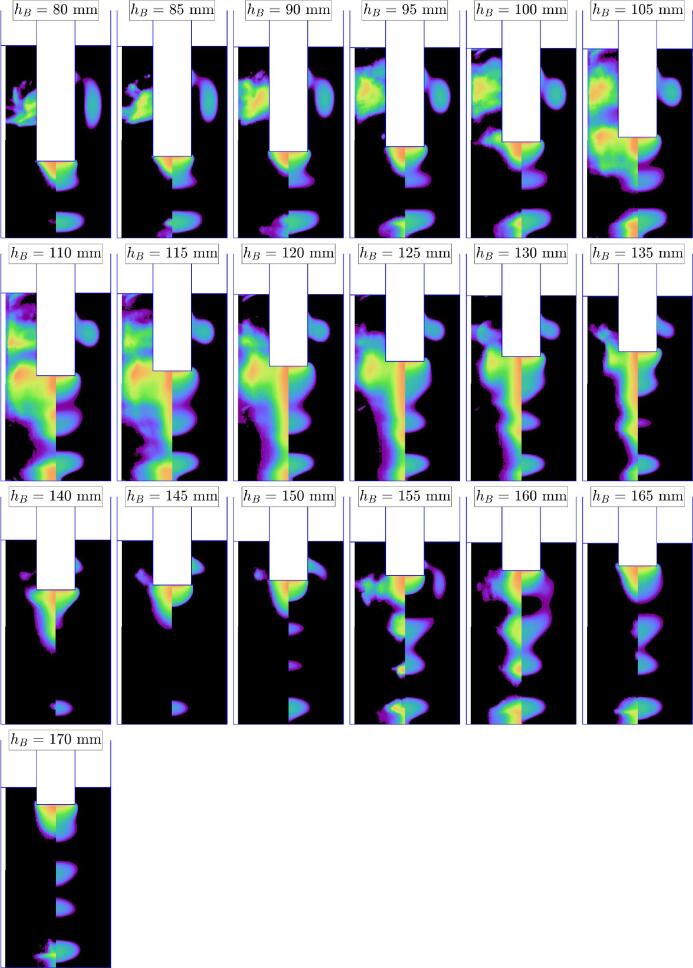
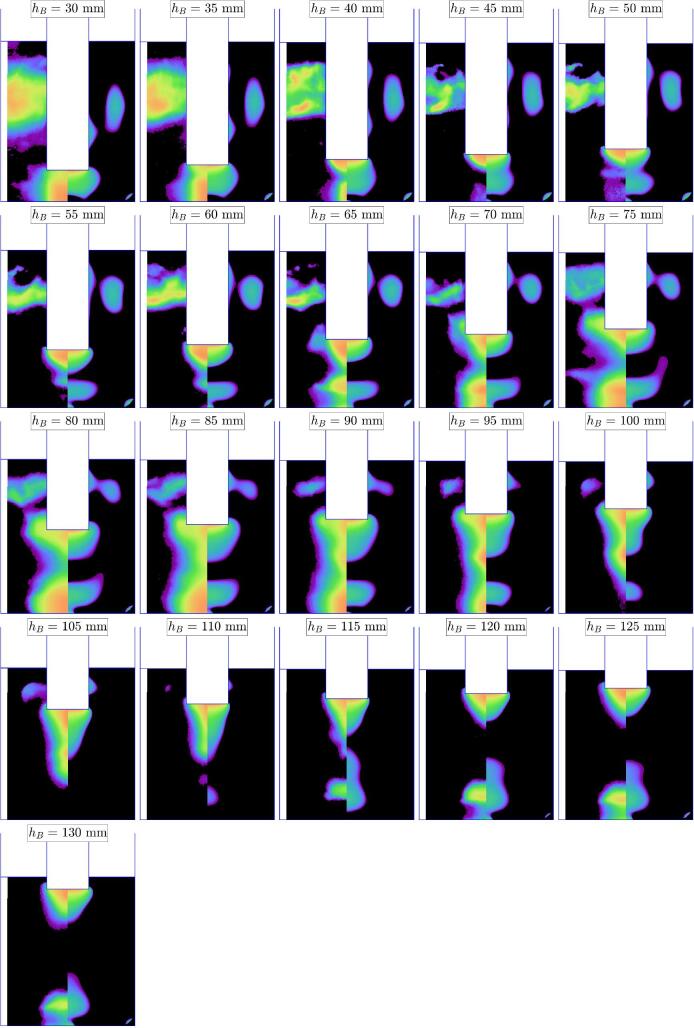
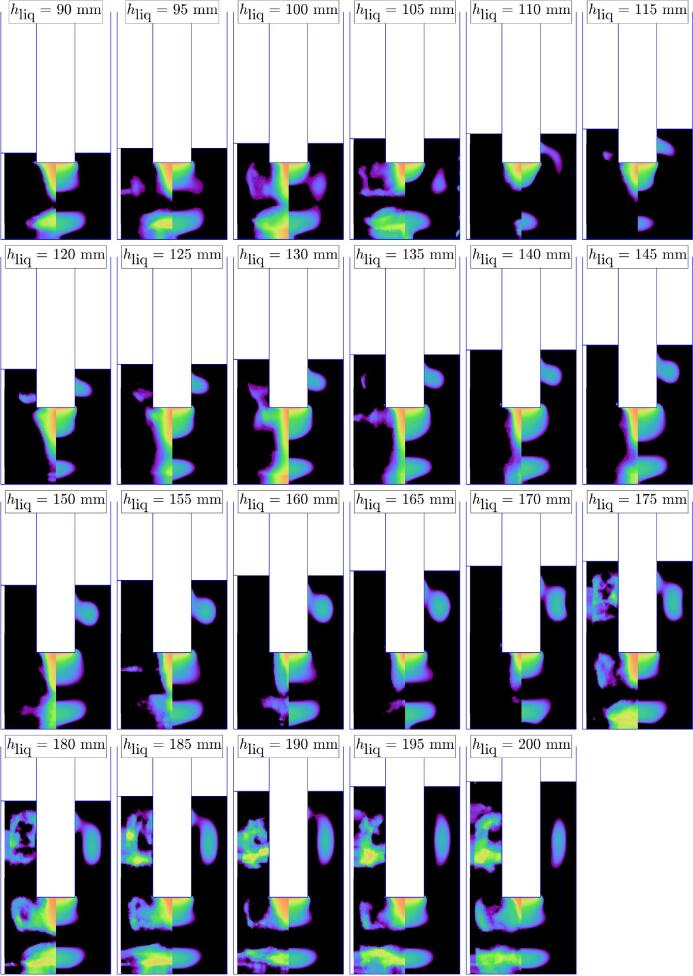
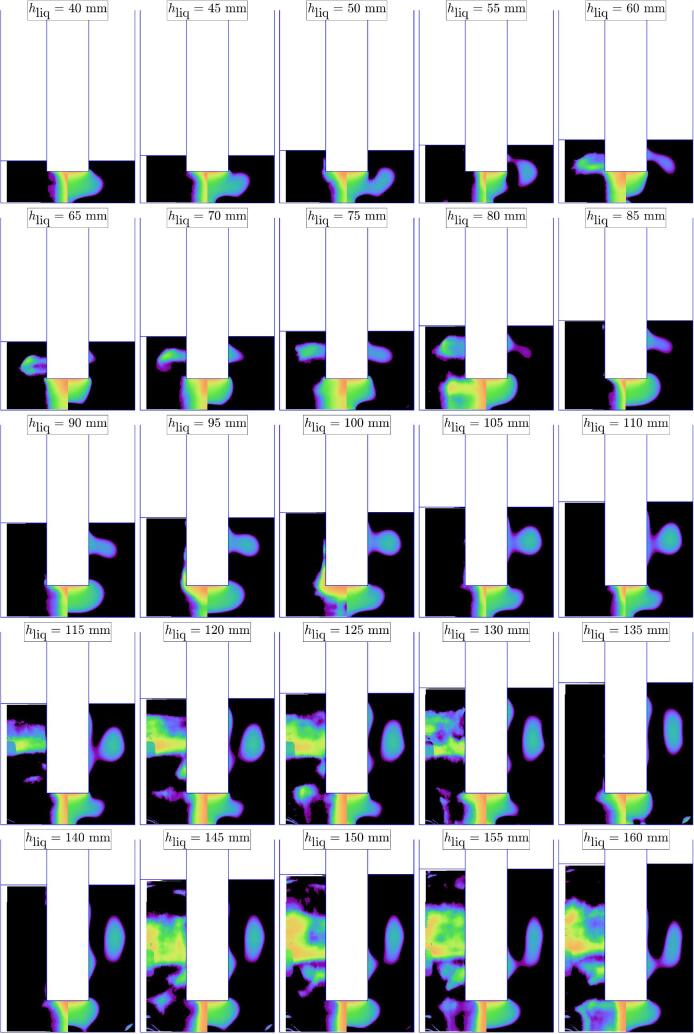
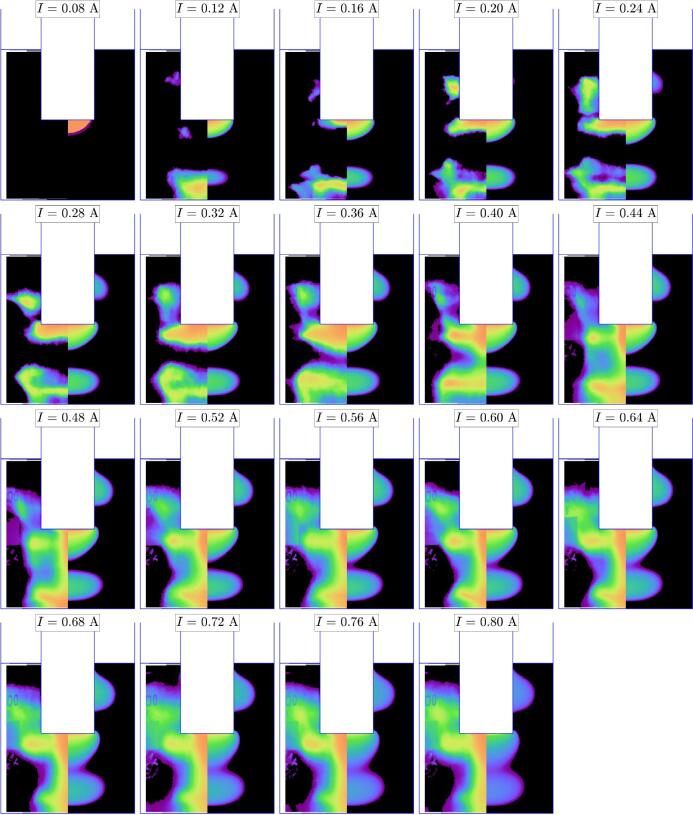
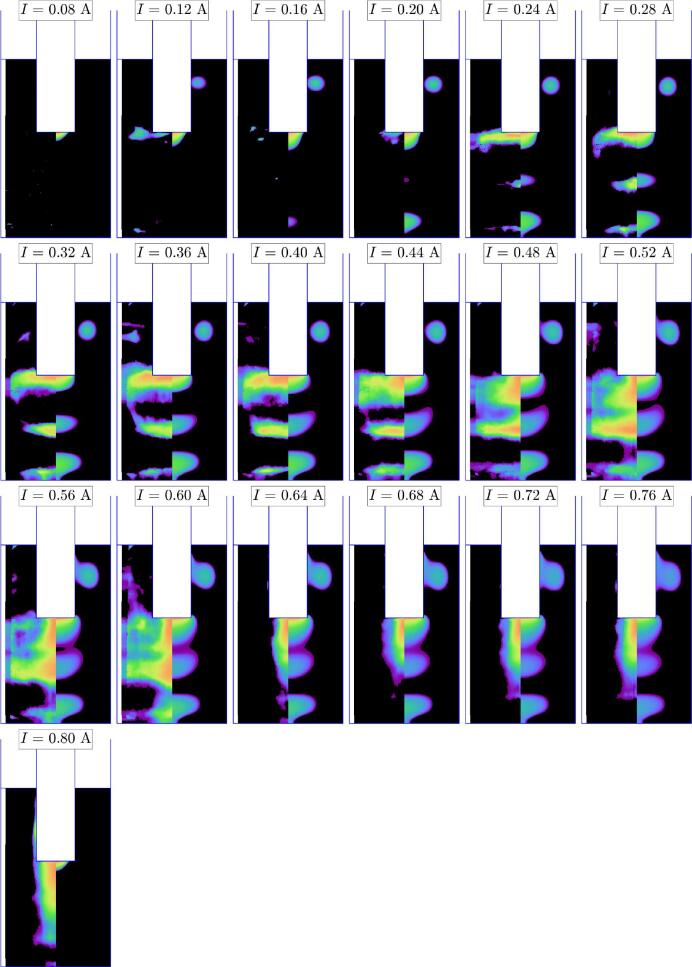
This investigation focuses on the influence of geometric factors on cavitational activity within a 20kHz sonoreactor containing water. Three vessels with different shapes were used, and the transducer immersion depth and liquid height were varied, resulting in a total of 126 experiments conducted under constant driving current. For each one, the dissipated power was quantified using calorimetry, while luminol mapping was employed to identify the shape and location of cavitation zones. The raw images of blueish light emission were transformed into false colors and corrected to compensate for refraction by the water-glass and glass-air interfaces. Additionally, all configurations were simulated using a sonoreactor model that incorporates a nonlinear propagation of acoustic waves in cavitating liquids. A systematic visual comparison between luminol maps and color-plots displaying the computed bubble collapse temperature in bubbly regions was conducted. The calorimetric power exhibited a nearly constant yield of approximately 70% across all experiments, thus validating the transducer command strategy. However, the numerical predictions consistently overestimated the electrical and calorimetric powers by a factor of roughly 2, indicating an overestimation of dissipation in the cavitating liquid model. Geometric variations revealed non-monotonic relationships between transducer immersion depth and dissipated power, emphasizing the importance of geometric effects in sonoreactor. Complex features were revealed by luminol maps, exhibiting appearance, disappearance, and merging of different luminol zones. In certain parametric regions, the luminol bright regions are reminiscent of linear eigenmodes of the water/vessel system. In the complementary parametric space, these structures either combine with, or are obliterated by typical elongated axial structures. The latter were found to coincide with an increased calorimetric power, and are conjectured to result from a strong cavitation field beneath the transducer producing acoustic streaming. Similar methods were applied to an additional set of 57 experiments conducted under constant geometry but with varying current, and suggested that the transition to elongated structures occurs above some amplitude threshold. While the model partially reproduced some experimental observations, further refinement is required to accurately account for the intricate acoustic phenomena involved.
本研究聚焦于几何因素对装有水的20kHz声化学反应器内空化活动的影响。使用了三种不同形状的容器,并改变了换能器浸入深度和液体高度,在恒定驱动电流下共进行了126次实验。对于每次实验,使用量热法对耗散功率进行量化,同时采用鲁米诺映射来确定空化区域的形状和位置。发出蓝光的原始图像被转换为伪彩色,并进行校正以补偿水 - 玻璃和玻璃 - 空气界面的折射。此外,使用一个包含声波在空化液体中非线性传播的声化学反应器模型对所有配置进行了模拟。对鲁米诺图谱与显示气泡区域计算出的气泡崩溃温度的彩色图进行了系统的视觉比较。在所有实验中,量热功率的产率几乎恒定,约为70%,从而验证了换能器指令策略。然而,数值预测始终将电功率和量热功率高估了约2倍,这表明在空化液体模型中对耗散的估计过高。几何变化揭示了换能器浸入深度与耗散功率之间的非单调关系,强调了几何效应在声化学反应器中的重要性。鲁米诺图谱揭示了复杂的特征,不同的鲁米诺区域出现、消失和合并。在某些参数区域,鲁米诺亮区让人联想到水/容器系统的线性本征模。在互补的参数空间中,这些结构要么与典型的细长轴向结构结合,要么被其掩盖。发现后者与量热功率增加相吻合,并推测是由换能器下方产生声流的强空化场导致的。类似的方法应用于另外一组57次实验,这些实验在几何形状恒定但电流变化的情况下进行,结果表明向细长结构的转变发生在某个振幅阈值之上。虽然该模型部分再现了一些实验观察结果,但需要进一步改进以准确解释所涉及的复杂声学现象。