Hans Popper Laboratory of Molecular Hepatology, Division of Gastroenterology and Hepatology, Department of Internal Medicine III, Medical University of Vienna, Vienna, Austria.
Division of Gastroenterology and Hepatology, Department of Internal Medicine III, Medical University of Vienna, Vienna, Austria; CeMM Research Center for Molecular Medicine of the Austrian Academy of Sciences, Vienna, Austria.
Cell Mol Gastroenterol Hepatol. 2023;16(5):847-856. doi: 10.1016/j.jcmgh.2023.08.003. Epub 2023 Aug 10.
BACKGROUND & AIMS: Glucagon-like peptide (GLP)-2 may exert antifibrotic effects on hepatic stellate cells (HSCs). Thus, we aimed to test whether application of the GLP-2 analogue teduglutide has hepatoprotective and antifibrotic effects in the Mdr2/Abcb4 mouse model of sclerosing cholangitis displaying hepatic inflammation and fibrosis.
Mdr2 mice were injected daily for 4 weeks with teduglutide followed by gene expression profiling (bulk liver; isolated HSCs) and immunohistochemistry. Activated HSCs (LX2 cells) and immortalized human hepatocytes and human intestinal organoids were treated with GLP-2. mRNA profiling by reverse transcription polymerase chain reaction and electrophoretic mobility shift assay using cytosolic and nuclear protein extracts was performed.
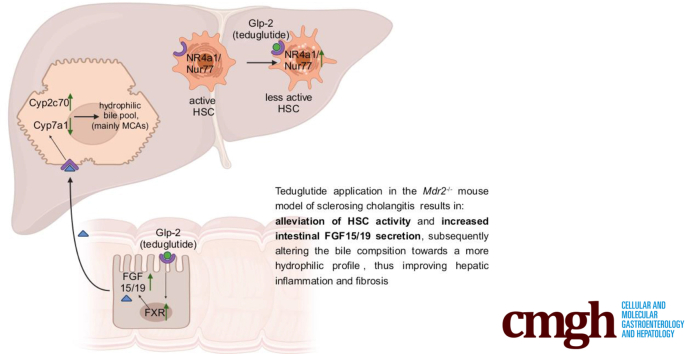
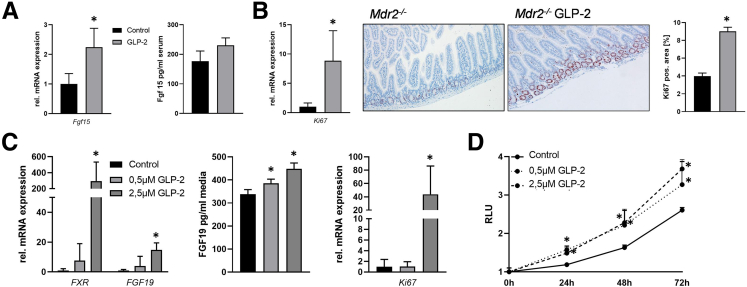
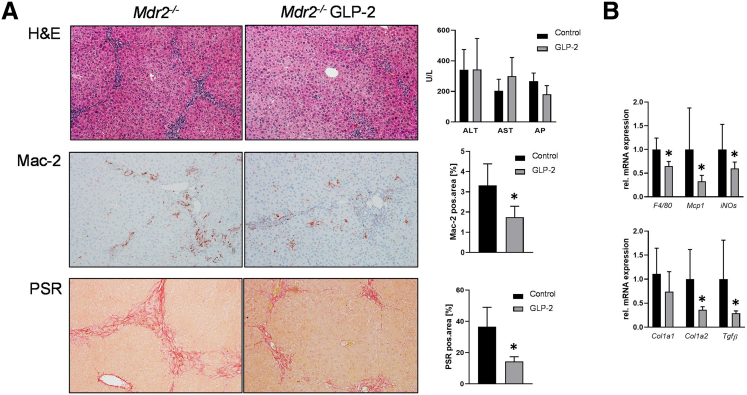
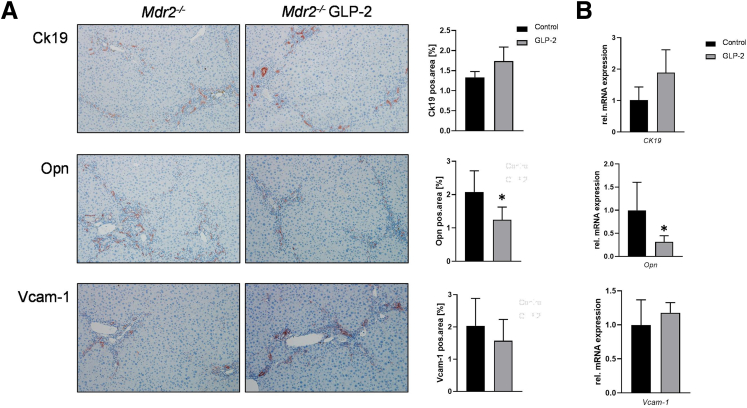
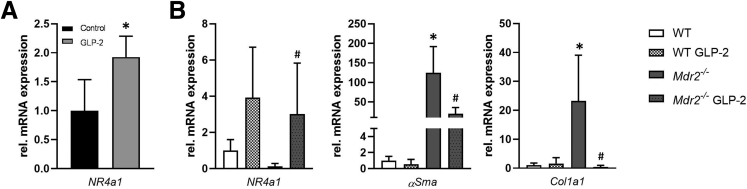
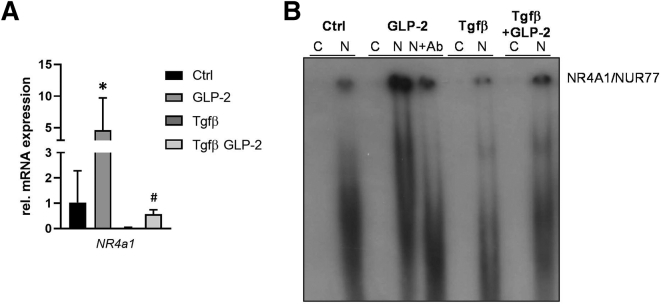
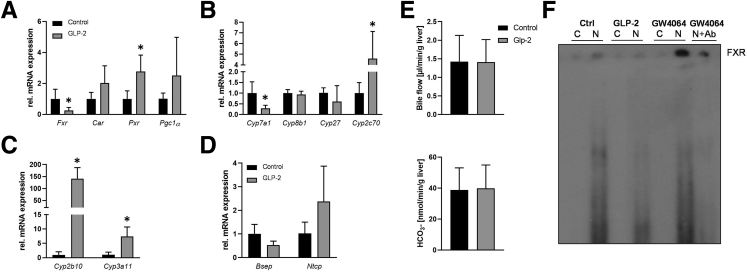
Hepatic inflammation, fibrosis, and reactive cholangiocyte phenotype were improved in GLP-2-treated Mdr2 mice. Primary HSCs isolated from Mdr2 mice and LX2 cells exposed to GLP-2 in vitro displayed significantly increased mRNA expression levels of NR4a1/Nur77 (P < .05). Electrophoretic mobility shift assay revealed an increased nuclear NR4a1 binding after GLP-2 treatment in LX2 cells. Moreover, GLP-2 alleviated the Tgfβ-mediated reduction of NR4a1 nuclear binding activity. In vivo, GLP-2 treatment of Mdr2 mice resulted in increased intrahepatic levels of muricholic acids (accordingly Cyp2c70 mRNA expression was significantly increased), and in reduced mRNA levels of Cyp7a1 and FXR. Serum Fgf15 levels were increased in Mdr2 mice treated with GLP-2. Accordingly, GLP-2 treatment of human intestinal organoids activated their FXR-FGF19 signaling axis.
GLP-2 treatment increased NR4a1/Nur77 activation in HSCs, subsequently attenuating their activation. GLP-2 promoted intestinal Fxr-Fgf15/19 signaling resulting in reduced Cyp7a1 and increased Cyp2c70 expression in the liver, contributing to hepatoprotective and antifibrotic effects of GLP-2 in the Mdr2 mouse model.
胰高血糖素样肽-2(GLP-2)可能对肝星状细胞(HSCs)发挥抗纤维化作用。因此,我们旨在检测 GLP-2 类似物特利格鲁肽在 Mdr2/Abcb4 小鼠模型中的应用是否具有抗纤维化作用,该模型表现为肝炎症和纤维化以及胆汁硬化。
Mdr2 小鼠每日接受特利格鲁肽注射 4 周,随后进行基因表达谱分析(肝脏;分离的 HSCs)和免疫组织化学分析。GLP-2 处理激活的 HSCs(LX2 细胞)和永生化人肝细胞及人肠类器官。通过逆转录聚合酶链反应和细胞质和核蛋白提取物的电泳迁移率变动分析进行 mRNA 谱分析。
GLP-2 治疗可改善 Mdr2 小鼠的肝炎症、纤维化和反应性胆管细胞表型。从 Mdr2 小鼠分离的原代 HSCs 和体外暴露于 GLP-2 的 LX2 细胞的 NR4a1/Nur77 基因的 mRNA 表达水平显著增加(P <.05)。电泳迁移率变动分析显示,GLP-2 处理后 LX2 细胞中的核 NR4a1 结合增加。此外,GLP-2 减轻了 TGFβ介导的 NR4a1 核结合活性的降低。在体内,Mdr2 小鼠给予 GLP-2 治疗可导致肝内鼠胆酸水平升高(相应地 Cyp2c70 mRNA 表达显著增加),并降低 Cyp7a1 和 FXR 的 mRNA 水平。Mdr2 小鼠给予 GLP-2 治疗后血清 Fgf15 水平升高。相应地,GLP-2 处理人肠类器官激活了它们的 FXR-FGF19 信号通路。
GLP-2 治疗增加了 HSCs 中的 NR4a1/Nur77 激活,随后减弱了其激活。GLP-2 促进了肠道 Fxr-Fgf15/19 信号传导,导致肝脏中 Cyp7a1 减少和 Cyp2c70 表达增加,这有助于 GLP-2 在 Mdr2 小鼠模型中发挥抗纤维化作用。