Bio21 Molecular Science and Biotechnology Institute, The University of Melbourne, Parkville, VIC, 3010, Australia.
Department of Veterinary Biosciences, Faculty of Science, Melbourne Veterinary School, The University of Melbourne, Building 400, Parkville, VIC, 3010, Australia.
Parasit Vectors. 2023 Aug 13;16(1):279. doi: 10.1186/s13071-023-05902-1.
Lucilia cuprina and L. sericata (family Calliphoridae) are globally significant ectoparasites of sheep. Current literature suggests that only one of these blowfly subspecies, L. cuprina dorsalis, is a primary parasite causing myiasis (flystrike) in sheep in Australia. These species and subspecies are difficult to distinguish using morphological features. Hence, being able to accurately identify blowflies is critical for diagnosis and for understanding their relationships with their hosts and environment.
In this study, adult blowflies (5 pools of 17 flies; n = 85) were collected from five locations in different states [New South Wales (NSW), Queensland (QLD), Tasmania (TAS), Victoria (VIC) and Western Australia (WA)] of Australia and their mitochondrial (mt) genomes were assembled.
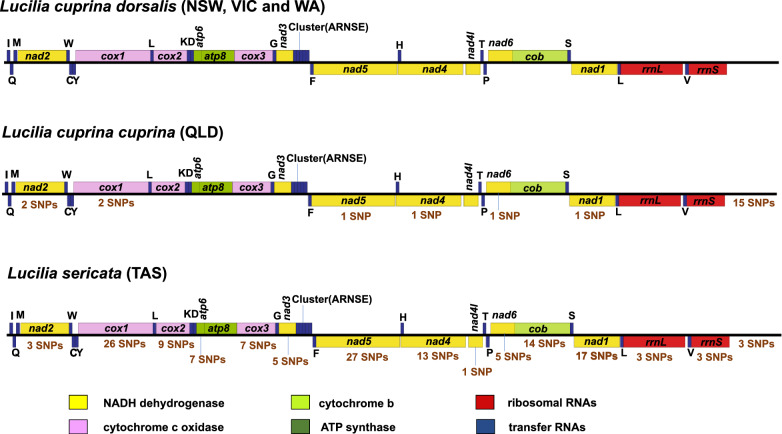
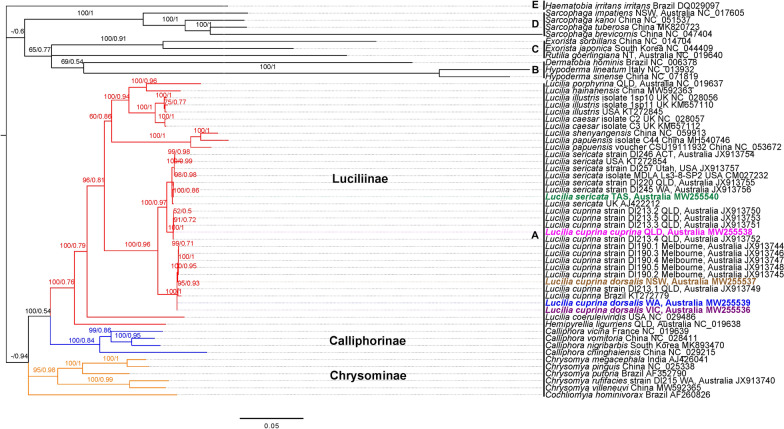
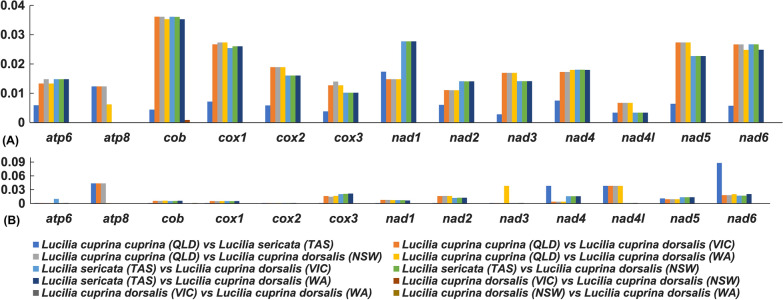
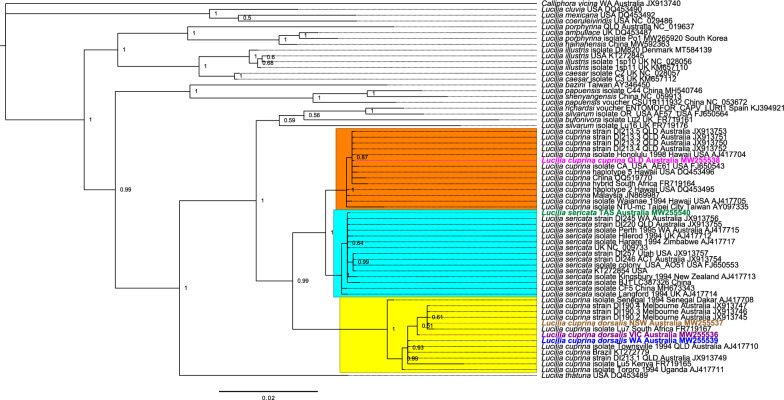
Each mt genome assembled was ~ 15 kb in size and encoded 13 protein-coding genes, 2 ribosomal RNAs, 22 transfer RNAs and a control region. The Lucilia species mt genomes were conserved in structure, and the genes retained the same order and direction. The overall nucleotide composition was heavily biased towards As and Ts-77.7% of the whole genomes. Pairwise nucleotide diversity suggested divergence between Lucilia cuprina cuprina, L. c. dorsalis and L. sericata. Comparative analyses of these mt genomes with published data demonstrated that the blowflies collected from sheep farm in TAS clustered within a clade with L. sericata. The flies collected from an urban location in QLD were more closely related to L. sericata and represented the subspecies L. c. cuprina, whereas the flies collected from sheep farms in NSW, VIC and WA represented the subspecies L. c. dorsalis.
Phylogenetic analyses of the mt genomes representing Lucilia from the five geographic locations in Australia supported the previously demonstrated paraphyly of L. cuprina with respect to L. sericata and revealed that L. c. cuprina is distinct from L. c. dorsalis and that L. c. cuprina is more closely related to L. sericata than L. c. dorsalis. The mt genomes reported here provide an important molecular resource to develop tools for species- and subspecies-level identification of Lucilia from different geographical regions across Australia.
丽蝇属的铜绿蝇(L. cuprina)和丝光绿蝇(L. sericata)(丽蝇科)是全球范围内重要的绵羊外寄生虫。目前的文献表明,这两个亚种蝇只有一个,即 L. cuprina dorsalis,是澳大利亚绵羊蝇蛆病(蝇蛆病)的主要寄生虫。这些物种和亚种很难通过形态特征来区分。因此,能够准确识别苍蝇对于诊断和了解它们与宿主和环境的关系至关重要。
本研究中,从澳大利亚五个不同州/领地(新南威尔士州(NSW)、昆士兰州(QLD)、塔斯马尼亚州(TAS)、维多利亚州(VIC)和西澳大利亚州(WA))的五个地点收集了 5 个蝇群(每个蝇群 17 只苍蝇,n = 85),并组装了它们的线粒体(mt)基因组。
每个组装的 mt 基因组大小约为 15kb,编码 13 个蛋白质编码基因、2 个核糖体 RNA、22 个转移 RNA 和一个控制区。丽蝇属物种的 mt 基因组在结构上是保守的,基因保留相同的顺序和方向。核苷酸组成总体上偏向 As 和 Ts-77.7%的整个基因组。核苷酸多样性的成对比较表明,铜绿蝇(L. cuprina cuprina)、L. c. dorsalis 和丝光绿蝇(L. sericata)之间存在分化。与已发表数据的这些 mt 基因组的比较分析表明,从塔斯马尼亚绵羊养殖场收集的苍蝇聚集在一个与 L. sericata 相关的分支中。从昆士兰州一个城市地区收集的苍蝇与 L. sericata 关系更密切,代表 L. c. cuprina 亚种,而从新南威尔士州、维多利亚州和西澳大利亚州的绵羊养殖场收集的苍蝇代表 L. c. dorsalis 亚种。
对代表澳大利亚五个地理位置的丽蝇属 mt 基因组的系统发育分析支持了铜绿蝇属相对于丝光绿蝇属的并系关系,并表明 L. c. cuprina 与 L. c. dorsalis 不同,并且 L. c. cuprina 与 L. sericata 的关系比 L. c. dorsalis 更密切。这里报道的 mt 基因组为开发澳大利亚不同地理区域的丽蝇属种和亚种鉴定工具提供了重要的分子资源。