Department of Diagnostic and Interventional Neuroradiology, School of Medicine, Klinikum rechts der Isar, Technical University of Munich, Munich, Germany.
Department of Radiology and Nuclear Medicine, University Medical Centre Mannheim, Medical Faculty Mannheim-University of Heidelberg, Mannheim, Germany.
Front Endocrinol (Lausanne). 2023 Jul 31;14:1222041. doi: 10.3389/fendo.2023.1222041. eCollection 2023.
Opportunistic quantitative computed tomography (oQCT) derived from non-dedicated routine CT has demonstrated high accuracy in diagnosing osteoporosis and predicting incident vertebral fractures (VFs). We aimed to investigate the cost-effectiveness of oQCT screening compared to dual-energy X-ray absorptiometry (DXA) as the standard of care for osteoporosis screening.
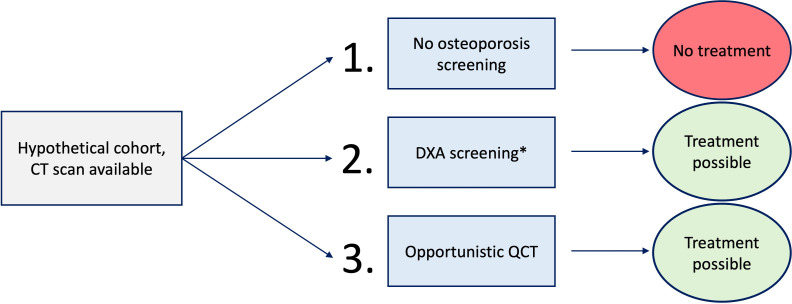
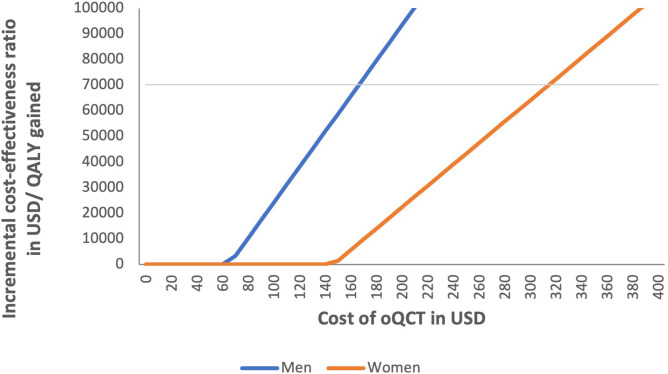
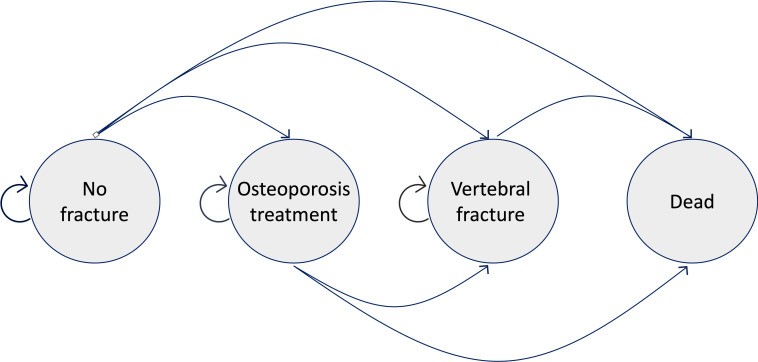
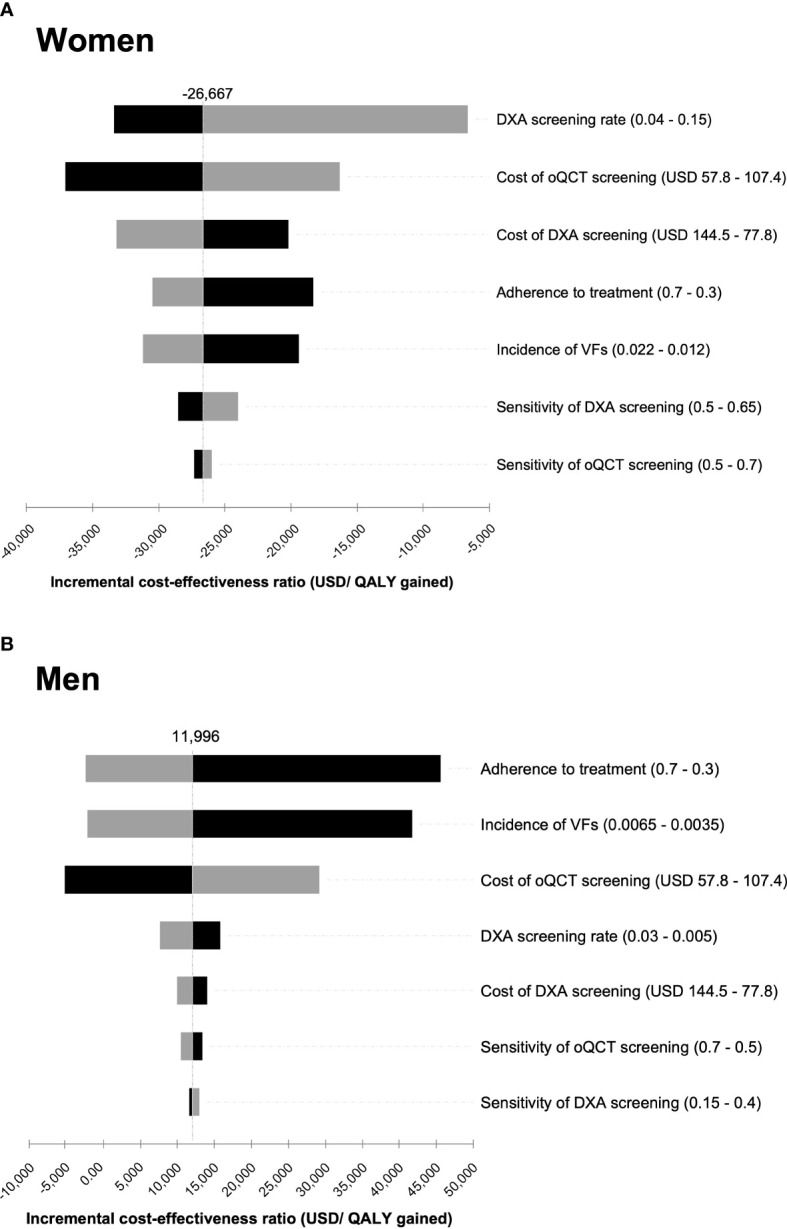
Three screening strategies ("no osteoporosis screening", "oQCT screening", and "DXA screening") after routine CT were simulated in a state-transition model for hypothetical cohorts of 1,000 patients (women and men aged 65 years) over a follow-up period of 5 years (base case). The primary outcomes were the cumulative costs and the quality-adjusted life years (QALYs) estimated from a U.S. health care perspective for the year 2022. Cost-effectiveness was assessed based on a willingness-to-pay (WTP) threshold of $70,249 per QALY. The secondary outcome was the number of prevented VFs. Deterministic and probabilistic sensitivity analyses were conducted to test the models' robustness.
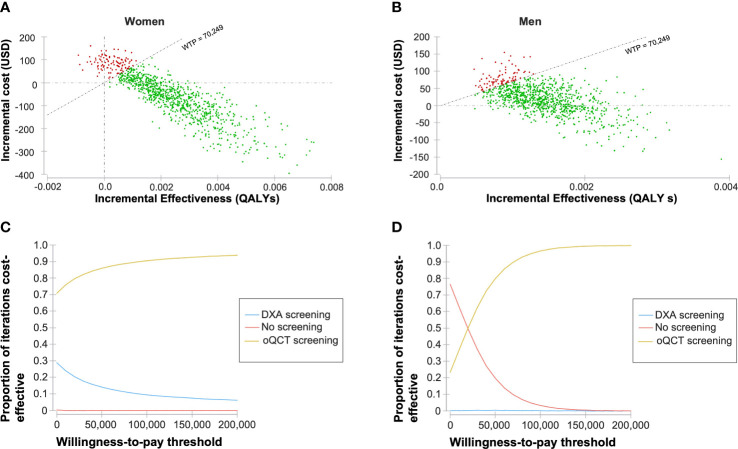
Compared to DXA screening, oQCT screening increased QALYs in both sexes (additional 2.40 per 1,000 women and 1.44 per 1,000 men) and resulted in total costs of $3,199,016 and $950,359 vs. $3,262,934 and $933,077 for women and men, respectively. As a secondary outcome, oQCT screening prevented 2.6 and 2.0 additional VFs per 1,000 women and men, respectively. In the probabilistic sensitivity analysis, oQCT screening remained cost-effective in 88.3% (women) and 90.0% (men) of iterations.
oQCT screening is a cost-effective ancillary approach for osteoporosis screening and has the potential to prevent a substantial number of VFs if considered in daily clinical practice.
从非专用常规 CT 获得的机会性定量 CT(oQCT)已证明在诊断骨质疏松症和预测椎体骨折(VF)方面具有很高的准确性。我们旨在研究 oQCT 筛查与双能 X 射线吸收法(DXA)相比作为骨质疏松症筛查标准的成本效益。
在常规 CT 后,通过状态转换模型模拟了三种筛查策略(“不进行骨质疏松症筛查”、“oQCT 筛查”和“DXA 筛查”),用于假设的 1000 名患者队列(年龄为 65 岁的女性和男性)在 5 年的随访期间(基础案例)。主要结果是从美国医疗保健角度估计的 2022 年的累积成本和质量调整生命年(QALY)。基于 70,249 美元/QALY 的意愿支付(WTP)阈值评估成本效益。次要结果是预防 VF 的数量。进行了确定性和概率敏感性分析以测试模型的稳健性。
与 DXA 筛查相比,oQCT 筛查在两性中都增加了 QALY(女性每 1000 人增加 2.40,男性每 1000 人增加 1.44),并导致总成本分别为 3,199,016 美元和 950,359 美元,而女性和男性分别为 3,262,934 美元和 933,077 美元。作为次要结果,oQCT 筛查分别预防了每 1000 名女性和男性 2.6 和 2.0 例额外的 VF。在概率敏感性分析中,oQCT 筛查在 88.3%(女性)和 90.0%(男性)的迭代中仍然具有成本效益。
oQCT 筛查是骨质疏松症筛查的一种具有成本效益的辅助方法,如果在日常临床实践中考虑使用,它有可能预防大量的 VF。