Department of Respiratory and Critical Care Medicine, the First Medical Center of PLA General Hospital, Beijing, 100853, P. R. China.
BMC Pediatr. 2023 Aug 14;23(1):399. doi: 10.1186/s12887-023-04233-5.
The study was to investigate serum total IgE levels and the distribution of specific IgE types in children aged 6-9 years with tic disorder, in order to provide knowledge for diagnosis and treatment of children with tic disorder.
Total serum IgE levels were detected by enzyme-linked immunosorbent assay (ELISA). Specific IgE levels in 72 children with tic disorder and normal 31 children were detected by EUROblot, respectively.
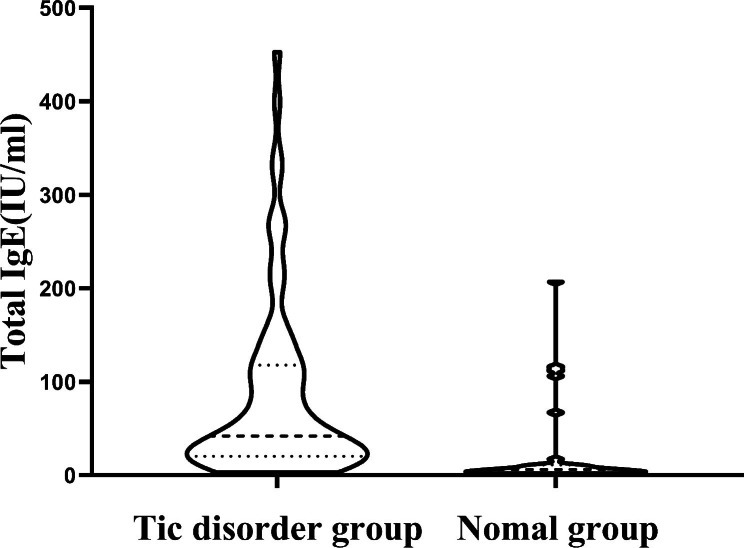
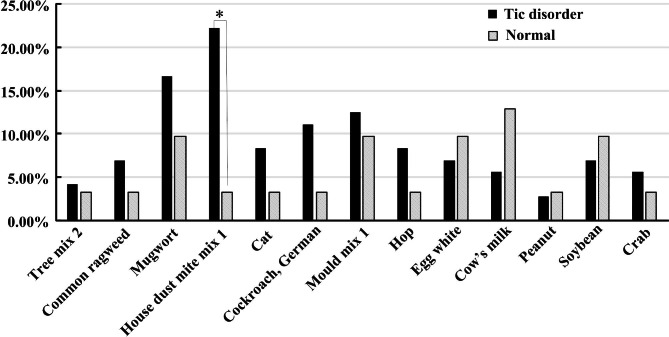
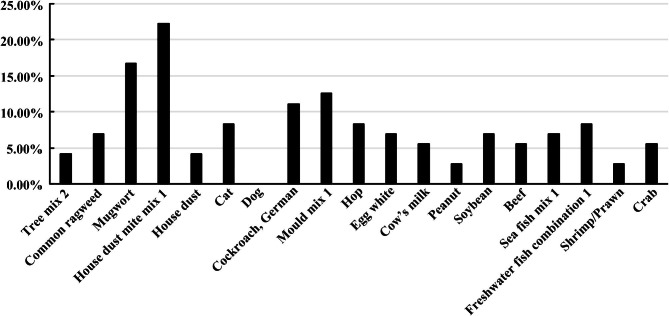
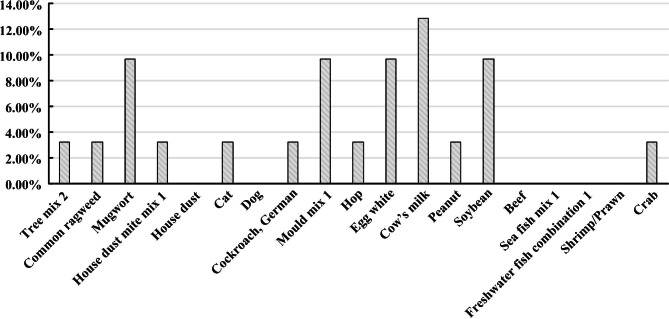
The total serum IgE level of children with tic disorder aged 6-9 years was significantly higher than those of children in control group. Specific IgE distribution in tic disorder group was observed increased mainly including inhaled mugwort, dust mite combination 1 (house dust mite/dust mite), mold combination (penicillium point/mycobacteria/Aspergillus fumigatus/streptomyces), cockroaches in Germany respectively, and also food freshwater fish combination 1 (salmon/sea bass/carp), marine fish combination 1 (cod/lobster/scallop), egg white, and crab, while elevated specific IgE of normal children group was mainly food-based (egg white, milk, and soybean). The significant different specific IgE between two groups was dust mite combination 1 (house dust mite/dust mite) (P < 0.05).
The total serum IgE level of children with tic disorder aged 6-9 years was significantly increased, which may be related to the disease. Specific IgE in children with tic disorder was mainly inhalation allergens, especially dust mite combination 1 (house dust mite/dust mite), which should be avoided in clinical diagnosis and daily life.
研究 6-9 岁儿童抽动障碍患者血清总 IgE 水平及特异性 IgE 类型分布,为儿童抽动障碍的诊断和治疗提供依据。
采用酶联免疫吸附试验(ELISA)检测 72 例抽动障碍患儿和 31 例正常儿童血清总 IgE 水平,应用 EUROblot 检测 72 例抽动障碍患儿和 31 例正常儿童特异性 IgE 类型。
6-9 岁抽动障碍患儿血清总 IgE 水平明显高于对照组,抽动障碍组特异性 IgE 分布以吸入性变应原蒿属、屋尘螨/粉尘螨组合 1、霉菌组合(青霉菌点青霉分枝杆菌/烟曲霉/链格孢)、德国蟑螂明显增高,食物性变应原淡水鱼组合 1(鲑鱼/鲈鱼/鲤鱼)、海鱼组合 1(鳕鱼/龙虾/扇贝)、蛋清、蟹也明显增高,正常对照组以食物性变应原蛋清、牛奶、大豆增高为主。两组间差异有统计学意义的是屋尘螨/粉尘螨组合 1(P<0.05)。
6-9 岁儿童抽动障碍患者血清总 IgE 水平明显增高,可能与疾病有关。抽动障碍患儿特异性 IgE 以吸入性变应原为主,尤其屋尘螨/粉尘螨组合 1,在临床诊断和日常生活中应尽量避免。