Department of Bioengineering, University of Pennsylvania, 210 S. 33rd St., Philadelphia, PA, 19104, USA.
Perelman School of Medicine, University of Pennsylvania, 3400 Civic Center Blvd., Philadelphia, PA, 19104, USA.
Sci Rep. 2023 Aug 16;13(1):13292. doi: 10.1038/s41598-023-39746-7.
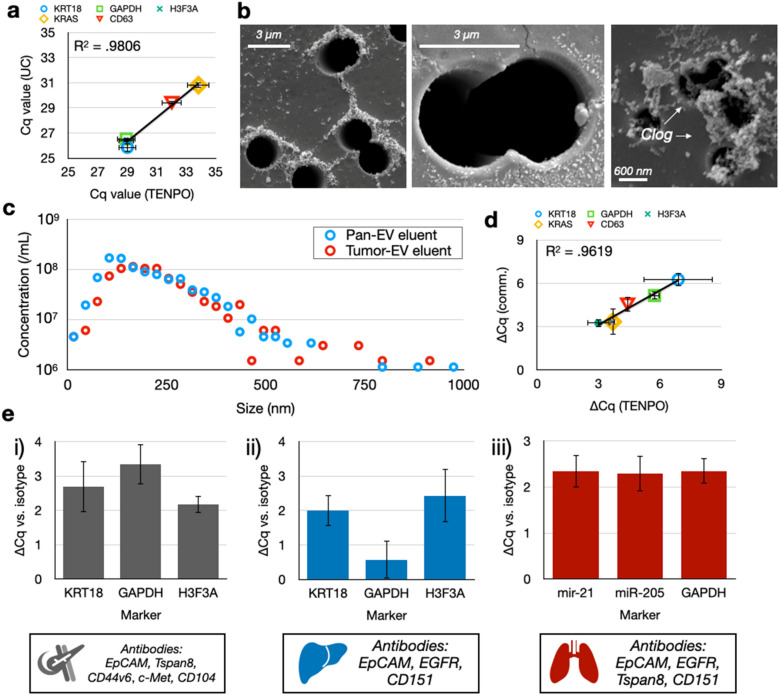
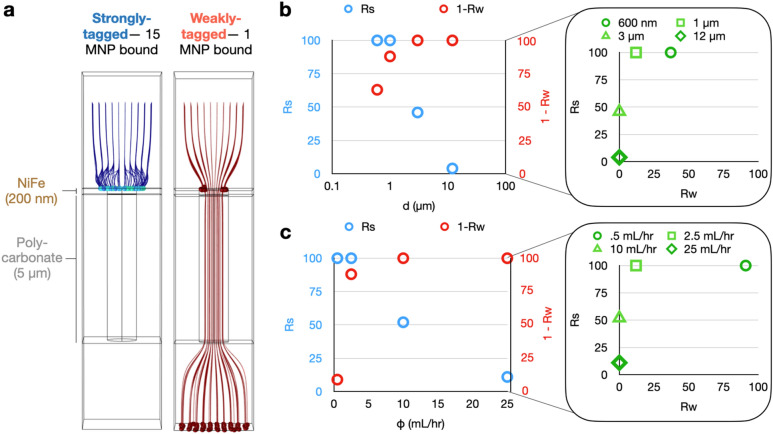
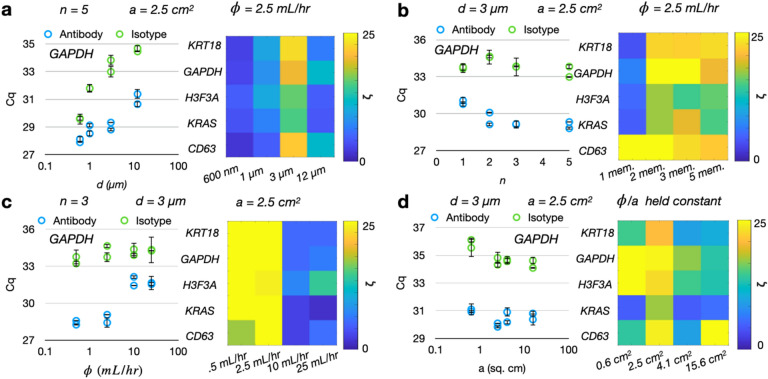
The isolation of specific subpopulations of extracellular vesicles (EVs) based on their expression of surface markers poses a significant challenge due to their nanoscale size (< 800 nm), their heterogeneous surface marker expression, and the vast number of background EVs present in clinical specimens (10-10 EVs/mL in blood). Highly parallelized nanomagnetic sorting using track etched magnetic nanopore (TENPO) chips has achieved precise immunospecific sorting with high throughput and resilience to clogging. However, there has not yet been a systematic study of the design parameters that control the trade-offs in throughput, target EV recovery, and ability to discard background EVs in this approach. We combine finite-element simulation and experimental characterization of TENPO chips to elucidate design rules to isolate EV subpopulations from blood. We demonstrate the utility of this approach by reducing device background > 10× relative to prior published designs without sacrificing recovery of the target EVs by selecting pore diameter, number of membranes placed in series, and flow rate. We compare TENPO-isolated EVs to those of gold-standard methods of EV isolation and demonstrate its utility for wide application and modularity by targeting subpopulations of EVs from multiple models of disease including lung cancer, pancreatic cancer, and liver cancer.
基于表面标志物表达的特定细胞外囊泡 (EV) 亚群的分离具有很大的挑战性,因为它们的纳米级尺寸 (<800nm)、其异质表面标志物表达和临床标本中存在的大量背景 EV (血液中 10-10 EV/mL)。使用轨道蚀刻磁性纳米孔 (TENPO) 芯片的高度并行纳米磁分选已实现了精确的免疫特异性分选,具有高通量和抗堵塞能力。然而,在这种方法中,尚未对控制吞吐量、目标 EV 回收和丢弃背景 EV 能力之间的权衡的设计参数进行系统研究。我们结合 TENPO 芯片的有限元模拟和实验特性来阐明从血液中分离 EV 亚群的设计规则。我们通过选择孔径、串联放置的膜的数量和流速,在不牺牲目标 EV 回收率的情况下,将设备背景降低到比以前发表的设计高 >10×,从而证明了这种方法的实用性。我们将 TENPO 分离的 EV 与 EV 分离的金标准方法进行了比较,并通过针对来自肺癌、胰腺癌和肝癌等多种疾病模型的 EV 亚群,展示了其广泛应用和模块化的实用性。