School of Public Health and Preventive Medicine, Monash University, Melbourne, VIC, Australia.
Clinical Epidemiology Program, Ottawa Hospital Research Institute, Ottawa, Canada.
Stat Methods Med Res. 2023 Nov;32(11):2123-2134. doi: 10.1177/09622802231194753. Epub 2023 Aug 17.
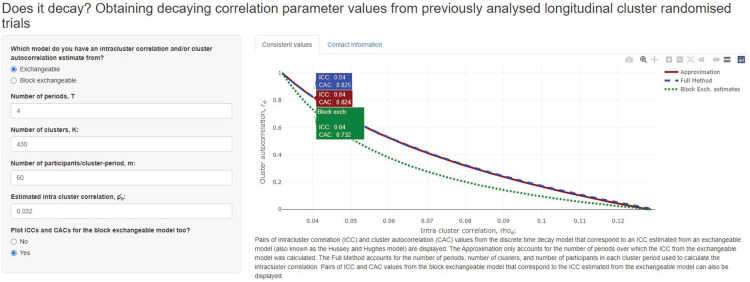
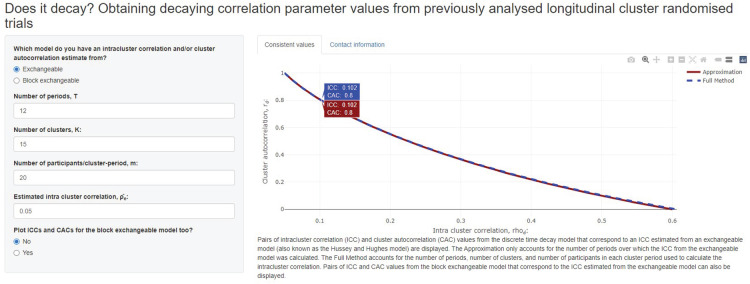
A frequently applied assumption in the analysis of data from cluster randomised trials is that the outcomes from all participants within a cluster are equally correlated. That is, the intracluster correlation, which describes the degree of dependence between outcomes from participants in the same cluster, is the same for each pair of participants in a cluster. However, recent work has discussed the importance of allowing for this correlation to decay as the time between the measurement of participants in a cluster increases. Incorrect omission of such a decay can lead to under-powered studies, and confidence intervals for estimated treatment effects can be too narrow or too wide, depending on the characteristics of the design. When planning studies, researchers often rely on previously reported analyses of trials to inform their choice of intracluster correlation. However, most reported analyses of clustered data do not incorporate a correlation decay. Thus, often all that is available are estimates of intracluster correlations obtained under the potentially incorrect assumption of no decay. In this article, we show that it is possible to use intracluster correlation values obtained from models that incorrectly omit a decay to inform plausible choices of decaying correlations. Our focus is on intracluster correlation estimates for continuous outcomes obtained by fitting linear mixed models with exchangeable or block-exchangeable correlation structures. We describe how plausible values for decaying correlations may be obtained given these estimated intracluster correlations. An online app is presented that allows users to obtain plausible values of the decay, which can be used at the trial planning stage to assess the sensitivity of sample size and power calculations to decaying correlation structures.
在分析集群随机试验数据时,经常假设一个集群内的所有参与者的结果都是同等相关的。也就是说,描述同一集群内参与者之间结果的依赖性程度的组内相关系数,对于集群中的每一对参与者来说都是相同的。然而,最近的研究已经讨论了允许这种相关性随着集群中参与者之间测量时间的增加而衰减的重要性。不正确地忽略这种衰减可能会导致研究力度不足,并且对于估计的治疗效果的置信区间可能太窄或太宽,这取决于设计的特征。在规划研究时,研究人员通常依赖先前报告的试验分析来为他们选择组内相关系数提供信息。然而,大多数报告的聚类数据分析都没有纳入相关性衰减。因此,通常唯一可用的是在可能不正确地假设没有衰减的情况下获得的组内相关系数的估计值。在本文中,我们表明,可以使用从不正确地忽略衰减的模型中获得的组内相关系数值来为具有衰减相关性的合理选择提供信息。我们的重点是适用于具有可交换或块可交换相关性结构的线性混合模型拟合获得的连续结果的组内相关系数估计值。我们描述了如何根据这些估计的组内相关系数获得衰减相关性的合理值。还介绍了一个在线应用程序,允许用户获得衰减的合理值,可在试验规划阶段用于评估样本量和功效计算对衰减相关性结构的敏感性。