CARIM School for Cardiovascular Diseases, Maastricht University, Maastricht, the Netherlands.
Department of Internal Medicine, Maastricht University Medical Center, Maastricht, the Netherlands.
Diabetologia. 2023 Nov;66(11):2030-2041. doi: 10.1007/s00125-023-05986-5. Epub 2023 Aug 17.
AIMS/HYPOTHESIS: To assess the associations between glucose metabolism status and a range of continuous measures of glycaemia with corneal nerve fibre measures, as assessed using corneal confocal microscopy.
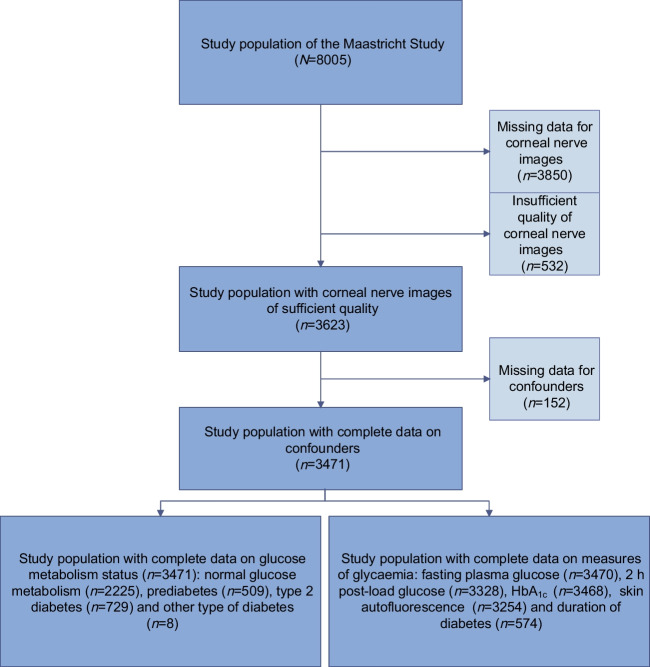
We used population-based observational cross-sectional data from the Maastricht Study of N=3471 participants (mean age 59.4 years, 48.4% men, 14.7% with prediabetes, 21.0% with type 2 diabetes) to study the associations, after adjustment for demographic, cardiovascular risk and lifestyle factors, between glucose metabolism status (prediabetes and type 2 diabetes vs normal glucose metabolism) plus measures of glycaemia (fasting plasma glucose, 2 h post-load glucose, HbA, skin autofluorescence [SAF] and duration of diabetes) and composite Z-scores of corneal nerve fibre measures or individual corneal nerve fibre measures (corneal nerve bifurcation density, corneal nerve density, corneal nerve length and fractal dimension). We used linear regression analysis, and, for glucose metabolism status, performed a linear trend analysis.
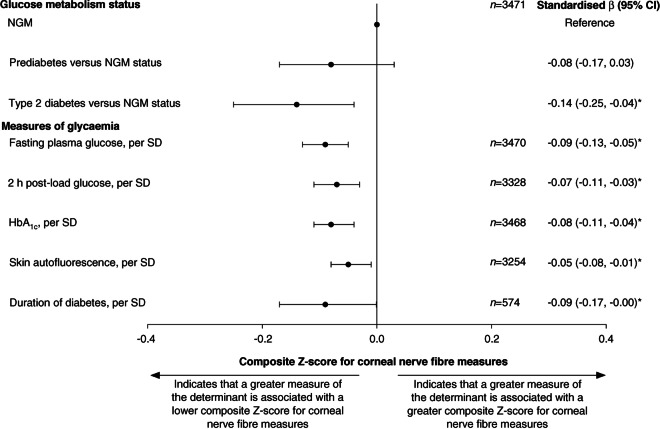
After full adjustment, a more adverse glucose metabolism status was associated with a lower composite Z-score for corneal nerve fibre measures (β coefficients [95% CI], prediabetes vs normal glucose metabolism -0.08 [-0.17, 0.03], type 2 diabetes vs normal glucose metabolism -0.14 [-0.25, -0.04]; linear trend analysis showed a p value of 0.001), and higher levels of measures of glycaemia (fasting plasma glucose, 2 h post-load glucose, HbA, SAF and duration of diabetes) were all significantly associated with a lower composite Z-score for corneal nerve fibre measures (per SD: -0.09 [-0.13, -0.05], -0.07 [-0.11, -0.03], -0.08 [-0.11, -0.04], -0.05 [-0.08, -0.01], -0.09 [-0.17, -0.001], respectively). In general, directionally similar associations were observed for individual corneal nerve fibre measures.
CONCLUSIONS/INTERPRETATION: To our knowledge, this is the first population-based study to show that a more adverse glucose metabolism status and higher levels of glycaemic measures were all linearly associated with corneal neurodegeneration after adjustment for an extensive set of potential confounders. Our results indicate that glycaemia-associated corneal neurodegeneration is a continuous process that starts before the onset of type 2 diabetes. Further research is needed to investigate whether early reduction of hyperglycaemia can prevent corneal neurodegeneration.
目的/假设:评估葡萄糖代谢状态与一系列连续血糖测量值与角膜神经纤维测量值之间的关联,这些测量值是使用角膜共聚焦显微镜评估的。
我们使用基于人群的横断面观察性 Maastricht 研究中的数据,该研究共纳入了 3471 名参与者(平均年龄 59.4 岁,48.4%为男性,14.7%患有前驱糖尿病,21.0%患有 2 型糖尿病),在调整人口统计学、心血管风险和生活方式因素后,研究了葡萄糖代谢状态(前驱糖尿病和 2 型糖尿病与正常葡萄糖代谢)加上血糖测量值(空腹血糖、负荷后 2 小时血糖、糖化血红蛋白、皮肤自发荧光[SAF]和糖尿病病程)与角膜神经纤维测量值的综合 Z 评分或个别角膜神经纤维测量值(角膜神经分支密度、角膜神经密度、角膜神经长度和分形维数)之间的关系。我们使用线性回归分析,并且对于葡萄糖代谢状态,我们进行了线性趋势分析。
在充分调整后,葡萄糖代谢状态越差与角膜神经纤维测量值的综合 Z 评分越低相关(β系数[95%CI],前驱糖尿病与正常葡萄糖代谢 -0.08[-0.17,0.03],2 型糖尿病与正常葡萄糖代谢 -0.14[-0.25,-0.04];线性趋势分析显示 p 值为 0.001),血糖测量值(空腹血糖、负荷后 2 小时血糖、糖化血红蛋白、SAF 和糖尿病病程)水平越高与角膜神经纤维测量值的综合 Z 评分越低相关(每标准差:-0.09[-0.13,-0.05],-0.07[-0.11,-0.03],-0.08[-0.11,-0.04],-0.05[-0.08,-0.01],-0.09[-0.17,-0.001])。一般来说,个别角膜神经纤维测量值也观察到了方向相似的关联。
结论/解释:据我们所知,这是第一项基于人群的研究,表明在调整了一系列潜在混杂因素后,葡萄糖代谢状态越差和血糖测量值越高与角膜神经退行性变呈线性相关。我们的研究结果表明,与血糖相关的角膜神经退行性变是一个连续的过程,在 2 型糖尿病发病前就已经开始。需要进一步研究以确定早期降低高血糖是否可以预防角膜神经退行性变。