Center for Systems and Community Design and NYU-CUNY Prevention Research Center, CUNY Graduate School of Public Health and Health Policy, New York, NY, United States of America.
Division of Health Behavior Research and Implementation Science, Albert Einstein College of Medicine, New York, NY, United States of America.
PLoS One. 2023 Aug 17;18(8):e0284765. doi: 10.1371/journal.pone.0284765. eCollection 2023.
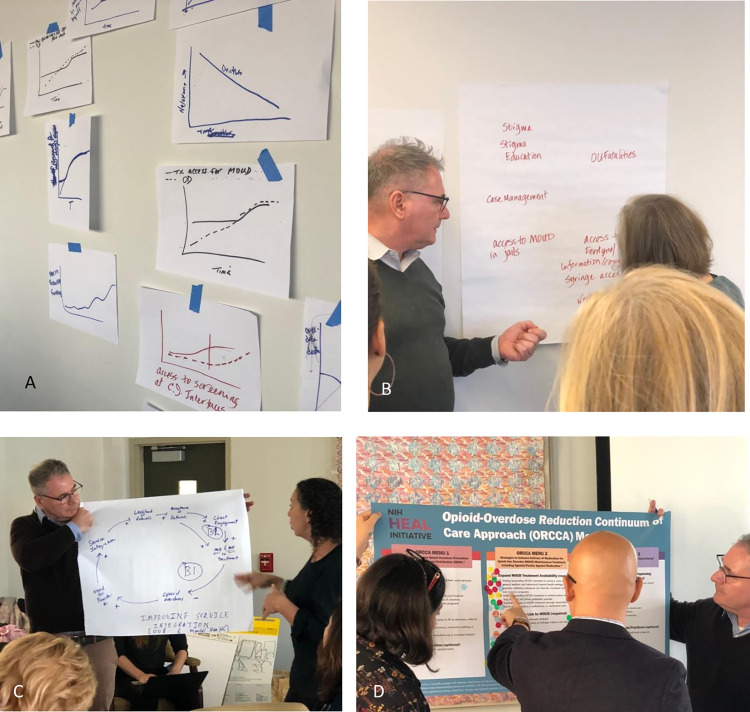
Group model building is a process of engaging stakeholders in a participatory modeling process to elicit their perceptions of a problem and explore concepts regarding the origin, contributing factors, and potential solutions or interventions to a complex issue. Recently, it has emerged as a novel method for tackling complex, long-standing public health issues that traditional intervention models and frameworks cannot fully address. However, the extent to which group model building has resulted in the adoption of evidence-based practices, interventions, and policies for public health remains largely unstudied. The goal of this systematic review was to examine the public health and healthcare applications of GMB in the literature and outline how it has been used to foster implementation and dissemination of evidence-based interventions.
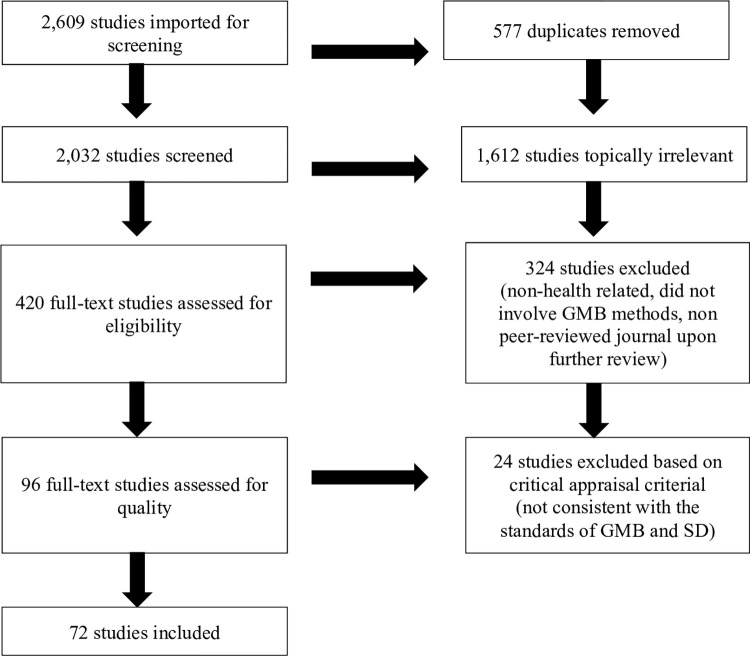
We searched PubMed, Web of Science, and other databases through August 2022 for studies related to public health or health care where GMB was cited as a main methodology. We did not eliminate studies based on language, location, or date of publication. Three reviewers independently extracted data on GMB session characteristics, model attributes, and dissemination formats and content.
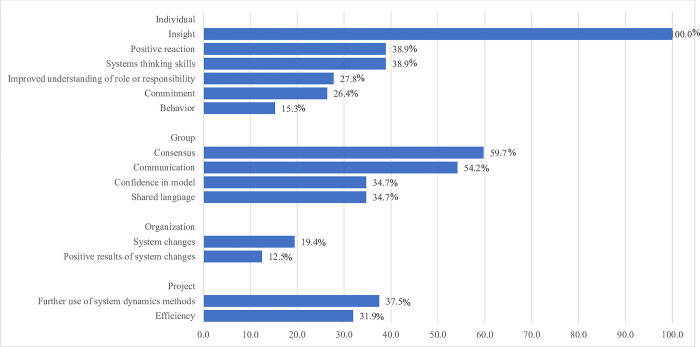
Seventy-two studies were included in the final review. Majority of GMB activities were in the fields of nutrition (n = 19, 26.4%), health care administration (n = 15, 20.8%), and environmental health (n = 12, 16.7%), and were conducted in the United States (n = 29, 40.3%) and Australia (n = 7, 9.7%). Twenty-three (31.9%) studies reported that GMB influenced implementation through policy change, intervention development, and community action plans; less than a third reported dissemination of the model outside journal publication. GMB was reported to have increased insight, facilitated consensus, and fostered communication among stakeholders.
GMB is associated with tangible benefits to participants, including increased community engagement and development of systems solutions. Transdisciplinary stakeholder involvement and more rigorous evaluation and dissemination of GMB activities are recommended.
群体模型构建是一个让利益相关者参与参与式建模过程的过程,以引出他们对问题的看法,并探讨关于复杂问题的起源、促成因素以及潜在解决方案或干预措施的概念。最近,它已成为解决传统干预模型和框架无法完全解决的复杂长期公共卫生问题的一种新方法。然而,群体模型构建在多大程度上导致了公共卫生领域采用基于证据的实践、干预措施和政策,在很大程度上仍未得到研究。本系统评价的目的是审查文献中 GMB 在公共卫生和医疗保健中的应用,并概述它如何用于促进基于证据的干预措施的实施和传播。
我们通过 2022 年 8 月在 PubMed、Web of Science 和其他数据库中搜索了与公共卫生或医疗保健相关的研究,其中 GMB 被引用为主要方法。我们没有根据语言、地点或出版日期排除研究。三位审稿人独立提取了关于 GMB 会议特征、模型属性和传播格式和内容的数据。
最终综述共纳入 72 项研究。大多数 GMB 活动集中在营养领域(n = 19,26.4%)、医疗保健管理领域(n = 15,20.8%)和环境卫生领域(n = 12,16.7%),并在美国(n = 29,40.3%)和澳大利亚(n = 7,9.7%)进行。23 项(31.9%)研究报告称 GMB 通过政策变更、干预措施制定和社区行动计划影响实施;不到三分之一的研究报告了模型在期刊出版之外的传播。据报道,GMB 提高了利益相关者的洞察力、促进了共识,并促进了他们之间的沟通。
GMB 与参与者的切实利益相关,包括增加社区参与和制定系统解决方案。建议跨学科利益相关者参与以及更严格的 GMB 活动评估和传播。