Crop, Livestock and Environment Division, Japan International Research Center for Agricultural Sciences, Ohwashi 1-1, Tsukuba, Ibaraki 305-8686, Japan.
Plant Functional Biotechnology, Agro-Biotechnology Research Center, Graduate School of Agricultural and Life Sciences, The University of Tokyo, Yayoi 1-1-1, Bunkyo-ku, Tokyo 113-8657, Japan.
Plant Physiol. 2023 Nov 22;193(4):2865-2879. doi: 10.1093/plphys/kiad458.
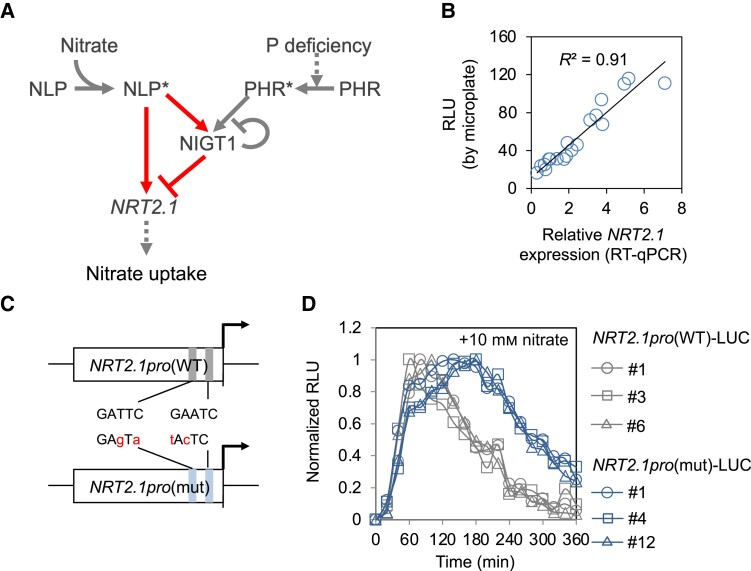
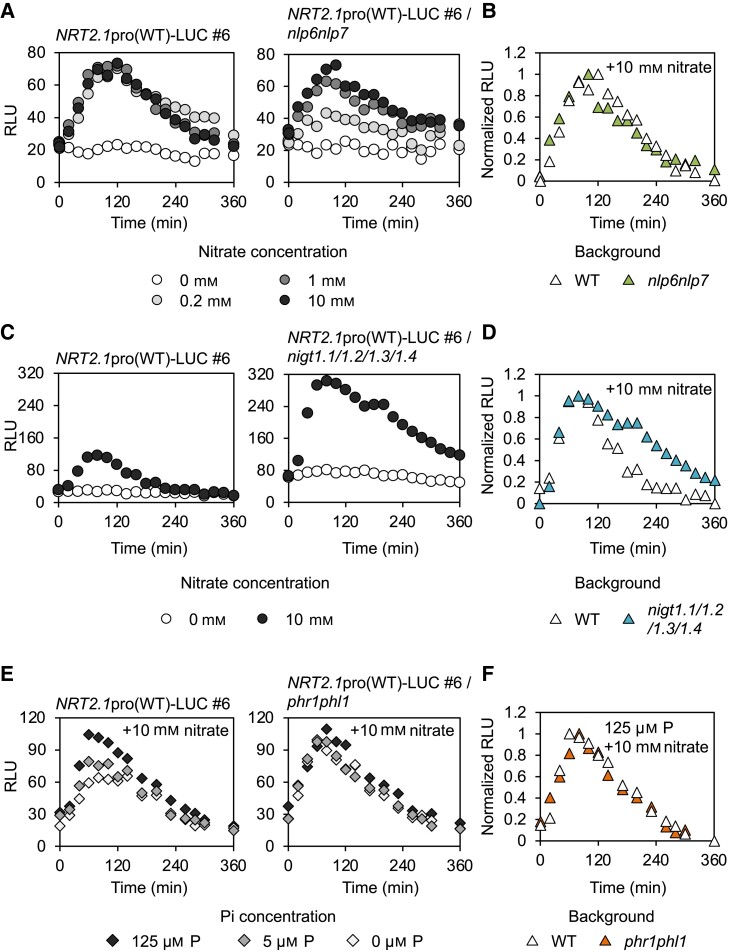
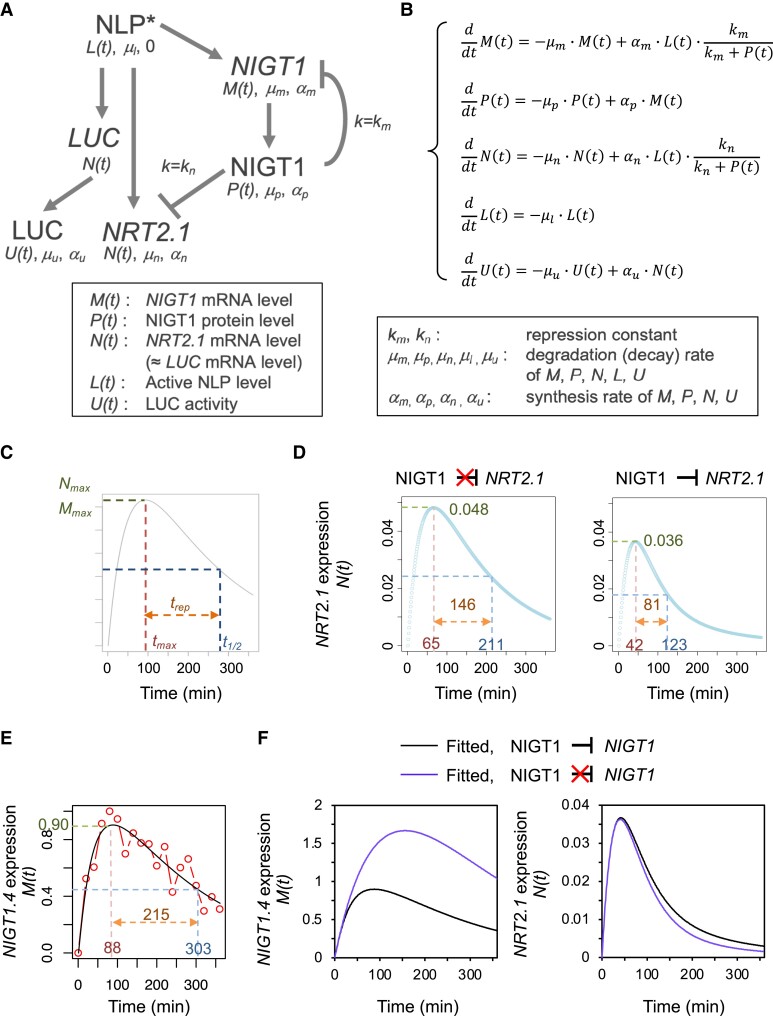
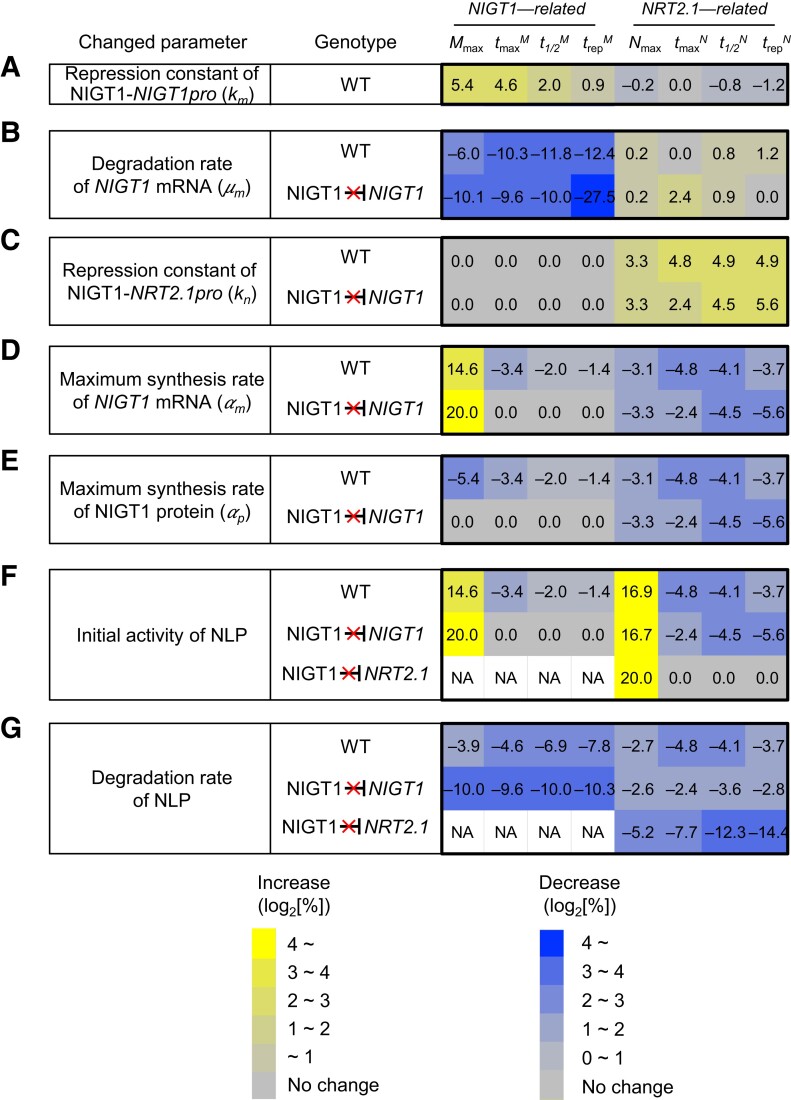
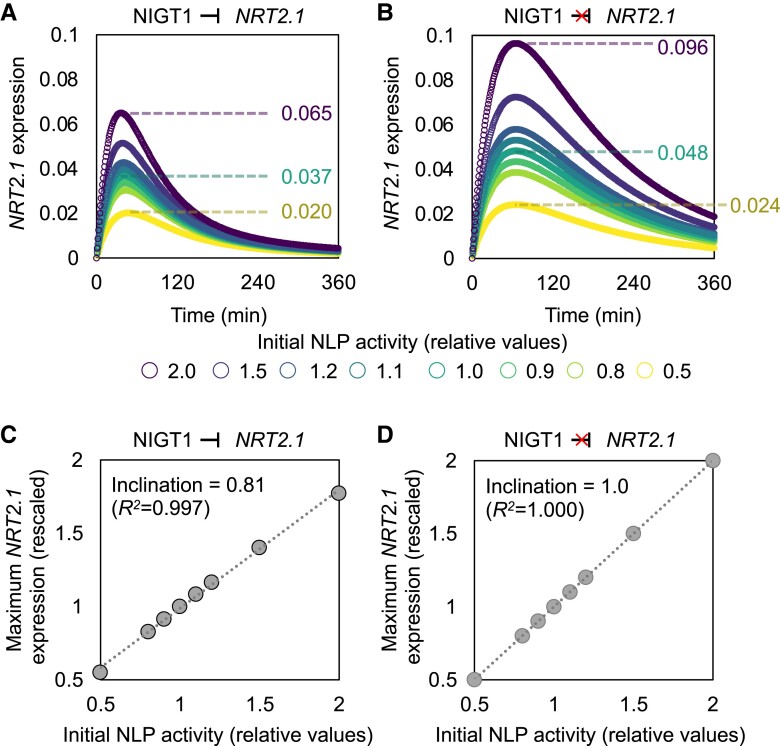
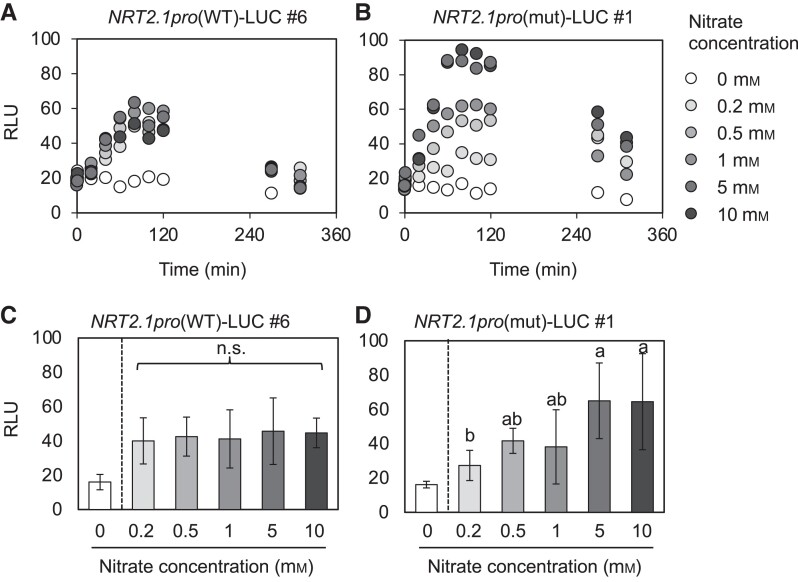
Arabidopsis (Arabidopsis thaliana) high-affinity NITRATE TRANSPORTER2.1 (NRT2.1) plays a dominant role in the uptake of nitrate, the most important nitrogen (N) source for most terrestrial plants. The nitrate-inducible expression of NRT2.1 is regulated by NIN-LIKE PROTEIN (NLP) family transcriptional activators and NITRATE-INDUCIBLE GARP-TYPE TRANSCRIPTIONAL REPRESSOR1 (NIGT1) family transcriptional repressors. Phosphorus (P) availability also affects the expression of NRT2.1 because the PHOSPHATE STARVATION RESPONSE1 transcriptional activator activates NIGT1 genes in P-deficient environments. Here, we show a biology-based mathematical understanding of the complex regulation of NRT2.1 expression by multiple transcription factors using 2 different approaches: a microplate-based assay for the real-time measurement of temporal changes in NRT2.1 promoter activity under different nutritional conditions, and an ordinary differential equation (ODE)-based mathematical modeling of the NLP- and NIGT1-regulated expression patterns of NRT2.1. Both approaches consistently reveal that NIGT1 stabilizes the amplitude of NRT2.1 expression under a wide range of nitrate concentrations. Furthermore, the ODE model suggests that parameters such as the synthesis rate of NIGT1 mRNA and NIGT1 proteins and the affinity of NIGT1 proteins for the NRT2.1 promoter substantially influence the temporal expression patterns of NRT2.1 in response to nitrate. These results suggest that the NLP-NIGT1 feedforward loop allows a precise control of nitrate uptake. Hence, this study paves the way for understanding the complex regulation of nutrient acquisition in plants, thus facilitating engineered nutrient uptake and plant response patterns using synthetic biology approaches.
拟南芥(Arabidopsis thaliana)高亲和力硝酸盐转运蛋白 2.1(NRT2.1)在硝酸盐的摄取中起着主导作用,硝酸盐是大多数陆地植物最重要的氮(N)源。NRT2.1 的硝酸盐诱导表达受 NIN-LIKE PROTEIN(NLP)家族转录激活因子和 NITRATE-INDUCIBLE GARP-TYPE TRANSCRIPTIONAL REPRESSOR1(NIGT1)家族转录阻遏因子调控。磷(P)可用性也会影响 NRT2.1 的表达,因为在 P 缺乏的环境中,PHOSPHATE STARVATION RESPONSE1 转录激活因子会激活 NIGT1 基因。在这里,我们使用两种不同的方法,即基于微板的实时测定不同营养条件下 NRT2.1 启动子活性的时间变化的测定方法,以及基于常微分方程(ODE)的 NLP 和 NIGT1 调控的 NRT2.1 表达模式的数学建模,来基于生物学理解多种转录因子对 NRT2.1 表达的复杂调控。这两种方法都一致表明,NIGT1 在广泛的硝酸盐浓度范围内稳定了 NRT2.1 表达的幅度。此外,ODE 模型表明,NIGT1 mRNA 和 NIGT1 蛋白的合成速率以及 NIGT1 蛋白与 NRT2.1 启动子的亲和力等参数对 NRT2.1 对硝酸盐的响应的时间表达模式有很大影响。这些结果表明,NLP-NIGT1 前馈环允许对硝酸盐摄取进行精确控制。因此,本研究为理解植物中养分获取的复杂调控铺平了道路,从而为使用合成生物学方法促进养分摄取和植物响应模式的设计提供了依据。