Ueda Yoshiaki, Yanagisawa Shuichi
Crop, Livestock and Environment Division, Japan International Research Center for Agricultural Sciences, Tsukuba, Japan.
Agro-Biotechnology Research Center, Graduate School of Agricultural and Life Sciences, The University of Tokyo, Tokyo, Japan.
Bio Protoc. 2024 Dec 5;14(23):e5127. doi: 10.21769/BioProtoc.5127.
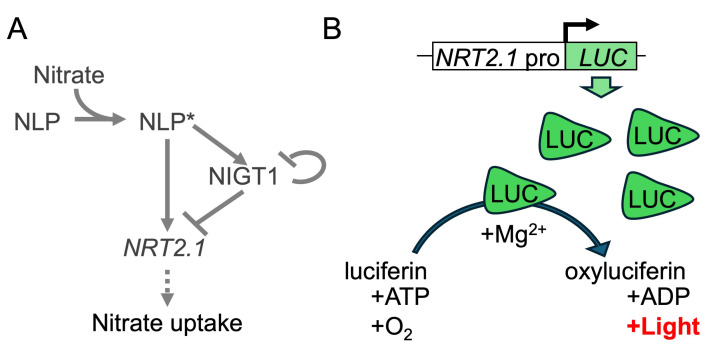
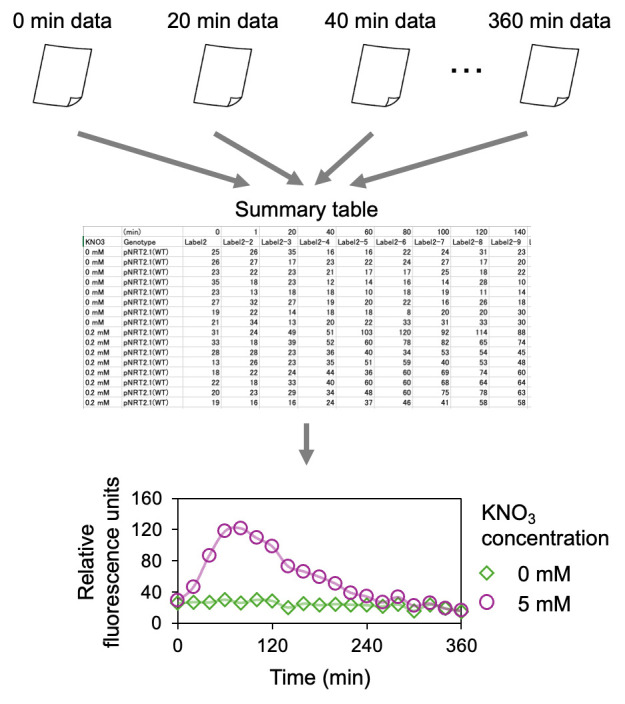
Gene expression analysis is a fundamental technique to elucidate the regulatory mechanisms of genes of interest or to reveal the patterns of plant response to environmental stimuli. Traditionally, gene expression analyses have required RNA extraction, followed by cDNA synthesis and qPCR analyses. However, this conventional method is costly and time-consuming, limiting the amount of data collected. The protocol outlined in this study, which utilizes a chemiluminescence system, offers a cost-effective and rapid method for assessing the expression of Arabidopsis () genes, exemplified by analyzing the nitrate-inducible expression of a major nitrate transporter gene, nitrate transporter 2.1 (). A reporter construct, containing the promoter fused to the firefly luciferase gene, was introduced into wild-type and mutant Arabidopsis plants. Seeds obtained from the transgenic lines were grown for 3 days in 96-well microplates containing a nitrate-free nutrient solution. After 3 days, the nutrient solution was replaced with a fresh batch, which was supplemented with luciferin potassium. One hour later, nitrate was added at various concentrations, and the temporal expression pattern of was analyzed by monitoring the chemiluminescence signals. This method allowed for the cost-effective, quantitative, and high-throughput analysis of expression over time under the effects of various nutrient conditions and genetic backgrounds. Key features • Small-scale and immediate assessment of promoter activity using 3-day-old Arabidopsis seedlings expressing the firefly luciferase gene under the control of the Arabidopsis promoter. • Comparison of various Arabidopsis genotypes and nutrient conditions using 96-well microplates. • Quantitative assessment of the temporal changes in gene expression levels. Graphical overview Graphical summary of the microplate-based expression monitoring system . Note: The steps within gray square brackets are part of a general protocol and are not included in this manuscript.
基因表达分析是阐明目标基因调控机制或揭示植物对环境刺激响应模式的一项基本技术。传统上,基因表达分析需要先提取RNA,然后进行cDNA合成和qPCR分析。然而,这种传统方法成本高且耗时,限制了所收集的数据量。本研究中概述的方案利用化学发光系统,提供了一种经济高效且快速的方法来评估拟南芥基因的表达,以分析主要硝酸盐转运蛋白基因硝酸盐转运蛋白2.1()的硝酸盐诱导型表达为例。将一个含有与萤火虫荧光素酶基因融合的启动子的报告基因构建体导入野生型和突变型拟南芥植株中。从转基因系获得的种子在含有无硝酸盐营养液的96孔微孔板中培养3天。3天后,将营养液换成新鲜批次,并添加荧光素钾。1小时后,加入不同浓度的硝酸盐,通过监测化学发光信号来分析的瞬时表达模式。该方法能够在各种营养条件和遗传背景的影响下,对随时间变化的表达进行经济高效、定量且高通量的分析。关键特性 • 使用在拟南芥启动子控制下表达萤火虫荧光素酶基因的3日龄拟南芥幼苗,对启动子活性进行小规模且即时的评估。 • 使用96孔微孔板比较各种拟南芥基因型和营养条件。 • 对基因表达水平的瞬时变化进行定量评估。图形概述 基于微孔板的表达监测系统的图形总结。注意:灰色方括号内的步骤是一般方案的一部分,本手稿中未包含。