Australian Centre for Heart Health, Melbourne, VIC, Australia.
Melbourne Centre for Behaviour Change, School of Psychological Sciences, University of Melbourne, Melbourne, VIC, Australia.
BMC Cardiovasc Disord. 2023 Aug 18;23(1):408. doi: 10.1186/s12872-023-03439-w.
Cardiac distress may be viewed as a persistent negative emotional state that spans multiple psychosocial domains and challenges a patient's capacity to cope with living with their heart condition. The Cardiac Distress Inventory (CDI) is a disease-specific clinical assessment tool that captures the complexity of this distress. In busy settings such as primary care, cardiac rehabilitation, and counselling services, however, there is a need to administer briefer tools to aid in identification and screening. The aim of the present study was to develop a short, valid screening version of the CDI.
A total of 405 participants reporting an acute coronary event in the previous 12 months was recruited from three hospitals, through social media and by direct enrolment on the study website. Participants completed an online survey which included the full version of the CDI and general distress measures including the Kessler K6, Patient Health Questionnaire-4, and Emotion Thermometers. Relationship of the CDI with these instruments, Rasch analysis model fit and clinical expertise were all used to select items for the short form (CDI-SF). Construct validity and receiver operating characteristics in relation to the Kessler K6 were examined.
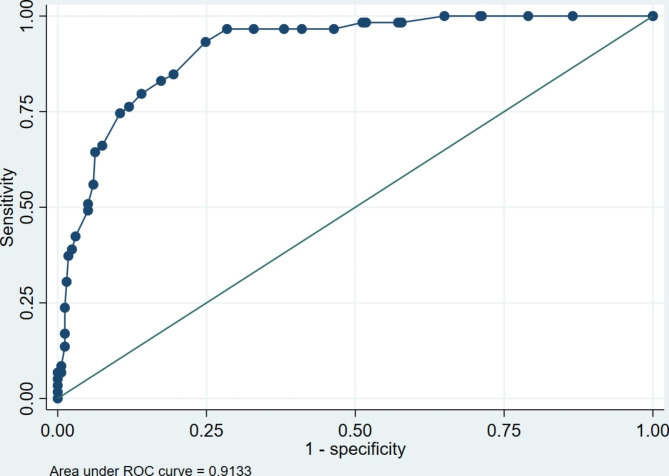
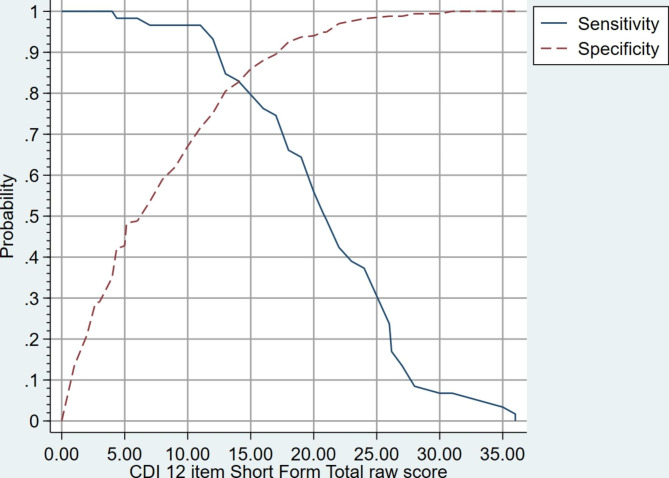
The final 12 item CDI-SF exhibited excellent internal consistency indicative of unidimensionality and good convergent and discriminant validity in comparison to clinical status measures, all indicative of good construct validity. Using the K6 validated cutoff of ≥ 18 as the reference variable, the CDI-SF had a very high Area Under the Curve (AUC) (AUC = 0.913 (95% CI: 0.88 to 0.94). A CDI-SF score of ≥ 13 was found to indicate general cardiac distress which may warrant further investigation using the original CDI.
The psychometric findings detailed here indicate that the CDI-SF provides a brief psychometrically sound screening measure indicative of general cardiac distress, that can be used in both clinical and research settings.
心脏不适可以被视为一种持续的负面情绪状态,跨越多个心理社会领域,挑战患者应对心脏疾病的能力。心脏不适量表(CDI)是一种特定于疾病的临床评估工具,可捕捉到这种不适的复杂性。然而,在初级保健、心脏康复和咨询服务等繁忙环境中,需要使用更简短的工具来辅助识别和筛查。本研究旨在开发 CDI 的简短、有效的筛查版本。
共有 405 名在过去 12 个月内发生急性冠状动脉事件的参与者从三家医院、通过社交媒体和直接在研究网站上报名参加招募。参与者完成了一项在线调查,其中包括 CDI 的完整版本和一般困扰测量,包括 Kessler K6、患者健康问卷-4 和情绪温度计。CDI 与这些工具的关系、Rasch 分析模型拟合和临床专业知识都用于选择短格式(CDI-SF)的项目。还检查了与 Kessler K6 相关的结构有效性和接收器工作特征。
最终的 12 项 CDI-SF 表现出极好的内部一致性,表明具有单一维度,与临床状态测量相比具有良好的收敛和区分效度,均表明具有良好的结构效度。使用 K6 验证的≥18 作为参考变量,CDI-SF 的曲线下面积(AUC)非常高(AUC=0.913(95%CI:0.88-0.94)。CDI-SF 得分≥13 表明存在一般心脏不适,可能需要使用原始 CDI 进一步调查。
详细的心理测量学发现表明,CDI-SF 提供了一种简短的心理测量可靠的筛查措施,可用于临床和研究环境中,用于指示一般心脏不适。