Truong Truong T, Mikloska Klara, Sum Judith, Oberländer Martina, von Bubnoff Nikolas, Christiansen Lea, Tornow Sebastian, Derer Stefanie, Janke Florian, Sültmann Holger, Zeissig Sebastian, Linnebacher Michael, Schafmayer Clemens, Lehnert Michael, Hutzenlaub Tobias, Paust Nils, Juelg Peter
Hahn-Schickard, 79110 Freiburg, Germany.
Laboratory for MEMS Applications, IMTEK─Department of Microsystems Engineering, University of Freiburg, 79110 Freiburg, Germany.
Anal Chem. 2025 Jun 3;97(21):11259-11268. doi: 10.1021/acs.analchem.5c01361. Epub 2025 May 17.
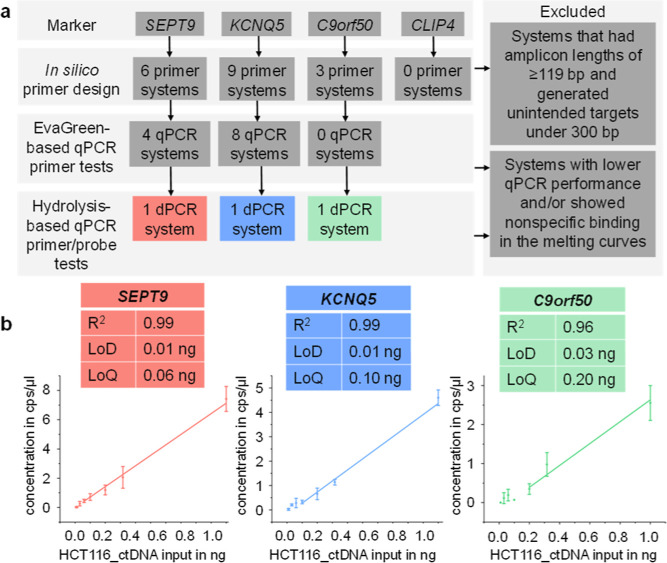
Colorectal cancer (CRC) remains a major global health challenge, with an increasing incidence of early-onset cases among young adults. Targeted analysis of cell-free DNA (cfDNA) methylation in blood has emerged as a promising minimally invasive diagnostic approach. While digital PCR (dPCR) offers high sensitivity and low turnaround times, conventional bisulfite-based dPCR assays require large plasma volumes due to cfDNA degradation, limiting clinical feasibility. To overcome this limitation, we developed a bisulfite-free, low-plasma-volume assay by coupling cell-free methylated DNA immunoprecipitation (cfMeDIP) with multiplexed dPCR for methylation detection. Assays were designed for CRC targets based on publicly available bisulfite-based plasma data and optimized for native, bisulfite-untreated cfDNA. The cfMeDIP-dPCR assays were first developed and optimized on circulating tumor DNA surrogates derived from HCT116 cells and subsequently validated in a pilot study, including 32 early-onset CRC (EO-CRC) patients and 29 non-CRC individuals. Methylation ratios, defined as the proportion of methylated to total cfDNA copies per marker, served as a diagnostic indicator. Three out of four selected markers (, , and ) were successfully adapted, with significantly higher methylation ratios ( ≤ 0.001) in the EO-CRC cohort. demonstrated the highest diagnostic performance, achieving an 85% sensitivity at a 90% specificity, with methylation ratios correlating with the tumor stage. This study presents the first cfMeDIP-dPCR approach, demonstrating its potential as a sensitive liquid biopsy assay. Requiring only 0.5 mL of plasma, i.e., more than 20 times less than a sensitivity-matched bisulfite-based assay, cfMeDIP-dPCR facilitates clinical implementation for CRC and other diseases with epigenetic signatures.
结直肠癌(CRC)仍然是一项重大的全球健康挑战,年轻人中早发性病例的发病率不断上升。对血液中游离DNA(cfDNA)甲基化进行靶向分析已成为一种有前景的微创诊断方法。虽然数字PCR(dPCR)具有高灵敏度和短周转时间,但由于cfDNA降解,传统的基于亚硫酸氢盐的dPCR检测需要大量血浆,限制了临床可行性。为克服这一限制,我们通过将游离甲基化DNA免疫沉淀(cfMeDIP)与多重dPCR相结合用于甲基化检测,开发了一种无需亚硫酸氢盐、低血浆量的检测方法。基于公开的基于亚硫酸氢盐的血浆数据设计针对CRC靶点的检测方法,并针对天然的、未经过亚硫酸氢盐处理的cfDNA进行优化。cfMeDIP-dPCR检测方法首先在源自HCT116细胞的循环肿瘤DNA替代物上开发和优化,随后在一项包括32例早发性CRC(EO-CRC)患者和29名非CRC个体的初步研究中进行验证。甲基化比率定义为每个标记物甲基化cfDNA拷贝数与总cfDNA拷贝数的比例,作为诊断指标。四个选定标记物中的三个(、和)成功适配,EO-CRC队列中的甲基化比率显著更高(≤0.001)。表现出最高的诊断性能,在90%特异性时达到85%的灵敏度,甲基化比率与肿瘤分期相关。本研究提出了第一种cfMeDIP-dPCR方法,证明了其作为一种灵敏的液体活检检测方法的潜力。cfMeDIP-dPCR仅需0.5 mL血浆,即比灵敏度匹配的基于亚硫酸氢盐的检测方法少20多倍,便于CRC和其他具有表观遗传特征的疾病的临床应用。