Sports and Health Improvement Research Center of College of Physical Education and Sports, Beijing Normal University, Xinjiekouwai Street 19, Haidian District, Beijing, 100875, China.
The Sports Medicine Laboratory of Peking University Third Hospital, Peking University Health Science Center, Beijing, China.
Sci Rep. 2023 Aug 19;13(1):13505. doi: 10.1038/s41598-023-40319-x.
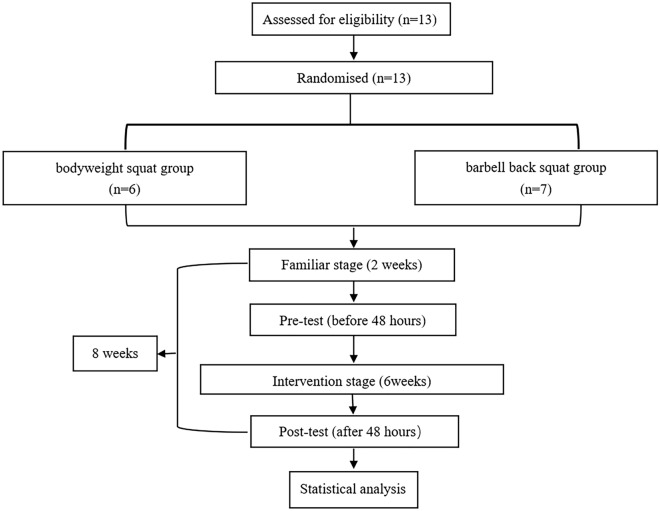
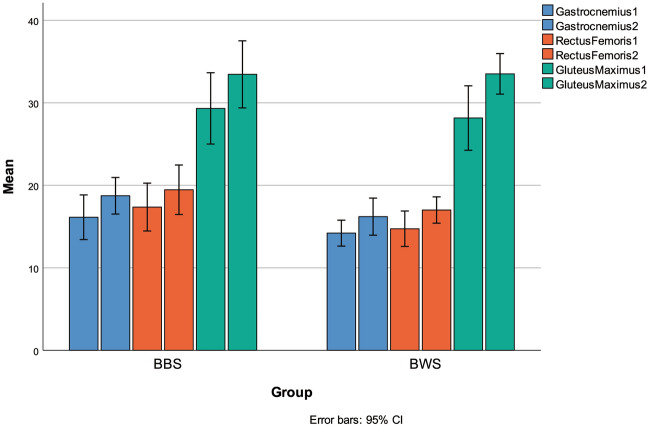
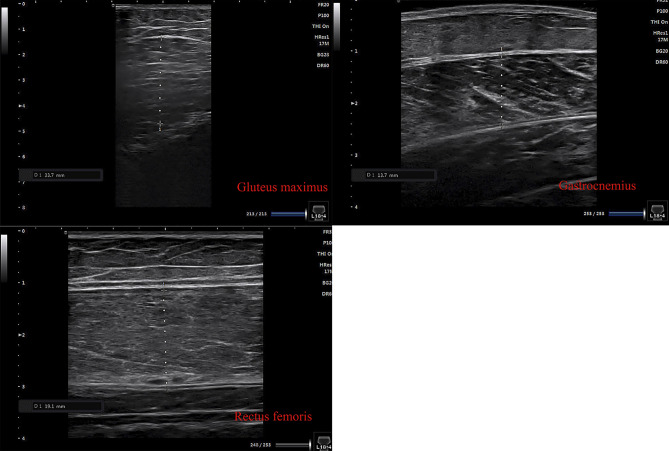
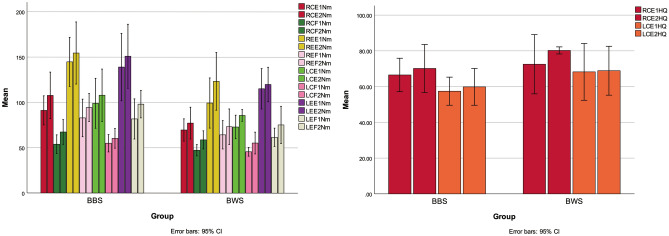
The objective of this study was to compare the effects of progressive bodyweight training and barbell back squat on muscle strength, muscluar hypertrophy, and body fat percentage in sedentary young women. Thirteen sedentary young women (aged 19.77 ± 0.83 years, height 164.91 ± 6.01) were randomly assigned to either the progressive bodyweight group (n = 6, consisting of 10 levels of movements progressing from bilateral to unilateral) or the barbell squat group (n = 7, 60-80% 1RM). Both groups underwent two training sessions per week for 6 weeks. Measurements of muscle strength (isokinetic knee extensor and flexor muscle peak torque of each leg), muscle thickness (gluteus maximus, rectus femoris, and gastrocnemius muscles), and body fat percentage were taken at baseline and post-testing. Both groups showed a significant increase in isometric peak torque of the knee extensor and flexor (p < 0.05), but there were no significant between-group differences in isometric peak torque of the knee extensor and flexor (p > 0.05) or in the mean concentric peak torque of the knee H/Q ratio (p > 0.05). Both groups also showed significant increases in muscle thickness (p < 0.05), with no significant differences in Gastrocnemius, Rectus femoris and Gluteus maximus (p > 0.05). The percentage of body fat significantly decreased in the barbell group (pre: 28.66 ± 4.58% vs post: 24.96 ± 5.91%, p = 0.044), but not in the bodyweight group (pre: 24.18 ± 4.63% vs post: 24.02 ± 4.48%, p = 0.679). Our findings indicate that while both training methods increased maximum strength and muscle mass, barbell back squat training may be more effective in reducing body fat percentage.
本研究的目的是比较渐进式体重训练和杠铃深蹲对久坐年轻女性肌肉力量、肌肉肥大和体脂百分比的影响。13 名久坐的年轻女性(年龄 19.77±0.83 岁,身高 164.91±6.01)被随机分配到渐进式体重组(n=6,包括从双侧到单侧的 10 个运动水平)或杠铃深蹲组(n=7,60-80%1RM)。两组均每周进行两次训练,持续 6 周。在基线和测试后测量肌肉力量(每条腿的等速膝关节伸肌和屈肌峰值扭矩)、肌肉厚度(臀大肌、股直肌和腓肠肌)和体脂百分比。两组的膝关节等长伸肌和屈肌的峰值扭矩(p<0.05)均显著增加,但膝关节等长伸肌和屈肌的峰值扭矩(p>0.05)或膝关节 H/Q 比的平均向心峰值扭矩(p>0.05)均无显著组间差异。两组的肌肉厚度也均显著增加(p<0.05),但腓肠肌、股直肌和臀大肌无显著差异(p>0.05)。杠铃组的体脂百分比显著下降(前:28.66±4.58%vs 后:24.96±5.91%,p=0.044),但体重组无显著变化(前:24.18±4.63%vs 后:24.02±4.48%,p=0.679)。我们的研究结果表明,虽然两种训练方法都能增加最大力量和肌肉质量,但杠铃深蹲训练可能更有效地降低体脂百分比。