Department of Urology, The Second Affiliated Hospital of Anhui Medical University, Hefei, China.
Department of Pathology, School of Basic Medicine, Anhui Medical University, Hefei, Anhui, China.
Front Immunol. 2023 Aug 2;14:1181370. doi: 10.3389/fimmu.2023.1181370. eCollection 2023.
Cuproptosis plays a crucial role in cancer, and different subtypes of cuproptosis have different immune profiles in prostate adenocarcinoma (PRAD). This study aimed to investigate immune genes associated with cuproptosis and develop a risk model to predict prognostic characteristics and chemotherapy/immunotherapy responses of patients with PRAD.
The CIBERSORT algorithm was used to evaluate the immune and stromal scores of patients with PRAD in The Cancer Genome Atlas (TCGA) cohort. Validation of differentially expressed genes DLAT and DLD in benign and malignant tissues by immunohistochemistry, and the immune-related genes of DLAT and DLD were further screened. Univariable Cox regression were performed to select key genes. Least absolute shrinkage and selection operator (LASSO)-Cox regression analyse was used to develop a risk model based on the selected genes. The model was validated in the TCGA, Memorial Sloan-Kettering Cancer Center (MSKCC) and Gene Expression Omnibus (GEO) datasets, as well as in this study unit cohort. The genes were examined functional enrichment analysis, and the tumor immune features, tumor mutation features and copy number variations (CNVs) of patients with different risk scores were analysed. The response of patients to multiple chemotherapeutic/targeted drugs was assessed using the pRRophetic algorithm, and immunotherapy was inferred by the Tumor Immune Dysfunction and Exclusion (TIDE) and immunophenoscore (IPS).
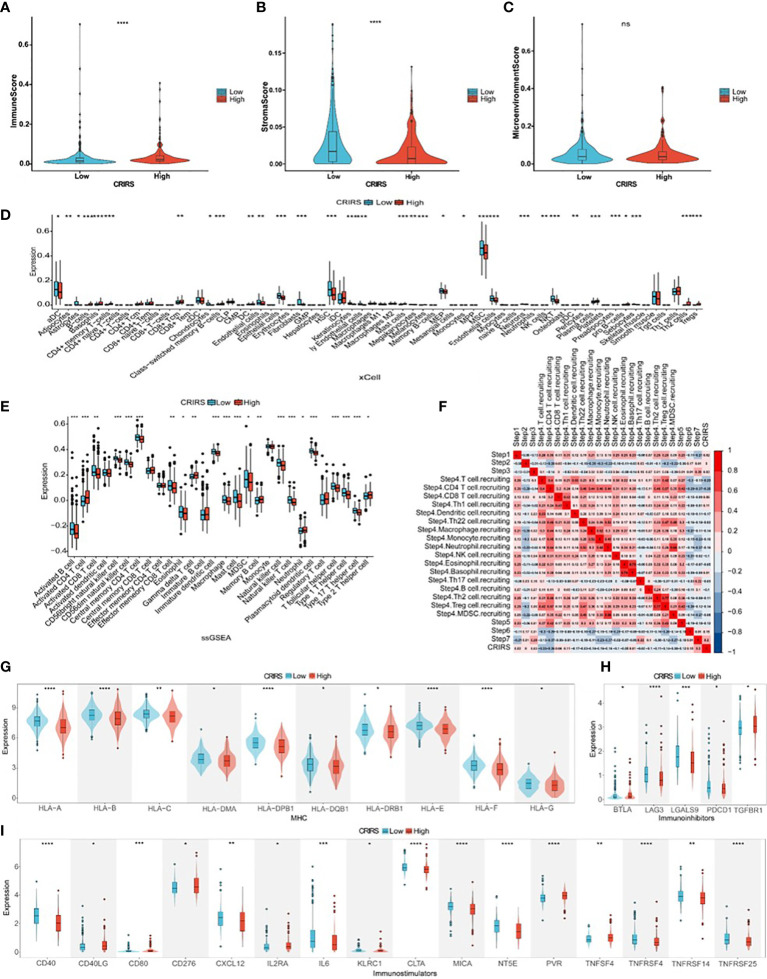
Cuproptosis-related immune risk scores (CRIRSs) were developed based on PRLR, DES and LECT2. High CRIRSs indicated poor overall survival (OS), disease-free survival (DFS) in the TCGA-PRAD, MSKCC and GEO datasets and higher T stage and Gleason scores in TCGA-PRAD. Similarly, in the sample collected by the study unit, patients with high CRIRS had higher T-stage and Gleason scores. Additionally, higher CRIRSs were negatively correlated with the abundance of activated B cells, activated CD8 T cells and other stromal or immune cells. The expression of some immune checkpoints was negatively correlated with CRIRSs. Tumor mutational burden (TMB), mutant-allele tumor heterogeneity (MATH) and copy number variation (CNV) scores were all higher in the high-CRIRS group. Multiple chemotherapeutic/targeted drugs and immunotherapy had better responsiveness in the low-CRIRS group.
Overall, lower CRIRS indicated better response to treatment strategies and better prognostic outcomes.
铜死亡在癌症中起着关键作用,不同亚型的铜死亡在前列腺腺癌(PRAD)中有不同的免疫特征。本研究旨在探讨与铜死亡相关的免疫基因,并建立一个风险模型,以预测 PRAD 患者的预后特征和化疗/免疫治疗反应。
使用 CIBERSORT 算法评估 TCGA 队列中 PRAD 患者的免疫和基质评分。通过免疫组化验证良性和恶性组织中差异表达基因 DLAT 和 DLD 的表达,并进一步筛选 DLAT 和 DLD 的免疫相关基因。进行单变量 Cox 回归以选择关键基因。基于所选基因,采用最小绝对收缩和选择算子(LASSO)-Cox 回归分析建立风险模型。在 TCGA、纪念斯隆-凯特琳癌症中心(MSKCC)和基因表达综合(GEO)数据集以及本研究单位队列中对该模型进行验证。对基因进行功能富集分析,并分析不同风险评分患者的肿瘤免疫特征、肿瘤突变特征和拷贝数变异(CNVs)。使用 pRRophetic 算法评估患者对多种化疗/靶向药物的反应,并通过 Tumor Immune Dysfunction and Exclusion(TIDE)和 immunophenoscore(IPS)推断免疫治疗。
基于 PRLR、DES 和 LECT2 开发了与铜死亡相关的免疫风险评分(CRIRSs)。高 CRIRSs 表明 TCGA-PRAD、MSKCC 和 GEO 数据集以及 TCGA-PRAD 中的总生存期(OS)和无病生存期(DFS)较差,且 T 分期和 Gleason 评分较高。同样,在研究单位收集的样本中,CRIRS 较高的患者 T 分期和 Gleason 评分较高。此外,较高的 CRIRSs 与活化 B 细胞、活化 CD8 T 细胞和其他基质或免疫细胞的丰度呈负相关。一些免疫检查点的表达与 CRIRSs 呈负相关。高 CRIRSs 组的肿瘤突变负荷(TMB)、突变等位基因肿瘤异质性(MATH)和拷贝数变异(CNV)评分均较高。低 CRIRSs 组对多种化疗/靶向药物和免疫治疗的反应更好。
总的来说,较低的 CRIRSs 表明对治疗策略的反应更好,预后结果更好。