Choi Hee-Jeong, Jeong Yoo Joo, Kim Jieun, Hoe Hyang-Sook
Department of Neural Development and Disease, Korea Brain Research Institute (KBRI), Daegu, Republic of Korea.
Department of Brain and Cognitive Sciences, Daegu Gyeongbuk Institute of Science and Technology, Daegu, Republic of Korea.
Front Pharmacol. 2023 Aug 2;14:1238639. doi: 10.3389/fphar.2023.1238639. eCollection 2023.
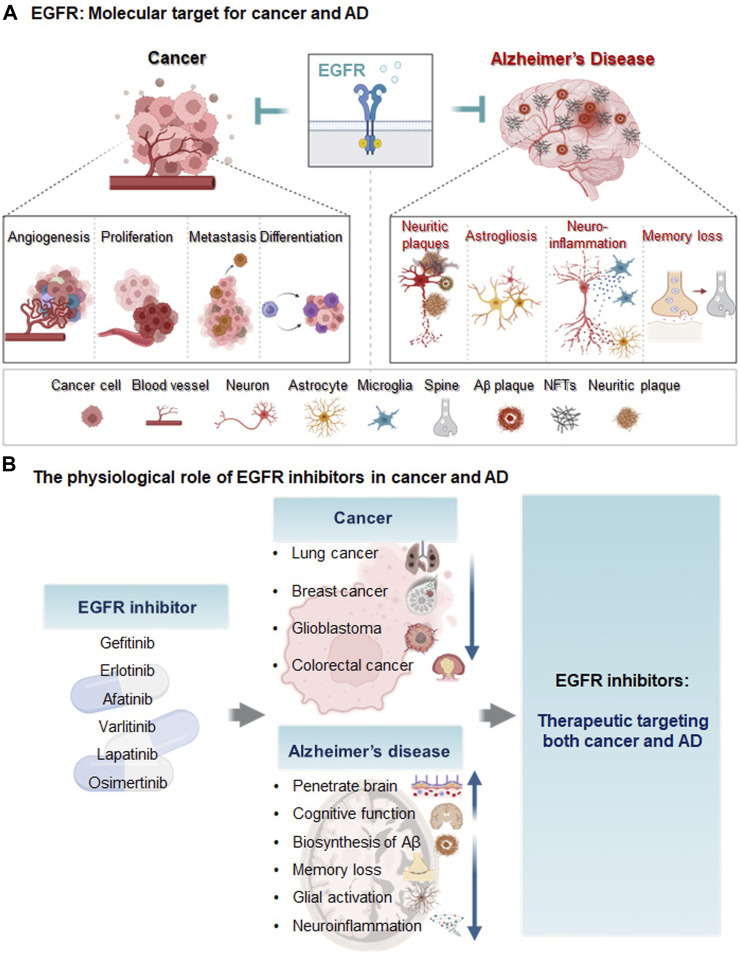
Many researchers are attempting to identify drugs that can be repurposed as effective therapies for Alzheimer's disease (AD). Several recent studies have highlighted epidermal growth factor receptor (EGFR) inhibitors approved for use as anti-cancer drugs as potential candidates for repurposing as AD therapeutics. In cancer, EGFR inhibitors target cell proliferation and angiogenesis, and studies in AD mouse models have shown that EGFR inhibitors can attenuate amyloid-beta (Aβ) pathology and improve cognitive function. In this review, we discuss the different functions of EGFR in cancer and AD and the potential of EGFR as a dual molecular target for AD diseases. In addition, we describe the effects of anti-cancer EGFR tyrosine kinase inhibitors (TKIs) on AD pathology and their prospects as therapeutic interventions for AD. By summarizing the physiological functions of EGFR in cancer and AD, this review emphasizes the significance of EGFR as an important molecular target for these diseases.
许多研究人员正在尝试确定可重新用作阿尔茨海默病(AD)有效治疗药物的药物。最近的几项研究强调,已被批准用作抗癌药物的表皮生长因子受体(EGFR)抑制剂有重新用作AD治疗药物的潜在可能性。在癌症中,EGFR抑制剂靶向细胞增殖和血管生成,而在AD小鼠模型中的研究表明,EGFR抑制剂可以减轻β-淀粉样蛋白(Aβ)病变并改善认知功能。在这篇综述中,我们讨论了EGFR在癌症和AD中的不同功能,以及EGFR作为AD疾病双重分子靶点的潜力。此外,我们描述了抗癌EGFR酪氨酸激酶抑制剂(TKIs)对AD病理的影响及其作为AD治疗干预手段的前景。通过总结EGFR在癌症和AD中的生理功能,本综述强调了EGFR作为这些疾病重要分子靶点的重要性。